
Tethered vs Socketed EV Charger: Which AC Wallbox Should Distributors Stock?
A tethered vs socketed EV charger decision is not only about whether the cable is attached to the wallbox. Two AC chargers can use similar electronics, deliver the same charging power and support the same smart features while creating very different installation, maintenance, inventory and ownership requirements.
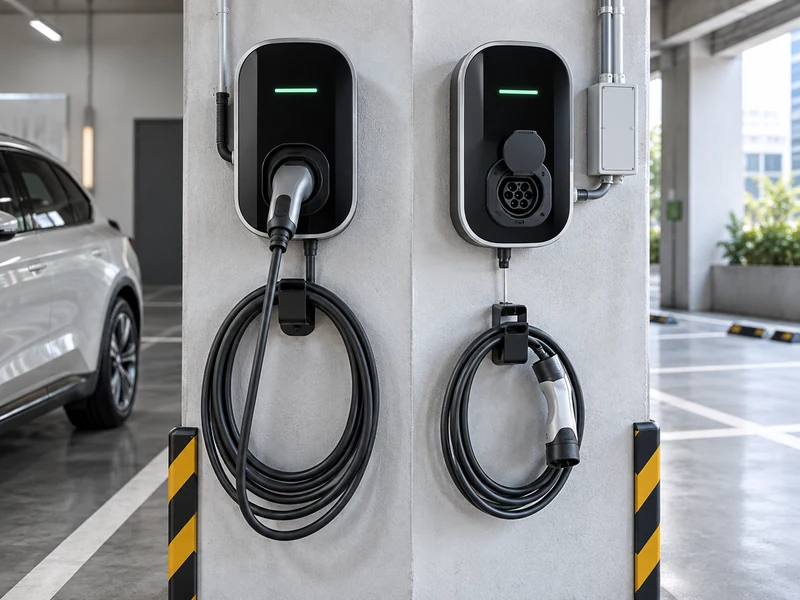
A tethered charger has a permanently attached charging cable. A socketed charger provides a vehicle-side charging socket and requires a separate detachable cable. For a homeowner, the difference affects daily convenience and appearance. For a distributor, it also changes connector-SKU risk, cable-length inventory, warranty exposure, packaging, spare parts and replacement strategy.
Tethered vs Socketed EV Charger: The Short Answer
A tethered EV charger has a charging cable permanently attached to the wallbox. It is convenient because the driver parks, grabs the connector and plugs in. A socketed/untethered charger provides a charging socket and requires a detachable cable.
For distributors, tethered units are easy to sell as a complete solution but increase SKU complexity because cable length and vehicle connector are built into the product. Socketed units reduce some wallbox SKU variation but shift cable selection into a separate product.
For most private residential installations, tethered charging is often easier to explain and use. Socketed charging becomes more attractive where the buyer values a cleaner wallbox, independent cable replacement, shared parking infrastructure or reduced charger-level connector/cable SKU complexity. Neither format is automatically better; the correct choice depends on the sales channel, parking environment, connector standard, service model and inventory strategy.
1. What a Tethered Charger Changes
A tethered charger integrates three decisions into one SKU:
- wallbox electronics;
- vehicle connector;
- charging cable length/specification.
That makes the purchase simple for the end user. There is no separate cable to buy, store or remember.
Common advantages include:
- faster daily plug-in routine;
- one complete package;
- less chance of arriving without a cable;
- cable and charger can be validated as one supplied assembly;
- strong fit for private driveways and dedicated parking bays.
Trade-offs include:
- cable remains exposed at the installation location;
- damaged cable may require service of an integrated assembly;
- distributor must stock the correct connector and cable length;
- users cannot easily substitute a different cable.
2. What a Socketed Charger Changes
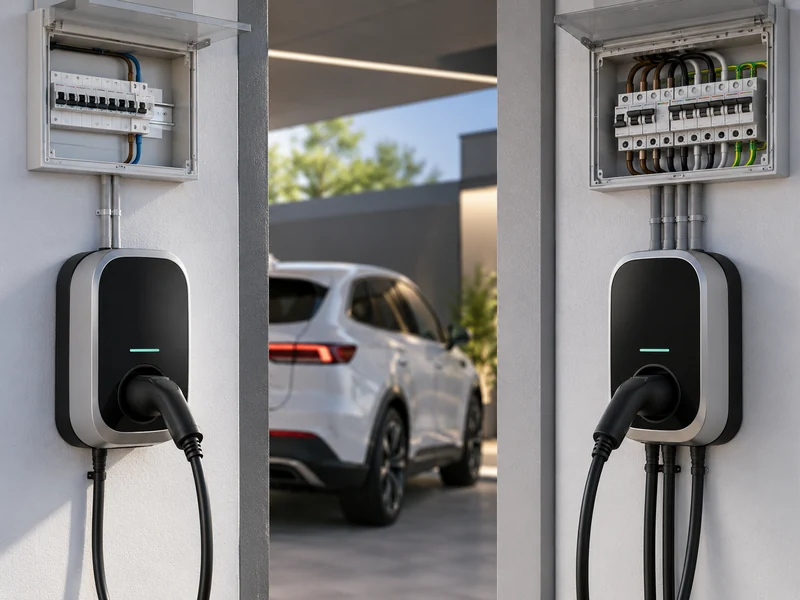
A socketed charger separates the EVSE from the charging cable.
Potential advantages:
- detachable cable can be replaced independently;
- customer can choose cable length separately;
- wallbox can look cleaner when unused;
- useful in public/semi-public environments where fixed cables are undesirable;
- easier inventory separation between charger and cable.
Potential disadvantages:
- user must carry/store a cable;
- cable can be forgotten, lost or stolen;
- an additional connector interface is introduced;
- the user may purchase a cable with a lower current rating than the charger.
3. Connector Standard Becomes an Inventory Question
With a tethered charger, the vehicle connector is fixed. If your market requires Type 2, a Type 1 tethered unit can become dead inventory.
With a socketed Type 2 AC charger in a Type 2 market, the detachable cable can provide more flexibility.
For wholesale planning, ask:
- What connector standard dominates the target country?
- Are imported vehicles creating mixed standards?
- Do customers already carry cables?
- Is the product sold primarily to homes, workplaces, hotels or public car parks?
If connector uncertainty is high, socketed configurations can reduce one dimension of wallbox inventory risk. But that does not remove the need to sell the correct cable. If the target market includes mixed vehicle standards, review ORIDY’s Type 1 vs Type 2 EV charging cable guide before finalizing the charger-and-cable SKU plan.
4. Cable Length Is a Commercial Specification
For tethered units, cable length is part of the charger SKU.
Common distributor questions include:
- Is 5m sufficient for the parking layout?
- Is 7m needed for front/rear charge-port variation?
- Will a longer cable drag on the ground?
- Does longer cable materially increase carton size and freight?
- Is a cable holder included?
The “best” cable length depends on parking geometry.
A wallbox beside a fixed private parking space may need only a moderate length. A dealership or mixed-use parking site may value more reach because charge ports appear on different sides of vehicles.
For socketed units, this decision moves to the separately purchased cable.
5. Convenience vs Visual Cleanliness
For residential charging, daily behaviour matters.
A tethered charger reduces friction: remove the connector from its holder and plug it into the car. For users charging every night, that convenience is meaningful.
A socketed charger can look cleaner when unused because no heavy cable hangs from the wall. This may matter for premium residential architecture or shared parking.
For distributors, consider the sales channel:
- Convenience-led retail: tethered often has a strong story.
- Premium minimalist installation: socketed can appeal visually.
- Commercial/public site: maintenance and cable management may dominate aesthetics.
6. Cable Wear and Replacement Strategy
Charging cables experience repeated handling, bending, pulling and outdoor exposure.
Potential wear points include:
- vehicle connector;
- cable jacket;
- strain relief;
- wallbox cable entry;
- socket interface.
With a detachable cable, replacement is straightforward if compatible cables are locally stocked.
With a tethered charger, replacement may require opening the unit or replacing a cable assembly according to the manufacturer’s service procedure.
Before importing tethered chargers, ask:
- Is the cable field-replaceable?
- Is a replacement cable assembly available?
- Does replacement require an authorized technician?
- How does warranty apply to cable damage?
- Are replacement holders and connectors available?
Spare-part availability should be considered before the first bulk order, not after the first warranty claim.
7. Socket Wear and Locking Behaviour Matter Too
Socketed chargers shift wear from the fixed cable to repeated socket mating.
Check:
- mechanical durability data if available;
- locking mechanism;
- behaviour during charging;
- unlock method after a session;
- manual release procedure during a power failure;
- weather protection when unused;
- drainage and installation orientation.
A low-cost socket mechanism can create a different failure mode from a low-cost tethered cable.
8. Public and Semi-Public Charging Changes the Decision
In a private garage, cable theft is unlikely. In an exposed commercial car park, it becomes a different risk.
A tethered cable is always present and convenient, but also continuously exposed to:
- weather;
- vehicles driving over it if poorly managed;
- vandalism;
- misuse;
- dirt and impact.
A socketed charger leaves the cable responsibility with the driver or site operator. That can reduce some site maintenance but may be less convenient for casual users.
9. Installation Power Does Not Change Because the Cable Is Detachable
A tethered vs socketed EV charger comparison is not a power-class comparison.
Both formats can exist at different AC power ratings.
The installer still needs to verify:
- single-phase/three-phase supply;
- charger rated current;
- circuit capacity;
- upstream protection;
- load balancing;
- local regulations;
- vehicle onboard-charger limit.
A 22kW socketed wallbox and a 22kW tethered wallbox can create similar electrical demand. Their ownership and maintenance models differ more than their basic power requirements. For power selection, see ORIDY’s 7kW vs 11kW vs 22kW EV charger guide.
ALT: Socketed EV charger with open outlet and detachable cable concept
10. Inventory Planning for Distributors
Imagine a product family with:
- 7kW and 22kW power options;
- Type 1 and Type 2 connectors;
- 5m and 7m cable options;
- two enclosure colours.
A tethered range can multiply into many SKUs quickly.
A socketed strategy can reduce some cable/connector combinations at the wallbox level, while cables are stocked separately.
For a distributor, the useful tethered vs socketed EV charger question is:
Which architecture minimizes slow-moving inventory while still covering the dominant installations in my market?
A practical launch strategy may involve one or two high-volume tethered SKUs plus socketed units for flexible projects.
11. OEM Branding Considerations
Tethered and socketed chargers can both support OEM branding, but packaging differs.
For tethered products, packaging must accommodate the cable and connector. This affects:
- carton volume;
- internal protection;
- shipping weight;
- cable presentation;
- accessory holder.
For socketed products, the charger carton can be more compact, while branded cables may be packaged separately.
Ask the supplier to quote OEM scope line by line:
- front logo;
- enclosure colour;
- app/startup branding if available;
- carton;
- manual;
- labels;
- RFID cards;
- cable branding where relevant.
12. What to Verify in a Supplier Quote
| Specification | Tethered Charger | Socketed Charger |
|---|---|---|
| Vehicle connector | Built into SKU | Separate cable determines connection |
| Cable length | Built into SKU | Separate purchase |
| Cable replacement | Service procedure may be required | Cable can usually be replaced independently |
| Daily convenience | High | User connects a separate cable |
| Appearance when unused | Cable remains on site | Cleaner wallbox appearance |
| Inventory complexity | More combinations | Can reduce wallbox combinations |
| Public-site exposure | Cable always present | Cable may be user-provided |
This is a commercial comparison, not a universal recommendation.
13. Certification and Documentation
Whether the charger is tethered or socketed, compliance should be checked for the exact product model and destination market.
For tethered units, confirm whether the attached cable/connector configuration is included in the product documentation.
For socketed products, ensure the separately sold charging cable has its own applicable documents rather than assuming the wallbox documentation covers it.
14. RFQ Template for Distributors
Send suppliers:
- destination market;
- required power;
- single/three phase;
- tethered or socketed;
- connector standard;
- cable length if tethered;
- smart functions;
- OCPP/load management requirement;
- IP/environment requirement;
- certification/document requirement;
- OEM scope;
- sample quantity;
- bulk quantity;
- trade term and destination.
Compare quotations only after the configurations are normalized.
15. Buyer Decision Scenarios: Which Format Fits Which Channel?
A useful tethered vs socketed EV charger comparison becomes much clearer when it is tied to a real sales channel.
Residential homeowner channel
A tethered charger is often easier to explain to homeowners because the product is visibly complete. The customer does not need to understand detachable cable ratings or remember to keep a separate cable in the vehicle. This can reduce purchase friction and simplify installation handover.
However, the distributor now owns the cable decision inside the wallbox SKU. A 5 m Type 2 tethered unit and a 7 m Type 2 tethered unit are two different inventory items even when the electronics are identical.
For a residential-focused distributor, a practical range might therefore include:
- one mainstream tethered cable length;
- one socketed wallbox for customers who already own cables or prefer a cleaner façade;
- a small number of replacement cable/connector accessories.
The exact mix should follow local parking geometry and connector standards rather than catalogue breadth.
Apartment, workplace and semi-public parking
Socketed wallboxes can make more sense where the charging point is shared by many drivers. The cable becomes the driver’s responsibility, and damaged or stolen cables do not require replacing a permanently attached wallbox cable.
But socketed infrastructure introduces its own issues:
- socket shutter/cover durability;
- connector-lock reliability;
- water/dust exposure when unused;
- user misuse with poor-quality detachable cables;
- compatibility of the cable rating with charger power.
The commercial choice is therefore not “socketed = public.” It is whether the site operator prefers a charger-owned cable or user-owned cable strategy.
Fleet and controlled commercial sites
A fleet operator may prefer tethered chargers because vehicles and bays are standardized. Faster daily connection and fewer loose accessories can matter more than wallbox SKU flexibility.
This is one of the places where buyer type should influence product selection more than consumer-style preference.
16. Total Cost of Ownership: Cable Replacement vs Separate-Cable Management
For wholesale buyers, the wallbox purchase price is only part of the cost.
With tethered chargers, consider:
- probability of cable abrasion or vehicle damage;
- labour required to replace the cable assembly;
- whether replacement cables are field-serviceable;
- whether opening the enclosure affects warranty conditions;
- spare-part lead time.
With socketed chargers, consider:
- detachable cable replacement frequency;
- customer complaints caused by low-quality third-party cables;
- socket locking-mechanism serviceability;
- whether the distributor also wants to sell Type 2 cables as a separate margin item.
A socketed wallbox may reduce one type of warranty exposure while creating a new accessory-management category.
17. Standards and Connector Evidence Buyers Should Request
The charger format does not change the need for correct EVSE and connector documentation.
IEC 61851-1:2017 sets general requirements for conductive EV charging equipment, including operating conditions, the EVSE-to-vehicle connection and electrical safety. IEC 62196-2:2025 covers dimensional compatibility requirements for standardized AC EV plugs, socket-outlets, vehicle connectors and vehicle inlets.
For procurement, ask the supplier which exact charger and connector configuration the documentation covers. A Type 2 socketed wallbox and a tethered Type 2 wallbox may share the same main electronics but still use different cable/connector assemblies.
Do not rely on a catalogue logo alone. Check:
- exact model number;
- rated current and phase;
- socket/connector configuration;
- cable length and conductor specification for tethered versions;
- applicable standard and edition;
- test-report or certificate scope.
Mid-Article Sourcing Check
Before comparing tethered vs socketed EV charger prices, send ORIDY ENERGY your destination market, connector standard, charging power, installation type, preferred cable strategy and expected quantity.
Website: https://oridy.net/
Contact: https://oridy.net/contact-us/
WhatsApp: https://wa.me/8618217811889
18. Distributor Stocking Matrix
| Sales Channel | Strong Starting Option | Why | Main Risk to Check |
|---|---|---|---|
| Residential installer | Tethered Type 2 | Simple daily use and complete package | Cable length / replacement |
| Premium residential | Socketed + quality detachable cable | Cleaner appearance and cable flexibility | User cable quality |
| Apartment / shared parking | Socketed | Shared infrastructure, user-owned cable | Socket lock and exposure |
| Fleet depot | Tethered | Fast repeated connection | Cable wear and bay layout |
| Mixed-import vehicle market | Socketed or carefully segmented tethered SKUs | Reduces connector-SKU complexity | Actual vehicle connector mix |
The table is a starting point, not a universal stocking rule. Use real customer and installer feedback before committing inventory.
How ORIDY ENERGY Can Help
ORIDY ENERGY supports China-side sourcing for renewable-energy products. For AC EV charger projects, we can help narrow supplier options based on the market, connector, power, tethered/socketed preference, software requirement, documents and quantity.
If you are deciding what to stock, send us your country, buyer type, preferred power classes, connector standard and expected quantity. We can help compare the commercial trade-offs before you lock the SKU list.
Frequently Asked Questions
Is a tethered EV charger easier for homeowners?
Usually, yes. The cable is always attached, so daily charging requires fewer steps. That convenience is one reason tethered wallboxes are common in dedicated home parking spaces.
Does a socketed charger allow any charging cable?
No. The cable must still use the correct connector standard, phase/current rating and applicable product specification. A high-power wallbox paired with an underspecified cable can reduce charging capability or create a mismatch.
Which format is better for public parking?
It depends on the operating model. Tethered cables are convenient for users but remain exposed to wear and vandalism. Socketed chargers reduce fixed-cable exposure but require users or operators to provide a compatible cable.
Which format is easier for a distributor to stock?
Socketed wallboxes can reduce some cable-length and connector combinations at the charger level, while tethered chargers are easier to sell as complete ready-to-use products. The better inventory strategy depends on market standardization and buyer behaviour.
Final Decision
For the final tethered vs socketed EV charger decision, choose tethered when daily convenience and a complete ready-to-use product are the priority. Choose socketed when detachable-cable flexibility, cleaner idle appearance or simplified charger inventory matters more.
For distributors, neither format is universally superior. The better decision is the one that matches local connector standards, customer behaviour, parking environment, spare-parts strategy and inventory economics.
Need Help Comparing Tethered and Socketed EV Charger Options?
If you are selecting EV chargers for distribution, installation or project supply, send ORIDY ENERGY:
- destination country;
- buyer type: residential / workplace / fleet / public parking;
- charging power;
- single-phase or three-phase requirement;
- Type 1 or Type 2 connector standard;
- tethered or socketed preference;
- cable length if tethered;
- expected quantity;
- OEM/private-label requirements;
- required certification or documentation;
- delivery city or port.
ORIDY ENERGY works as a China-side renewable-energy sourcing and supply-chain partner. We can help compare technically equivalent charger configurations and identify the commercial trade-offs before sample testing or bulk quotation.
Website: https://oridy.net/
Contact / RFQ: https://oridy.net/contact-us/
WhatsApp: https://wa.me/8618217811889