Can Hybrid Inverters Be Connected in Parallel? Wiring Diagrams & Setup Guide
Can Hybrid Inverters Be Connected in Parallel? Wiring Diagrams & Setup Guide
Yes, compatible hybrid inverters can be connected in parallel, provided the exact inverter models and firmware are designed and approved for parallel operation. Parallel configurations can increase total AC output power, support larger solar-storage installations and provide a modular path for future system expansion.
For example, two compatible 5kW hybrid inverters may be configured to deliver approximately 10kW of combined AC output. However, this depends on the manufacturer’s supported configuration, battery discharge capability, operating mode, communication architecture and applicable system limits.
Connecting hybrid inverters in parallel is not simply a matter of joining their AC outputs. The units must coordinate voltage, frequency, phase, power sharing, battery operation and grid interaction. An incorrectly designed configuration can cause inverter faults, unstable operation, equipment damage or electrical hazards.
For solar installers, EPC contractors, distributors and project buyers, several questions should be answered before purchasing equipment:
- Can the selected hybrid inverter model operate in parallel?
- How do two or three inverters share power?
- What does a parallel inverter connection diagram look like?
- Can multiple inverters share one battery bank?
- Can parallel inverters support three-phase installations?
- Will the combined system operate during a grid outage?
- What equipment and documentation should be included in the quotation?
This guide explains the operating principles, conceptual wiring arrangements, sizing calculations, installation considerations and procurement checks needed to evaluate a parallel hybrid inverter system.
Important: The diagrams and examples below explain system architecture only. They are not installation wiring instructions. Final electrical connections, protection devices and commissioning procedures must follow the exact manufacturer’s manual, local electrical regulations and applicable utility requirements. Installation and commissioning should be performed by appropriately qualified personnel.
1. Can Hybrid Inverters Be Connected in Parallel?
Hybrid inverters can operate in parallel only when the manufacturer explicitly supports the intended multi-inverter configuration.
A parallel-capable hybrid inverter normally includes a supported method for synchronizing its AC output with other units, exchanging operating information and coordinating power delivery.
Depending on the inverter platform, parallel operation may support:
- Higher combined single-phase AC output power.
- Additional PV input capacity through multiple inverter MPPT channels.
- Coordinated charging and discharging of battery storage.
- Expansion of residential or small commercial energy-storage systems.
- Supported three-phase configurations.
- Coordinated backup operation during grid outages.
However, not every hybrid inverter supports all these functions. Some models support parallel operation only in certain modes. Others may require dedicated communication cables, controllers, meters, firmware versions or battery configurations.
What Makes Two Hybrid Inverters Compatible?
Before connecting two units, verify the following:
| Requirement | What to Verify |
|---|---|
| Model compatibility | Both units belong to a manufacturer-approved parallel configuration. |
| Firmware | The installed firmware versions are approved to operate together. |
| Communication | Required parallel ports, cables and control settings are available. |
| AC architecture | The intended single-phase or three-phase arrangement is supported. |
| Battery compatibility | Battery voltage, BMS communication and combined current requirements are satisfied. |
| Backup capability | Parallel EPS or off-grid operation is supported if required. |
| Protection | AC and DC protection are designed for the combined system. |
| Documentation | The supplier provides a model-specific parallel installation manual and wiring diagram. |
Procurement advice: Never assume two inverters are compatible because they have the same power rating, appearance or battery voltage. Compatibility must be confirmed for the exact model and hardware revision.
2. How Do Parallel Hybrid Inverters Work?
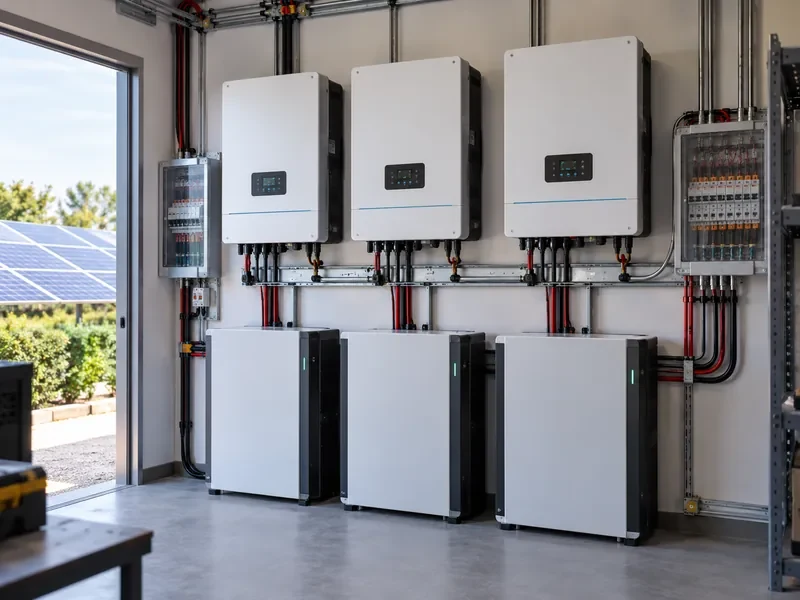
Parallel hybrid inverters operate as a coordinated power-conversion system. Multiple units contribute power to a supported common AC arrangement while maintaining the electrical synchronization and control required by their operating mode.
Phase and Frequency Synchronization
Inverters contributing to the same AC bus must maintain compatible voltage, frequency and phase relationships.
In grid-connected operation, the grid normally provides the voltage and frequency reference. In a supported islanded or backup configuration, the inverter system must establish and maintain an appropriate reference independently of the grid.
Unsynchronized outputs must not be directly connected together. Doing so can create severe circulating currents, protection trips or equipment damage.
Communication Between Inverters
Many parallel inverter systems use dedicated communication connections to coordinate operation.
Depending on the product family, the architecture may include:
- Dedicated parallel communication ports.
- CAN or RS485 communication.
- Manufacturer-specific communication cables.
- Device IDs or master/follower settings.
- External system controllers.
- Shared monitoring or energy-management functions.
Some systems use a designated master inverter, while others use different coordination methods. The control topology must be verified from the manufacturer’s documentation rather than assumed.
Power Sharing
When a supported parallel system supplies a common load, the inverters coordinate their contributions within the limits of the system.
Power sharing may depend on individual inverter ratings, operating modes, battery availability, thermal conditions and controller settings.
For this reason, total usable power should be confirmed from the approved system configuration, not calculated solely by adding the nameplate ratings.
3. Solar Inverter Parallel Connection Diagram Explained
A solar inverter parallel connection diagram should explain how the PV arrays, inverter units, battery storage, communication network, AC distribution and grid interface work together.
The following conceptual architecture illustrates a possible two-inverter solar-storage system.
PV Array A → Hybrid Inverter 1
PV Array B → Hybrid Inverter 2
Inverter 1 ↔ Approved Parallel Communication ↔ Inverter 2
↓
Manufacturer-Approved Common AC Arrangement
↓
Building Loads / Grid Interface / Supported Backup Loads
↕
Approved Battery Architecture with BMS and DC Protection
What Should a Parallel Connection Diagram Include?
A complete manufacturer-approved system drawing should identify:
- PV string assignments and MPPT inputs for each inverter.
- AC output connections and distribution arrangements.
- Grid connection and isolation requirements.
- Backup or EPS output connections, where supported.
- Battery DC connections, busbars and protection devices.
- BMS communication and battery current limits.
- Parallel inverter communication cables.
- Smart meters, CTs or external control equipment.
- Grounding, earthing and protective devices.
Not all parallel inverter systems use a shared battery bank. Some require separate battery connections or dedicated battery controllers.
Likewise, grid-connected AC connections and backup AC connections must not be treated as interchangeable.
Never connect inverter AC outputs together unless the exact system manual explicitly permits that arrangement.
4. How to Connect 2 Hybrid Inverters in Parallel
Connecting two hybrid inverters in parallel is a common design option when a project needs more AC power than one compatible inverter can provide.
Consider a residential solar-storage project with a target combined inverter output of 10kW.
Example: Two 5kW Hybrid Inverters
| Parameter | Illustrative Configuration |
|---|---|
| Inverter quantity | 2 units |
| Individual inverter rating | 5kW |
| Target combined AC rating | 10kW |
| System phase | Single-phase, if supported |
| Battery system | 51.2V nominal, illustrative |
| PV configuration | Separate strings assigned to approved MPPT inputs |
| Communication | Manufacturer-approved parallel connection |
| Metering | As specified by the parallel system manual |
This is a design example, not a confirmed ORIDY product configuration. The combined output, battery power and backup capability must be verified for the selected equipment.
Step 1: Verify Parallel Capability
Confirm that the exact inverter model supports two-unit parallel operation in the intended mode.
Request the latest installation manual, approved firmware list, supported topology and maximum parallel unit count.
Step 2: Confirm the AC Architecture
Determine whether the project requires single-phase power, a dedicated three-phase system or another manufacturer-supported arrangement.
The approved AC diagram must identify the required distribution, switching, isolation and protective devices.
Step 3: Calculate Battery Power Requirements
Determine whether the battery system can support the combined inverter demand under the expected operating conditions.
Battery voltage alone is insufficient. Continuous discharge current, BMS limits, inverter efficiency and battery state of charge must also be considered.
Step 4: Confirm Communication Accessories
Check whether the quotation includes all required communication cables, controllers and meters.
Missing accessories can delay installation even when the correct inverter units have been delivered.
Step 5: Verify PV Input Allocation
Each PV string must remain within the voltage and current limits of its assigned MPPT input.
Do not combine PV inputs between inverter units unless the manufacturer explicitly supports the arrangement.
Step 6: Follow the Approved Commissioning Procedure
A qualified installer should commission the system according to the exact manufacturer’s instructions, including device configuration, communication verification, grid operation, battery limits and backup tests where applicable.
Do not treat a generic online wiring diagram as a substitute for the approved installation manual.
5. How to Connect 3 Inverters in Parallel
Three-inverter configurations can be used in certain solar-storage applications, but the electrical architecture must be clearly defined.
There are two fundamentally different possibilities.
Option A: Three Inverters Increasing Single-Phase Power
Some inverter families support multiple units operating together on the same phase.
For example, three compatible 5kW units may provide a nominal combined rating of 15kW if the exact product family supports that configuration and the system’s operating limits allow it.
Such a design requires coordinated AC operation, battery current capacity, communication, protection and metering.
Option B: Three Single-Phase Inverters Forming a Three-Phase System
Certain inverter platforms allow supported single-phase units to be assigned to different phases of a three-phase system.
However, this capability is not universal.
A three-phase project must verify:
- Whether the inverter family supports three-phase formation.
- Required inverter quantity and phase assignment.
- Phase sequence and synchronization.
- Maximum power per phase.
- Permitted unbalanced-load operation.
- Meter and CT configuration.
- Battery connection requirements.
- Three-phase backup capability, if required.
Three single-phase inverters cannot automatically be combined into a three-phase system merely because each supports parallel operation.
For some projects, a dedicated three-phase hybrid inverter may provide a simpler and more appropriate solution.
Three-Inverter Configuration Comparison
| Configuration | Primary Purpose | Important Limitation |
|---|---|---|
| Three units on one phase | Increase single-phase output | Requires supported same-phase parallel architecture |
| One unit per phase | Build a supported three-phase system | Requires manufacturer-approved phase configuration |
| Three dedicated three-phase units | Increase three-phase system power | Requires compatible three-phase parallel control |
Before purchasing three units, ask the supplier to identify which architecture is actually supported.
6. Can Parallel Inverters Share One Battery Bank?
Some parallel hybrid inverter systems can share a common battery bank. Others require separate battery connections, dedicated battery controllers or manufacturer-specific communication arrangements.
There is no universal battery connection method for all hybrid inverters.
How Much Battery Current Do Two 5kW Inverters Need?
Consider two 5kW hybrid inverters with a combined AC output target of 10kW and a nominal 51.2V battery system.
The simplified DC current calculation, assuming 10kW of battery-side power, is:
Battery Current = DC Power ÷ Battery Voltage
10,000W ÷ 51.2V ≈ 195A
This is an idealized calculation before conversion losses.
If the system must deliver 10kW AC entirely from the battery and inverter efficiency is assumed to be 95%, the approximate battery current at 51.2V becomes:
10,000W ÷ (0.95 × 51.2V) ≈ 206A
The 95% efficiency is an illustrative assumption, not a verified rating for a specific inverter.
Actual current will vary with battery voltage, operating conditions, conversion efficiency and any simultaneous PV contribution.
A battery limited to 100A continuous discharge cannot independently supply the full battery-side power required in this example.
What Battery Specifications Should Be Checked?
- Nominal and operating battery voltage range.
- Maximum continuous discharge current.
- Maximum continuous charging current.
- BMS current and communication limits.
- Maximum permitted parallel battery module count.
- Battery module compatibility.
- DC busbar and conductor ratings.
- Required DC protection and isolation.
- Current-sharing requirements.
Battery energy capacity, measured in kWh, and battery power capability, measured in kW, are different specifications.
A battery bank may have enough stored energy for the required backup duration but still be unable to deliver the inverter system’s maximum instantaneous power.
For additional background, read our Battery and Inverter Compatibility Guide.
7. Parallel vs Series: Should Inverters Be Connected in Parallel or Series?
Searches for inverter parallel connections often include questions about connecting inverters in series.
It is important to distinguish the electrical configuration of inverter AC outputs from the series or parallel connection of PV modules and batteries.
Parallel Inverter Connection
In a manufacturer-supported parallel configuration, multiple inverter units coordinate their AC outputs to supply a common system arrangement.
The purpose is generally to increase available power or support a specified multi-inverter architecture.
Series Inverter Connection
Connecting the AC outputs of ordinary hybrid inverters in series is not a standard method for increasing solar-storage system power.
Do not attempt to increase AC voltage by wiring conventional inverter outputs in series unless the equipment manufacturer explicitly provides and approves such a specialized configuration.
Parallel vs Series Comparison
| Feature | Parallel Inverters | Series AC Connection |
|---|---|---|
| Main purpose | Increase coordinated output power | Not a general-purpose hybrid inverter expansion method |
| Manufacturer support | Required | Requires explicit specialized approval |
| Synchronization | Essential | Specialized electrical design required |
| Typical residential ESS use | Possible with compatible models | Not normally used |
| Buyer recommendation | Verify approved topology | Do not improvise |
When someone asks how to connect two inverters in series, the first step is to clarify whether they mean inverter AC outputs, PV strings or battery modules. These are different electrical systems with different design requirements.
8. How Many Hybrid Inverters Can Be Connected in Parallel?
The maximum number of hybrid inverters that can operate in parallel depends on the exact product family.
There is no universal maximum applicable to all hybrid inverters.
Manufacturers may impose limits based on:
- Communication architecture.
- Controller capability.
- Single-phase or three-phase operating mode.
- Firmware and hardware revisions.
- Maximum combined output power.
- Battery current capability.
- Metering and export control.
- Backup system architecture.
A supplier may advertise parallel capability, but the supported quantity can differ between grid-connected and backup operation or between different models.
Can Another Inverter Be Added Later?
Future expansion is possible only when the manufacturer supports adding compatible units to the existing system.
Before the first installation, confirm:
- Whether future production units will remain compatible.
- Whether older firmware can be updated.
- Whether additional communication hardware will be needed.
- Whether AC distribution and protection require upgrading.
- Whether the battery bank can support the additional load.
- Whether grid export settings must be revised.
A system should not be marketed as easily expandable unless its expansion procedure has been documented.
9. Do Parallel Hybrid Inverters Work During a Power Outage?
Some parallel hybrid inverter systems support coordinated backup or EPS operation during grid outages.
However, parallel grid-connected capability does not automatically guarantee parallel backup capability.
During a grid outage, an approved backup system must safely isolate from the grid, establish the required AC supply and coordinate the connected inverter units.
What Should Be Tested in Backup Mode?
- Grid-loss detection and transfer behavior.
- Available combined backup output.
- Battery discharge-current limits.
- Motor-starting and surge-load capability.
- Uneven load distribution.
- Communication interruption.
- Overload response.
- Recovery after low battery voltage.
- Restart after inverter faults.
Backup output ratings may differ from grid-connected output ratings. This difference should be checked before selecting equipment for critical loads.
Do Parallel Inverters Provide Redundancy?
Not automatically.
If one inverter fails, the remaining units may or may not continue operating. The outcome depends on the system architecture, controller dependency, fault type and approved operating logic.
True redundancy requires documented fault tolerance and appropriate testing.
Do not describe a system as N+1 redundant solely because multiple inverters are connected in parallel.
10. How Do Parallel Inverters Manage Solar PV and Grid Export?
Multiple hybrid inverters can increase the number of available MPPT inputs and allow different PV strings to be assigned to separate inverter units.
This can be useful for installations with multiple roof orientations, separate buildings or future PV expansion.
However, each PV input must remain within its specified voltage and current limits.
Grid-connected parallel systems also need an approved method for monitoring and controlling energy flow.
Smart Meters and CTs
Depending on the inverter family, a parallel system may use:
- One shared meter for the complete installation.
- Multiple meters or CTs.
- A master inverter collecting meter data.
- An external controller coordinating export limits.
Where zero-export operation is required, confirm whether the control applies to the complete system rather than only one inverter.
Meter direction, CT positioning and controller configuration must follow the approved design.
Protection and Electrical Design
As combined system power increases, AC breakers, DC protection, conductor sizing, fault-current calculations, isolation devices and distribution-board capacity must be reassessed.
PV array design should also follow applicable local requirements and relevant standards, such as IEC 62548-1.
For PV power-conversion equipment safety, IEC 62109-1 is another relevant reference.
These standards are references for evaluating requirements. Mentioning them does not establish that any particular inverter or parallel configuration has been certified.
11. When Should You Use Parallel Hybrid Inverters Instead of One Larger Inverter?
Parallel hybrid inverters are not always the most economical or technically appropriate solution.
The decision should consider the total installed system cost, expansion plans, available equipment, installation complexity and after-sales requirements.
When Parallel Inverters May Be Suitable
- A project requires more power than one available inverter can provide.
- The installer wants to standardize around one supported inverter family.
- Future expansion is expected and documented.
- Multiple PV input groups improve system design.
- Modular replacement and inventory management are important.
- The manufacturer provides mature parallel control and commissioning documentation.
When One Larger Inverter May Be Better
- The project does not require future expansion.
- A single larger inverter meets all electrical requirements.
- Parallel accessories add substantial cost.
- Commissioning simplicity is a priority.
- A dedicated three-phase inverter is more appropriate.
- Local service and technical support are stronger for the single-unit platform.
Compare the Complete System Cost
| Cost Item | Single Larger Inverter | Multiple Parallel Inverters |
|---|---|---|
| Inverter equipment | One larger unit | Multiple compatible units |
| Communication accessories | May be simpler | Parallel cables/controllers may be required |
| AC distribution | One inverter connection arrangement | Coordinated multi-unit distribution |
| Battery design | Must support required power | Must support combined inverter demand |
| Commissioning | Generally fewer units | Additional synchronization and configuration checks |
| Future expansion | May require replacement | Possible if the platform supports it |
| Spare parts | Larger replacement unit | Potentially standardized modules, subject to compatibility |
The lowest inverter unit price does not necessarily produce the lowest installed system cost.
12. What Should Buyers Check Before Ordering Parallel Hybrid Inverters?
For installers, distributors and project buyers, the procurement process should begin with the complete system architecture rather than an individual inverter quotation.
Before confirming an order, request the following documentation for the exact inverter model.
Technical Documentation
- Current product datasheet.
- Parallel installation and commissioning manual.
- Supported maximum unit count.
- Approved single-phase and three-phase configurations.
- Parallel AC connection diagram.
- Battery connection and BMS communication diagram.
- Firmware and hardware compatibility information.
- Meter and CT configuration.
- Supported backup/EPS arrangements.
- Applicable model-specific test and compliance documents for the destination market.
Complete Bill of Materials
A parallel inverter quotation may require more than inverter units.
Depending on the approved architecture, the complete BOM may include:
- Hybrid inverter units.
- Parallel communication cables.
- External controllers.
- Smart meters and CTs.
- Approved battery modules.
- Battery communication accessories.
- Required busbars and protective devices.
- Backup switching equipment.
- Monitoring accessories.
Some of these items may be supplied by the inverter manufacturer, while others may need to be sourced separately or specified by the local electrical designer.
After-Sales and Expansion Questions
Distributors should also verify replacement-unit compatibility, firmware support, commissioning assistance, troubleshooting documentation and warranty conditions for parallel installations.
For broader purchasing considerations, see our Hybrid Solar Inverter Wholesale Guide.
Planning a Parallel Hybrid Inverter Project?
ORIDY ENERGY helps international installers, EPC contractors and distributors compare suitable China-side hybrid inverter and battery-storage supply options.
To discuss a project, please share:
- Destination country and target application.
- Required total AC output power.
- Single-phase or three-phase requirements.
- PV capacity and battery specifications.
- Backup or EPS requirements.
- Expected inverter quantity.
- Future expansion plans.
- Estimated purchasing quantity.
We can help coordinate model-specific technical information, supplier comparison and commercial quotations before sample testing or bulk procurement.
Request a Parallel Inverter Configuration Review
WhatsApp: +86 182 1781 1889
13. How Do You Commission a Parallel Hybrid Inverter System?
Commissioning should be performed by qualified personnel using the exact manufacturer’s approved procedure.
A project-level commissioning checklist should include:
- Confirm inverter models, serial numbers and hardware revisions.
- Verify approved firmware compatibility.
- Confirm the intended phase architecture.
- Inspect AC and DC protection against the approved design.
- Verify battery voltage, current limits and BMS communication.
- Check PV string allocation and electrical limits.
- Verify parallel communication connections.
- Confirm meter and CT configuration.
- Apply manufacturer-specified device settings.
- Test permitted grid-connected operating modes.
- Verify charging and discharging behavior.
- Test load sharing within the approved system limits.
- Test backup operation where supported.
- Document final settings, test results and equipment versions.
This is a verification checklist, not a universal commissioning sequence. The manufacturer may require a different order, additional safety checks or specialized equipment.
Common Problems in Parallel Inverter Projects
| Problem | Possible Cause to Investigate |
|---|---|
| Parallel communication fault | Incorrect cable, device setting, firmware or controller configuration |
| Uneven power sharing | Unsupported configuration, control settings or operating limits |
| Battery current limitation | Insufficient BMS current rating or battery availability |
| Export control problems | Incorrect meter/CT installation or system-wide control settings |
| Backup mode unavailable | Unsupported EPS topology or missing required equipment |
| Expansion incompatibility | Hardware revision or firmware mismatch |
Fault diagnosis should follow the manufacturer’s troubleshooting procedure. These examples are possible investigation areas, not definitive diagnoses.
14. Frequently Asked Questions About Parallel Hybrid Inverters
Can I Use Two Inverters in Parallel?
Yes, if the exact inverter models are designed and approved for the intended parallel configuration. The system must also meet communication, battery, AC protection and operating-mode requirements.
Can Two 5kW Hybrid Inverters Produce 10kW?
Two compatible 5kW units may provide approximately 10kW of combined AC output in a supported configuration. Actual available power depends on the approved operating mode, battery capability and system limits.
How Do You Connect Two Inverters in Parallel?
The correct method depends on the manufacturer’s approved AC, DC, communication and protection architecture. Obtain the model-specific parallel connection diagram and have a qualified installer follow the official commissioning procedure.
Can Three Hybrid Inverters Work Together?
Yes, if the selected inverter family supports a three-unit configuration. The intended arrangement may involve same-phase power scaling, a supported three-phase architecture or another manufacturer-defined topology.
Can Parallel Hybrid Inverters Share One Battery?
Some models support a common battery bank, while others require separate connections or dedicated controllers. The battery system must also satisfy combined current and BMS communication requirements.
How Many Inverters Can Be Connected in Parallel?
The maximum number varies by manufacturer, model, firmware and operating mode. Always request the current supported parallel configuration table for the exact inverter.
Should Inverters Be Connected in Parallel or Series?
Manufacturer-supported parallel operation is an established method for coordinating multiple inverter units. Series connection of ordinary hybrid inverter AC outputs is not a general-purpose method for expanding system power and should not be attempted without explicit manufacturer approval.
Can Two Inverters Be Connected in Series?
Ordinary hybrid inverter AC outputs should not be connected in series unless a specific manufacturer-approved architecture explicitly permits it. This is different from connecting PV modules or batteries in series.
Is a Hybrid Inverter Grid-Tied?
Many hybrid inverters support grid-connected operation, but capabilities vary. Some models also support off-grid or backup operation. The exact grid-interactive and islanded operating modes must be verified for the selected model.
Will Parallel Inverters Continue Running if One Unit Fails?
Not necessarily. Continued operation depends on the manufacturer’s fault-handling architecture, communication dependencies and operating mode. Parallel capability does not automatically mean redundant operation.
Can I Add Another Hybrid Inverter Later?
Only if the product family supports expansion and the additional unit is compatible with the existing hardware, firmware, communication and electrical architecture.
Do I Need a Special Battery for Parallel Hybrid Inverters?
The battery must be compatible with the inverter system and capable of meeting its combined power and current requirements. The required battery architecture depends on the exact inverter and BMS design.
15. Final Buying Recommendations
Parallel hybrid inverters can provide a practical way to expand residential and small commercial solar-storage systems, but successful operation depends on much more than the number of inverter units.
The most important factors are:
- Verified model-specific parallel capability.
- Approved AC and communication architecture.
- Correct battery power and BMS sizing.
- Appropriate PV, metering and protection design.
- Documented backup and expansion capabilities.
- Reliable commissioning and after-sales support.
For a distributor or project buyer, the strongest purchasing decision is not simply choosing an inverter advertised as supporting multiple units in parallel.
It is selecting a complete, documented and technically suitable system configuration that matches the project’s electrical requirements, installation conditions and destination market.
Explore our Hybrid Solar Inverter Product Category to review available sourcing options.
Need Help Sourcing Parallel Hybrid Inverters from China?
ORIDY ENERGY works as a China-side renewable energy supply-chain and project coordination partner for international installers, distributors and EPC contractors.
We can help identify and compare suitable inverter and battery options, coordinate technical documentation with suppliers, clarify configuration requirements and support the commercial quotation process.
For a more accurate quotation, please provide your target market, required power, phase configuration, battery specifications, backup requirements and expected order quantity.
Website: https://oridy.net/
Contact: https://oridy.net/contact-us/
WhatsApp: https://wa.me/8618217811889