Build Your EV Charger Brand with OEM Manufacturing from China
How to Build Your EV Charger Brand with OEM Manufacturing from China
Here’s a scenario worth thinking about.
You’re an electrical equipment distributor in Dubai, or an automotive parts supplier in Johannesburg, or a solar installer in Lagos who’s been getting more and more questions about EV chargers. You could buy chargers from a European brand — pay $800 per wallbox wholesale, compete with 10 other distributors selling the exact same box with the exact same logo, and make 15% margin if you’re lucky. Or — you could go to the same Chinese factory that makes components for those European brands, have them produce a charger with YOUR company name laser-engraved on the front, YOUR brand colors on the cable, and YOUR packaging, and sell it at a price that gives you 40% margin while still undercutting the European-brand competition.
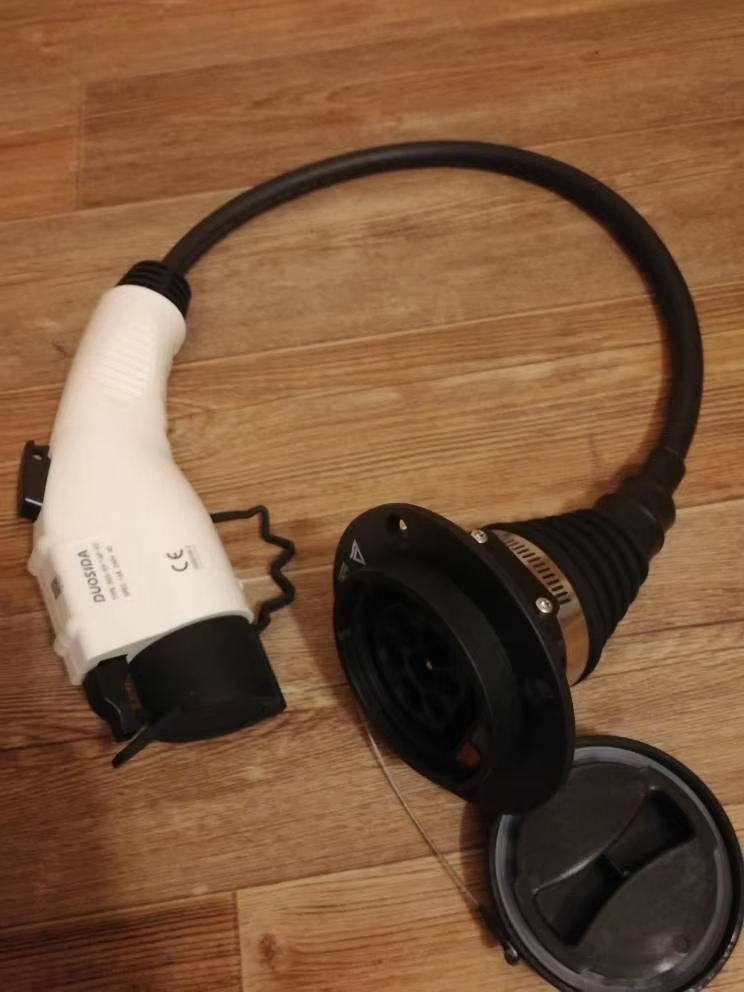
The second option is OEM manufacturing. It’s how most of the EV charging brands you see at trade shows got started. It’s not complicated — but it does require knowing the right steps, the right factory, and the right order of operations. This guide covers everything.
Quick Answer — How Do You Build Your Own EV Charger Brand Through OEM from China? Partner with an IATF 16949-certified manufacturer that offers OEM services (not all do), provide your logo artwork and brand specifications, approve a pre-production sample (usually 2-3 weeks), place a minimum order of 100-500 units depending on the product, and receive branded products at your warehouse via DDP shipping approximately 8-12 weeks later. The key difference between a successful OEM brand launch and a failed one is quality verification — always inspect before shipping, always verify certifications, and always start with a small trial order before committing to full OEM volume.
What Can You Actually Customize When OEM-ing EV Chargers?
Quick Answer: You can customize: (1) your logo — laser engraved or screen printed on the charging gun shell, wallbox faceplate, and cable, (2) brand colors — cable jacket color, enclosure color (within manufacturer capability), (3) packaging — custom-printed retail boxes with your brand, (4) user manual — your language, your brand name, your contact info, (5) cable length and connector configuration, and (6) smart features — your branded mobile app (white-label) or integration with your backend. What you typically CANNOT customize at low volumes: internal electronics, connector shell mold design, and firmware beyond configuration settings.
Dive Deeper
The OEM customization spectrum:
| Customization Level | MOQ | Cost Impact | Timeline Impact | Best For |
|---|---|---|---|---|
| Neutral Packaging (no logos, blank box) | 10-50 units | Minimal ($0-2/unit) | None | Market testing, first orders |
| Logo Only (laser engraving on existing shells) | 50-100 units | Low ($2-5/unit) | +1-2 weeks | Brand validation |
| Full OEM (logo + color + packaging + manual) | 100-300 units | Moderate ($5-15/unit) | +3-5 weeks | Brand launch |
| Deep OEM (custom mold + custom electronics) | 500-1,000+ units | High ($15-50/unit + mold fees $2,000-8,000) | +6-12 weeks | Established brand expansion |
Neutral packaging — the smart starting point: Most first-time brand builders start here. The factory ships products with absolutely no branding — no logos, no factory name, no “Made in China” visible on the front. You add your own stickers, labels, or packaging in your warehouse. This lets you test market response at minimal MOQ before investing in full OEM tooling. If a product sells well, you graduate to full OEM. If it doesn’t, you’re not stuck with 500 units of your own brand that nobody wants.
The logo that matters most is on the charging gun — not the box: When an EV driver plugs in, they see the connector in their hand. Your logo there — cleanly laser-engraved, not a sticker that peels off in the sun — is worth more than any packaging graphic. Invest in good logo execution on the product itself.
Custom cable printing: Your brand name printed continuously along the cable jacket (“YOURBRAND — Type 2 32A 3-Phase — IEC 62196”) creates a premium, factory-branded look. It costs approximately $0.50-1.50 per meter at volume and signals quality to anyone who sees the cable — including potential new customers.
How Do You Find the Right OEM Factory — and Avoid the Wrong One?
Quick Answer: Look for three things: (1) IATF 16949 certification — this is automotive-grade quality management, not just a generic ISO 9001, (2) existing OEM experience — ask for photos of branded products they’ve made for other clients (they’ll blur the client logos, but you can see the quality), and (3) in-house testing capability — they should have an electrical testing laboratory on-site, not subcontract testing. A factory that says “we don’t do OEM” or “minimum 5,000 units for branding” is either not a real manufacturer or isn’t interested in your business.
Dive Deeper
The difference between a factory that OEMs and a trading company that says it does:
A real OEM factory has:
- An in-house mold shop (for modifying or creating injection molds for connector shells)
- A laser engraving machine on the production line (not outsourced to a third-party shop)
- A graphic design person who handles logo mockups and packaging design (even if basic)
- A sample room where they assemble pre-production samples with your branding
- A quality control station that tests branded samples before shipping them to you
A trading company pretending to OEM has:
- A folder of “OEM examples” that are actually photos downloaded from other factories’ websites
- A promise that “our factory partner can do it” — but they can’t take you to the factory floor
- A vague timeline (“it depends on the factory’s schedule”) instead of a specific production schedule
- No direct communication with the actual production team
The verification process:
- Ask for photos of 3-5 different products they’ve OEM’d for different clients. Look for different logo styles, different color schemes, different packaging designs. If all the photos look the same, they’re showing you their own brand products, not OEM work.
- Ask for a live video call showing the laser engraving machine operating on the production line. Not a pre-recorded video — live. With today’s date or your name spoken on camera.
- Ask for a pre-production sample with your logo BEFORE committing to mass production. Pay for it (usually $100-300). If they won’t do a branded sample until you place a mass order, they don’t have the capability.
The IATF 16949 difference: This automotive industry quality certification is significantly harder to obtain than ISO 9001. It requires demonstrated process control, defect prevention, and supply chain management. A factory with IATF 16949 has quality systems that a generic electronics assembler doesn’t. For EV charging equipment — which connects to vehicles worth $30,000-100,000+ — automotive-grade quality is not a luxury.
What’s the OEM Process, Step by Step?
Quick Answer: (1) Provide artwork (AI/EPS/PDF vector files) and brand specifications, (2) Factory creates a digital mockup showing logo placement and packaging design — 3-5 business days, (3) You approve mockup or request revisions, (4) Factory produces 2-3 pre-production samples with your actual branding — 2-3 weeks, (5) You receive and approve physical samples (or request changes), (6) Factory produces full order — 3-6 weeks depending on quantity, (7) Pre-shipment quality inspection (third-party recommended), (8) Sea freight DDP to your warehouse — 3-6 weeks depending on destination.
Dive Deeper
Step 1: Artwork preparation — get this right from the start.
Provide your logo in vector format (Adobe Illustrator .ai or .eps). A JPG or PNG screenshot of your logo is not usable for laser engraving or printing. If you don’t have vector artwork, hire a designer on Fiverr for $20-50 to convert your logo. Also provide:
- Pantone color codes for your brand colors (not “blue” — “Pantone 286 C”)
- Preferred logo placement (center of wallbox faceplate? bottom of charging gun shell? along the cable?)
- Packaging dieline preferences (if you have them)
- User manual text in your preferred language
Step 3: The mockup stage — where most miscommunications happen.
The factory’s graphic designer in China may not intuitively understand your brand’s visual standards. A logo that looks perfectly centered on their screen may look off-center to your eye. Be specific in your feedback: “Move the logo 5mm up” is actionable. “It doesn’t look right” is not. Request mockups from multiple angles — front, side, close-up of the logo area.
Step 5: The pre-production sample — do not skip this.
This is the most critical step in the entire process. For $100-300, the factory produces 2-3 actual units with your actual branding — not renders, not photos of “similar” work. You hold the product in your hand. You plug it in. You check: is the logo crisp and centered? Is the color what you specified? Does the packaging feel premium or cheap? Are there any sharp edges, loose parts, or visual defects?
If something is wrong — the logo is blurry, the color is off, the packaging feels flimsy — this is the time to fix it. Fixing a logo after mass production means you own 500 units with a bad logo. Fixing a logo at the sample stage costs nothing but an extra week.
Step 7: Pre-shipment inspection — your last line of defense.
For orders over $10,000, hire a third-party inspection company (SGS, Bureau Veritas, AsiaInspection). For $300-600, an inspector visits the factory, checks your finished goods, verifies quantity and packaging, performs basic functional tests, and provides a detailed report with photos. If the goods pass inspection, you release the balance payment. If they don’t, the factory fixes the issues before you pay.
How Much Does OEM EV Charger Branding Actually Cost?
Quick Answer: The OEM premium over standard (unbranded) products is typically 10-25% at volumes of 100-500 units. One-time costs include: mold modification ($300-1,500 if needed for logo placement changes), graphic design ($0-200 if you provide complete artwork), and pre-production samples ($100-300). At 1,000+ units, the OEM premium drops to 5-10%. The real cost of OEM is not the per-unit premium — it’s the minimum order quantity commitment.
Dive Deeper
Real OEM cost breakdown for a Type 2 32A 5m charging cable (500 units):
| Item | Cost per Unit | Total (500 units) |
|---|---|---|
| Base product (unbranded) | $65.00 | $32,500 |
| Laser engraving (logo on gun shell) | $3.00 | $1,500 |
| Cable printing (brand name along jacket) | $2.50 | $1,250 |
| Custom packaging (printed box) | $2.00 | $1,000 |
| Custom user manual (printed) | $1.50 | $750 |
| One-time mold fee (if needed) | $2.00 (amortized over 500) | $1,000 |
| Pre-production samples | $1.00 (amortized) | $500 |
| TOTAL per branded unit | $77.00 | $38,500 |
| OEM premium vs. unbranded | 18.5% | $6,000 |
For an $18.5% premium per unit, you go from selling a generic cable at $85-95 (competing with everyone else on Alibaba) to selling YOUR brand at $120-140 (with zero direct competition — because nobody else sells your brand). The branded unit earns you approximately $35-55 more per unit in margin at retail. You recover the OEM premium in about 170 units sold.
The volume that makes OEM financially attractive: At 100 units, the one-time costs (mold, samples, design) are spread thin, making the per-unit OEM premium about 25-35%. At 500 units, it drops to 15-20%. At 2,000+ units, it drops to 8-12%. The crossover point where OEM becomes clearly better than reselling branded products is typically around 200-300 units — below that, consider starting with neutral packaging and manual branding.
How Do You Go to Market with Your Own EV Charger Brand?
Quick Answer: Start local. Build your reputation in one city or one country before trying to be “global.” Focus on a specific customer segment that you already serve — electricians, solar installers, automotive shops, property developers. Offer competitive pricing (20-30% below European brands). Provide local warranty and support that online sellers can’t match. Use social media to document real installations with real customers. A charger with your logo installed at a visible location is the best advertisement you can buy.
Dive Deeper
The local-first brand building playbook:
Month 1-2: Seed the market. Give 5-10 chargers at cost to respected installers or fleet operators in your area. Ask them to use them for 2 months and give honest feedback. Fix any issues. If they’re happy, ask for a testimonial and permission to photograph the installation. You now have social proof, real installation photos, and reference customers — before you’ve spent a dollar on advertising.
Month 3-6: Launch publicly. Create a simple website (or a well-organized WhatsApp Business catalog — this is more effective than a website in many African markets). Post your installation photos with customer testimonials. Price at 20-30% below the imported European brand equivalent. Offer a “first 10 customers” launch discount to generate initial sales velocity.
Month 6-12: Build distribution. Approach electrical wholesalers, solar installers, and automotive parts shops. Offer them 20-25% margin to stock your brand. Provide them with a simple countertop display and a one-page product sheet. Make it easy for them to sell: clear pricing, fast delivery, your WhatsApp number for technical questions.
The one marketing asset that matters more than everything else: A photo of your branded charger, cleanly installed on a wall, with a car plugged in, at a recognizable local location. That photo says: “This charger is real. It works here. You can buy it from someone in your city.” That photo is worth more than any certification PDF or spec sheet in building initial trust.
How Does Oridy Energy Help You Build Your EV Charger Brand?
We handle the complex part — finding the right factory, managing the OEM process, verifying quality, and shipping products to your warehouse. You handle the part only you can do — building customer relationships in your market.
- Factory matching: We work with IATF 16949-certified manufacturers with proven OEM capability. No trading companies. No rented showrooms.
- OEM project management: Logo mockups, sample coordination, production scheduling, packaging design — we manage the back-and-forth so you don’t have to become a manufacturing expert.
- Quality verification: Pre-shipment inspection on every order. You see test reports and photos before you pay the balance.
- DDP delivery: Your branded products arrive at your warehouse. We handle all logistics — dangerous goods for cables with electronics, customs clearance, duties, last-mile delivery.
- Flexible scaling: Start with neutral packaging at 20 units. Graduate to full OEM at 200 units. We grow with you.
Building a brand takes time. Building a supply chain shouldn’t. Let us handle the factory side so you can focus on your customers.
👉 Contact Oridy Energy to Discuss Your OEM Brand
📧 info@oridy.net | 📱 +86 18217811889
Frequently Asked Questions
Q: How long does the OEM process take from start to delivery?
A: Budget 10-14 weeks total: 2-3 weeks for artwork, mockups, and sample production; 1 week for sample review and approval; 3-6 weeks for mass production; 3-6 weeks for sea freight DDP delivery. Rush production is sometimes available at a premium. Air freight for samples is fast (5-7 days) but expensive.
Q: Can I OEM just a few units to start?
A: Full OEM (logo + color + packaging) typically requires 100-300 units minimum. However, you can start with neutral packaging at 10-50 units — products arrive unbranded, and you add your own stickers and labels locally. This lets you validate your market before committing to full OEM volumes.
Q: What if I want to change my logo or branding later?
A: Laser-engraved logos are permanent. Screen-printed logos on packaging can be changed between production runs. If you plan to iterate your branding, start with removable labels or stickers on the product itself and invest in permanent branding once your design is finalized.
Q: Will my OEM products have the same certifications as the factory’s own brand?
A: Yes, if you specify this. The factory’s existing certifications (TÜV, CE, CB, ETL) cover the product’s design and manufacturing process — not whose logo is on it. However, the certification documents will be in the factory’s name. If your customers require certificates in your company’s name, you’ll need to arrange your own certification testing (which the factory can facilitate). The product will pass because it’s the same product — you’re just getting your own certificate document.
Q: Can I get exclusive rights to a product design or market territory?
A: Generally, no — not at small to medium volumes. The factory’s business model is selling to multiple distributors in multiple markets. You can request territory exclusivity, but expect it to require a substantial volume commitment (1,000+ units per year) and possibly higher per-unit pricing. For most new brands, the better strategy is to build your brand so strong in your market that the factory’s other customers in your territory can’t compete — not because of contractual exclusivity, but because customers prefer your brand.
© 2026 Oridy Energy. Your Reliable New Energy Supply Chain Partner.