Dynamic Load Balancing EV Charger Guide: How to Prevent Charging From Overloading the Supply
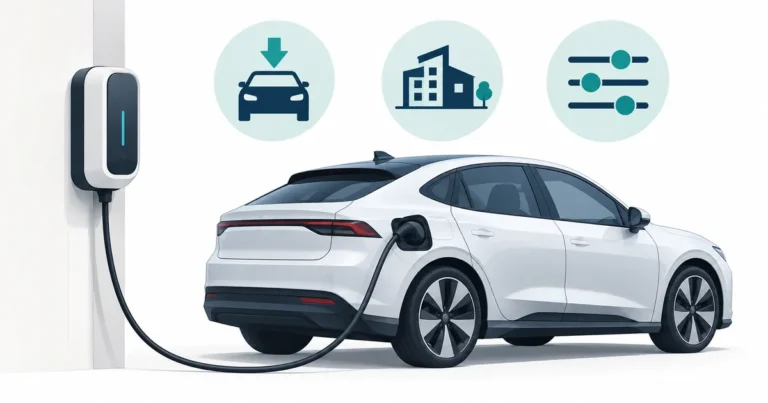
A dynamic load balancing EV charger can be the difference between a workable installation and a charger that regularly pushes a site toward its electrical limit. EV charging adds one of the largest continuous loads in many homes and small commercial sites. A 7kW-class wallbox can draw around 32A on a 230V single-phase supply. If that charging load runs while an electric shower, water heater, oven, air conditioner or heat pump is operating, the property may approach or exceed its available service capacity.
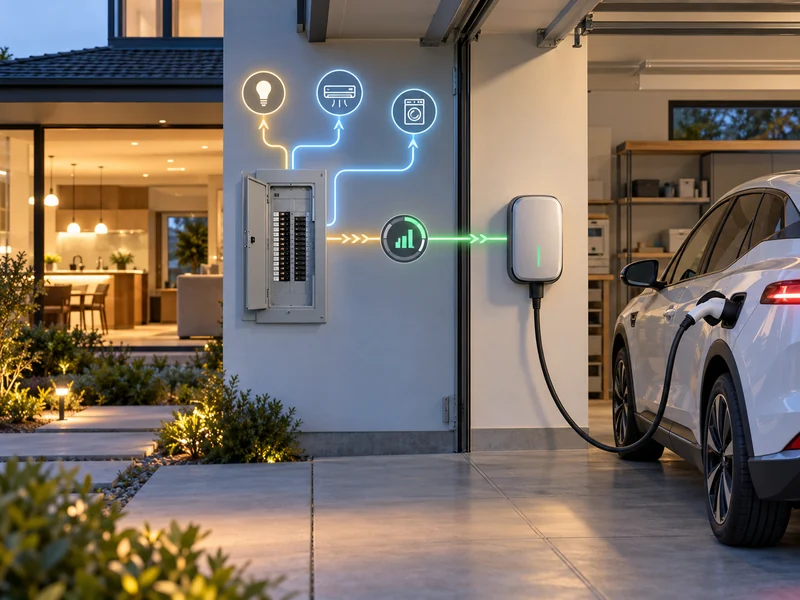
Dynamic load balancing addresses this by adjusting EV charging current according to the site’s real-time electrical demand.
For distributors and installers, it is not merely a smart-app feature. It can determine whether a charger fits an existing electrical service and can become a major product-selection criterion for residential, apartment and workplace projects.
Dynamic Load Balancing EV Charger: The Short Answer
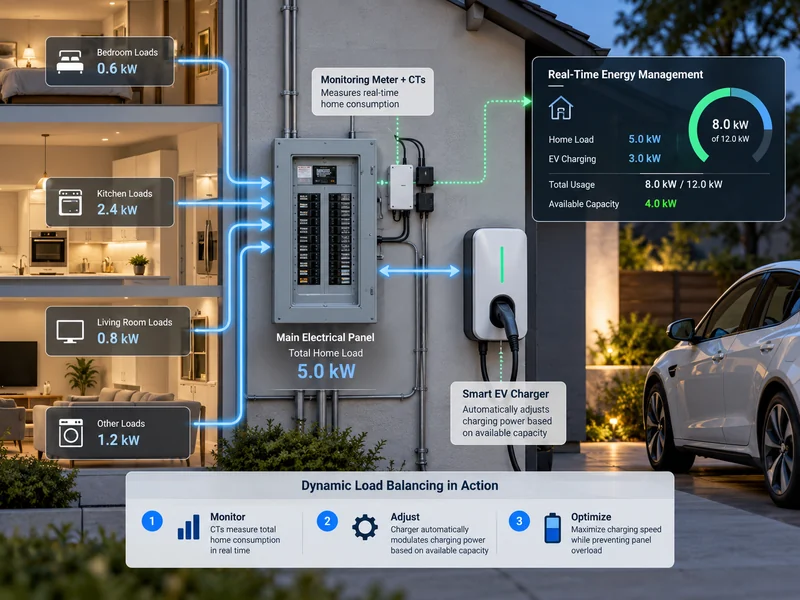
A dynamic load balancing system measures the current or power being used by a building and automatically increases or reduces EV charging so the total site demand stays within a configured limit. The system may use a current transformer (CT), smart meter or compatible energy meter to monitor the main supply.
When household demand rises, EV charging is reduced. When other loads fall, charging can increase again—within the vehicle, charger, circuit and configured limits. This is the core operating logic behind a dynamic load balancing EV charger.
Dynamic load balancing does not create more grid capacity. It allocates existing capacity more intelligently.
1. Why EV Charging Creates a New Load-Management Problem
Before EV ownership, a home may have been designed around loads that cycle on and off. EV charging can run continuously for several hours.
Consider a simplified single-phase example:
- property service limit: 63A;
- EV charger target current: 32A;
- other house loads at one moment: 38A.
Without control:
32A + 38A = 70A
That exceeds the assumed 63A site limit.
A load-balancing system could reduce EV charging to approximately 25A or less, depending on the control margin and design, so the total remains within the configured threshold.
This is a simplified illustration. Actual systems must follow local electrical requirements and manufacturer instructions.
2. Static Load Management vs Dynamic Load Balancing
These terms are sometimes mixed together.
Static limit
The EV charger is configured with a fixed maximum current lower than its hardware rating.
Example: a 32A charger is permanently limited to 20A.
Advantages:
- simple;
- predictable;
- no measurement hardware required.
Disadvantage:
- unused capacity is wasted when other building loads are low.
Dynamic load balancing
The system measures site demand and changes EV current in real time.
Advantages:
- uses available capacity more fully;
- can support faster charging when the building is quiet;
- can reduce unnecessary service upgrades in suitable projects.
Disadvantages:
- requires measurement and communication;
- commissioning is more complex;
- compatibility matters.
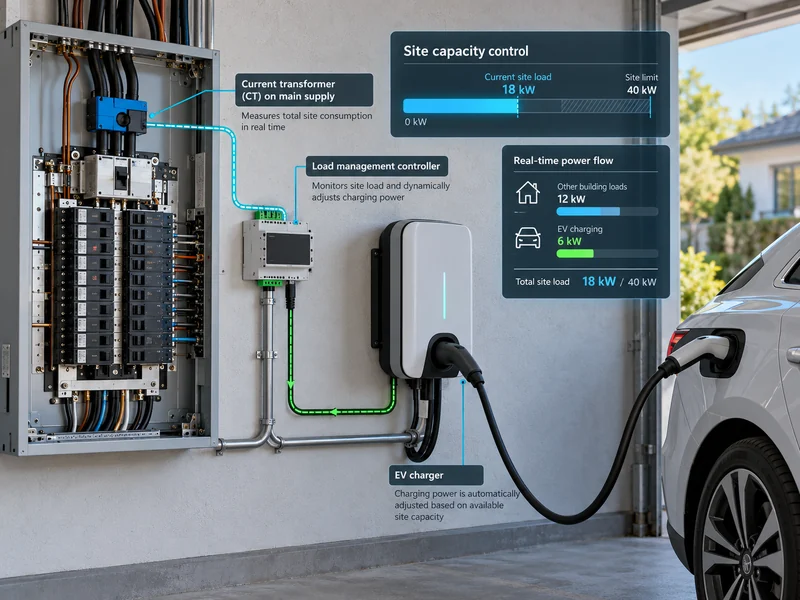
3. How the System Measures Building Demand
Common architectures use:
- CT clamps around supply conductors;
- an energy meter in the main panel;
- direct meter communication;
- an external load-management controller.
The exact design varies by charger manufacturer.
A distributor should verify:
- whether the sensor/meter is included;
- maximum measurement current;
- single-phase or three-phase support;
- communication method;
- cable length or wireless limitations;
- whether internet access is required;
- whether one meter can control multiple chargers;
- commissioning method.
If the supplier advertises “load balancing,” ask for the wiring diagram and manual rather than relying on a catalogue checkbox.
4. Single-Phase Home Example
Suppose a property has a configured maximum current of 80A.
At night:
- base house load: 8A;
- water heater: off;
- EV charger can rise toward its configured maximum of 32A.
Later, another appliance adds 25A:
- house load becomes approximately 33A;
- EV charger may still operate near its maximum within the simplified total.
If several large appliances switch on and house load reaches 60A:
- EV current must be reduced to remain below the configured site threshold.
This type of control allows faster charging during low-demand periods without setting one permanently conservative EV current.
5. Three-Phase Load Balancing Is More Complex
A three-phase building introduces per-phase loading.
The controller may need to consider:
- current on L1, L2 and L3;
- whether the charger is single-phase or three-phase;
- phase imbalance limits;
- other single-phase loads;
- multiple chargers connected to different phases.
A single total-kW number may not be enough. One phase can be overloaded while total three-phase power still appears acceptable.
For three-phase projects, ask whether the load-management logic controls:
- total power only;
- current per phase;
- both total and per-phase limits.
This distinction matters for apartment and commercial deployments. If you are also comparing charger power levels, see ORIDY’s 7kW vs 11kW vs 22kW EV charger guide.
6. One Charger vs Multiple Chargers
Dynamic load balancing for one home charger is different from load management for a car park.
One charger
The main goal is usually to protect the property service while maximizing one vehicle’s charging current.
Multiple chargers
The controller must decide how available power is shared.
Possible strategies include:
- equal sharing;
- first-come allocation;
- priority charging;
- scheduled charging;
- user-group limits;
- energy quotas;
- backend-controlled allocation.
For ten chargers sharing 60kW of available capacity, the site may not need 10 × 22kW = 220kW of dedicated supply if vehicles do not all require maximum power simultaneously. Smart allocation can materially change project economics.
7. Dynamic Load Balancing and Solar PV
Some smart charging systems can also respond to solar generation.
A more advanced residential strategy may include:
- minimum grid charging current;
- solar-surplus charging;
- scheduled off-peak charging;
- battery state-of-charge considerations;
- household load priority.
However, “solar charging” can mean different things across products.
Ask:
- Does the charger measure PV output directly or only net grid flow?
- Can it charge only from surplus solar?
- What is the minimum stable charging current?
- Can three-phase charging reduce intelligently when surplus is low?
- Does it integrate with a specific inverter/meter ecosystem?
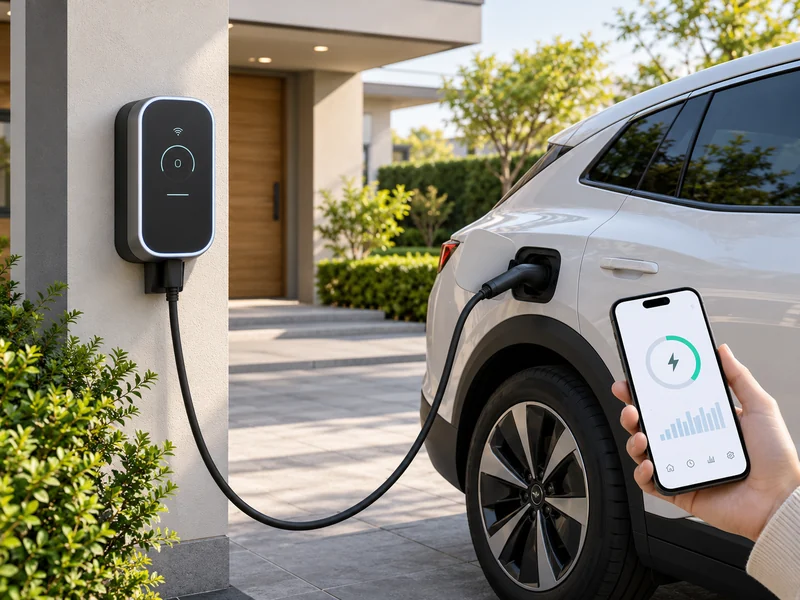
Do not assume a charger with Wi-Fi automatically integrates with every solar inverter. A charger marketed as “smart” still needs to match the actual site architecture, meter ecosystem and, where relevant, the solar-storage side of the project.
8. Home Battery Interaction
A home battery can complicate measurement because the meter may see import/export after battery activity rather than raw household demand.
Depending on system architecture, the EV charger may:
- charge from grid;
- charge from solar;
- indirectly draw from the home battery;
- be excluded from backup loads;
- be deliberately limited during battery discharge.
For a solar + battery + EV project, define priorities explicitly.
Example questions:
- Should the home battery discharge to charge the EV?
- Should EV charging stop during a grid outage?
- Is the charger on the backed-up board or a non-backup circuit?
- Should solar surplus go to the home battery first or the EV first?
These are system-design questions, not wallbox features alone.
9. Hardware Compatibility Matters
Load balancing may depend on a specific:
- CT sensor;
- meter model;
- gateway;
- firmware version;
- charger family;
- network topology.
Before a bulk order, test the exact hardware combination.
A strong supplier should provide:
- installation diagram;
- supported meter list;
- CT orientation instructions;
- communication settings;
- commissioning process;
- fault behaviour if communication is lost.
Ask what happens if the meter stops communicating. Does the charger continue at full current, fall back to a safe fixed current, stop charging or generate an alarm?
That fallback logic is part of product quality.
10. App and Cloud Dependence
Some systems calculate load balancing locally. Others rely partly on network communication.
For critical site-control functions, understand whether internet loss affects operation.
Distributors should test:
- LAN/Wi-Fi setup;
- cloud login;
- local fallback;
- firmware updates;
- app permissions;
- multi-user administration;
- installer vs customer accounts.
A residential buyer may tolerate a temporary app outage. A commercial site managing dozens of chargers has different expectations.
11. Do You Need Dynamic Load Balancing?
It is most valuable when:
- the EV charger is large relative to available service capacity;
- the home has several high-power electrical loads;
- service upgrades are expensive;
- multiple chargers share one supply;
- solar-aware charging is desired;
- the customer wants faster charging without a permanently low current limit.
It may be unnecessary when:
- charger current is small relative to service capacity;
- a dedicated circuit/service has ample headroom;
- the application is a simple fixed-current installation.
The distributor should offer it where it solves a real site constraint, not merely because it sounds “smart.” In other words, a dynamic load balancing EV charger should be sold as a capacity-management solution, not as an app feature alone.
12. RFQ Checklist for Load-Balancing Chargers
Ask the supplier for:
Electrical
- supported phase configuration;
- charger current range;
- maximum charger power;
- measurement range;
- minimum adjustable charging current.
Load management
- static limit supported?
- dynamic load balancing supported?
- one charger or multiple chargers?
- per-phase measurement?
- solar-surplus mode?
- priority rules?
Hardware
- meter/CT included?
- exact meter/CT model;
- communication interface;
- maximum cable distance;
- gateway required?
Software
- local or cloud control;
- app availability;
- OCPP support if required;
- firmware update process;
- offline behaviour.
Commercial
- sample kit including meter/CT;
- warranty;
- spare sensors/meters;
- OEM branding;
- exact model-level documents;
- quantity and trade term.
13. Common Buying Mistakes
Mistake 1: Buying “load balancing” without the meter
The charger may support the feature but require separate hardware.
Mistake 2: Testing the charger but not the control system
The wallbox can charge correctly while meter integration fails.
Mistake 3: Ignoring three-phase per-phase limits
Total power alone may not prevent one phase from overloading.
Mistake 4: Assuming solar integration works with any inverter
Check the exact measurement and integration method.
Mistake 5: Relying on cloud control without understanding offline fallback
Ask how the charger behaves if communication is lost.
14. Load-Balancing Architecture: What the Buyer Is Actually Purchasing
A dynamic load balancing product is not only a wallbox. It is a control system made from several components that must communicate correctly.
A typical project can include:
- EV charger;
- CT sensor or compatible energy meter;
- meter communication cable or wireless link;
- gateway/controller where required;
- configuration software or app;
- site current limit;
- optional solar or battery integration.
This matters commercially because two suppliers may quote a “load balancing charger” at similar wallbox prices while only one quotation includes the required meter or CT hardware.
For a distributor, normalize the complete kit before comparing unit cost. A dynamic load balancing EV charger quote is only meaningful when the meter, CT or controller scope is also clear.
Questions that expose incomplete quotations
Ask the supplier:
- Is the meter/CT included in the quoted price?
- Is one meter enough for one charger only, or can it control several chargers?
- What communication method is used between charger and meter?
- How far can the charger be installed from the meter?
- Does the system continue operating if internet access is lost?
- Can the site limit be configured locally by an installer?
- What happens if meter communication fails?
- Can the charger fall back to a safe fixed-current mode?
These answers matter more than an app screenshot.
15. Worked Example: Why the Site Limit Is More Useful Than the Charger Rating
Consider a property with a 63A single-phase service.
Assume:
- normal house load at one moment: 18A;
- electric water heater starts: +20A;
- target EV charger current: 32A.
Without load balancing, total demand would be:
18A + 20A + 32A = 70A
That is above the simplified 63A service limit.
If the charger controller is configured to keep site demand below 60A, the charger could temporarily reduce current to approximately:
60A – 38A = 22A
When the water heater turns off, available charging current increases again.
This example is intentionally simplified. Real installations must account for local electrical rules, diversity, protective-device characteristics and the charger’s permitted current steps. But it shows the commercial value clearly: the charger adapts to available capacity instead of forcing the homeowner to choose between full charging current and no charging.
16. Multi-Charger Projects: Power Sharing Is Not the Same as Building Load Balancing
In apartment, workplace and fleet projects, buyers often use the term “load balancing” for two different functions.
Charger-to-charger power sharing
A group of chargers shares a fixed power budget.
Example:
- site allocates 60kW to EV charging;
- six vehicles are connected;
- the system divides available EV power according to its control logic.
Whole-building dynamic load balancing
The EV charging budget itself changes according to the building’s real-time demand.
Example:
- building spare capacity is high at night, so EV charging receives more power;
- HVAC or production loads rise, so the EV budget is reduced.
A project may require one or both functions. A supplier saying “supports load balancing” should therefore be asked which architecture is actually supported.
17. Standards Context and Installer Responsibility
IEC 61851-1:2017 provides general requirements for conductive EV supply equipment, including operating conditions and electrical safety. Load-balancing software does not replace the underlying requirements for correct EVSE installation, circuit protection and site design.
For procurement, the important distinction is:
load management can help a project stay within available capacity, but it does not increase the rating of the service, cable or protective equipment.
Mid-Article Project CTA
If you are selecting a load-balancing charger, send ORIDY ENERGY the site phase, main service limit, charger quantity, target charger power, whether solar/battery integration is needed, and the destination market.
We can help compare China-side charger options on the basis of the full load-management architecture rather than the wallbox alone.
Website: https://oridy.net/
Contact: https://oridy.net/contact-us/
WhatsApp: https://wa.me/8618217811889
How ORIDY ENERGY Can Support Project Matching
For EV charger projects involving dynamic load balancing, ORIDY ENERGY can help compare China-side options based on:
- country and grid;
- charger power;
- single/three phase;
- number of chargers;
- available site capacity;
- solar/battery integration requirement;
- OCPP/backend requirement;
- meter/CT architecture;
- quantity.
Send the site type, number of chargers, electrical supply and required smart functions. That gives suppliers enough information to quote the correct load-management architecture rather than only a wallbox.
Frequently Asked Questions
Does dynamic load balancing make a charger more powerful?
No. It does not create additional grid capacity. It varies EV charging current so the charger uses available capacity without exceeding a configured site limit.
Does load balancing require internet access?
Not always. Some systems perform measurement and control locally, while others use gateways or cloud functions for part of the management process. The buyer should verify offline behaviour for the exact charger and meter architecture.
Can one CT or energy meter control several EV chargers?
Some product ecosystems support multi-charger control from one measurement point; others require different hardware or a central controller. This must be confirmed from the supplier’s architecture and maximum supported device count.
Is load balancing useful when a home has solar and a battery?
It can be. But the energy priorities become more complex because solar, stationary battery, household loads and the EV may all interact. Define whether EV charging should use only surplus solar, whether the home battery may discharge into the EV load and what happens during a grid outage.
Final Decision
A dynamic load balancing EV charger is valuable because it turns EV charging from a fixed high-power load into a controllable load that responds to the building.
For homeowners, it can help use existing electrical capacity more effectively. For apartment, workplace and fleet projects, it can become the foundation of multi-charger power allocation.
For distributors, the important buying decision is not the phrase “supports load balancing.” It is the complete meter + communication + charger + fallback-control architecture behind that claim.
Need Help Comparing Dynamic Load Balancing EV Charger Options?
If you are selecting EV chargers for distribution, installation or project supply, send ORIDY ENERGY:
- destination country;
- site type: residential / apartment / workplace / fleet;
- single-phase or three-phase supply;
- main service limit;
- charger quantity;
- target charging power;
- whether solar or battery integration is needed;
- meter / CT preference if known;
- OCPP or backend requirement;
- quantity and delivery city or port.
ORIDY ENERGY works as a China-side renewable-energy sourcing and supply-chain partner and can help compare suitable EV charging options and the complete load-management architecture before sample testing or bulk quotation.
Website: https://oridy.net/
Contact / RFQ: https://oridy.net/contact-us/
WhatsApp: https://wa.me/8618217811889