Portable EV Charger Supplier Guide: What Distributors Should Check Before Buying
Portable EV Charger Supplier Guide: What Distributors Should Check Before Buying
A portable EV charger can look like a simple product: one plug, one control box, one charging cable and one vehicle connector. For a distributor or importer, however, the buying decision is more complicated than choosing a power rating and asking for a unit price.
The charger sits between a building electrical supply and a vehicle worth tens of thousands of dollars. The input plug must match the local socket and electrical system. The vehicle connector must match the target fleet. The in-cable control and protection device must perform the required safety functions. Cable temperature, current limits, enclosure protection, labeling, documentation and warranty procedures all matter. A product that works in a supplier’s showroom can still become difficult to sell if the plug configuration, instructions, certificates or after-sales process do not match the destination market.
For distributors, installers and project buyers, the right question is therefore not simply:
“How much is your portable EV charger?”
A better question is:
“Can this exact charger configuration be safely, legally and commercially deployed in my target market, with documentation and after-sales support that I can verify before I order?”
This guide explains how to evaluate a portable EV charger supplier from that perspective.
Portable EV Charger Supplier: The Short Answer
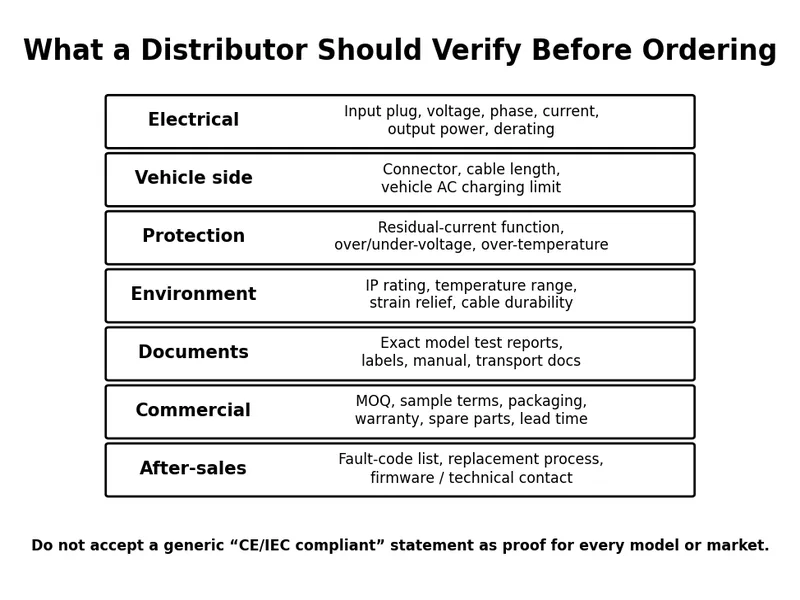
A suitable portable EV charger supplier should be able to confirm the complete configuration, not only the advertised charging power.
Before requesting a quotation, define at least:
| Item | What the buyer should specify | Why it matters |
|---|---|---|
| Destination market | Country and intended sales channel | Determines plug, voltage, labeling, documentation and local requirements |
| Input connection | Household plug or industrial plug, rated current, phase | Defines how the charger receives power |
| Vehicle connector | Type 1, Type 2 or other required interface | Must match the target vehicles |
| Charging current | Example: 8A, 10A, 13A, 16A, 32A depending on configuration | Affects power, socket loading and cable design |
| Phase | Single-phase or three-phase | Changes available power and compatibility |
| Cable length | Required usable length | Affects convenience, voltage drop, packaging and cost |
| Control/protection | IC-CPD functions and protective features | Core safety and compliance issue |
| Environment | Indoor/outdoor use, temperature and IP requirement | Must match real installation conditions |
| Documentation | Exact model certificates, reports, labels and manual | Required for import, sales and customer confidence |
| Commercial terms | Sample, MOQ, branding, packaging, warranty, lead time | Determines whether the product is viable for distribution |
If the supplier cannot answer these questions at model level, the buyer does not yet have enough information to compare quotations.
What Is a Portable EV Charger?
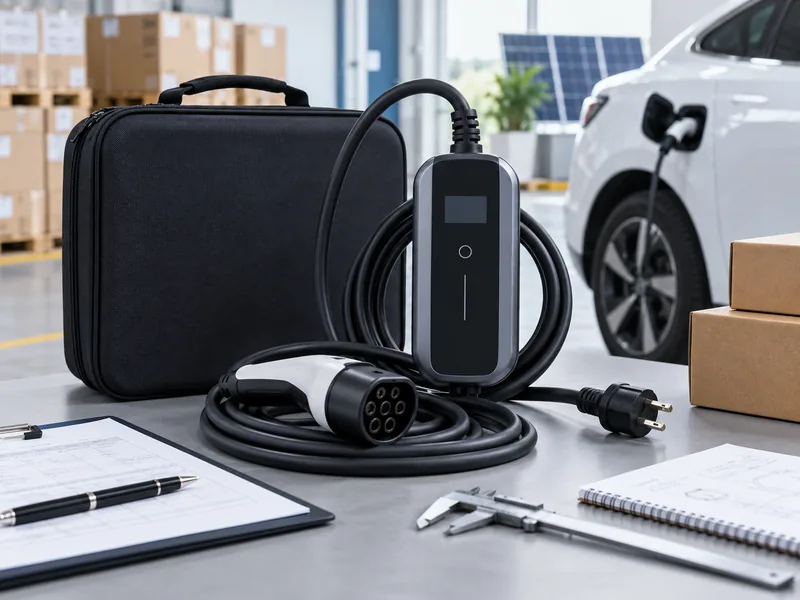
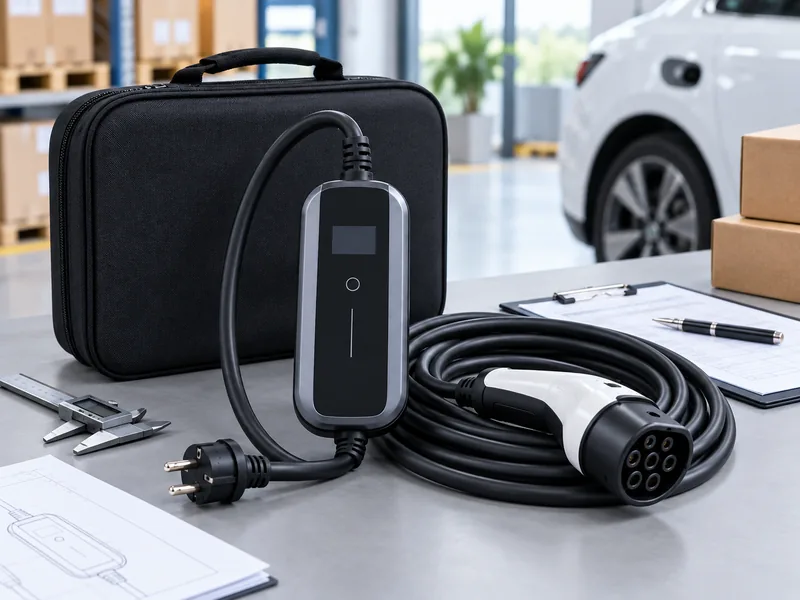
A portable EV charger is a movable AC charging device that connects an EV to an available AC supply without being permanently fixed to a wall.
In many markets, this is associated with Mode 2 charging, where an in-cable control and protection device—often called an IC-CPD—is integrated into the cable assembly. IEC 62752 covers IC-CPDs for Mode 2 charging and includes control and safety functions. The current IEC 62752:2024 edition also includes requirements related to temperature detection in the current-carrying parts of the household plug.
This distinction matters because a portable charger is not merely an extension cable with an EV connector.
The control box may be responsible for functions such as:
- communication/control signaling between supply equipment and vehicle;
- residual-current protection functions according to the product design and applicable standard;
- interruption of power under specified fault conditions;
- over-voltage or under-voltage monitoring depending on model;
- over-temperature protection depending on design;
- current selection;
- status indication and fault codes;
- scheduled charging or basic app functions on some models.
The exact functions vary by model. Buyers should verify them against the technical documentation rather than assuming that every portable charger includes the same protection package.
Portable EV Charger vs Wall-Mounted AC Charger
A portable charger and a wallbox can sometimes deliver similar AC power, but they solve different deployment problems.
| Factor | Portable EV charger | Wall-mounted AC charger |
|---|---|---|
| Installation | Uses a compatible existing or dedicated socket | Normally permanently wired or installed |
| Mobility | Can be carried between locations | Fixed |
| Typical buyer | EV owner, distributor, fleet, travel/emergency use | Homeowner, workplace, property, fleet depot |
| Site integration | Limited compared with advanced wallboxes | Can support load management, backend, RFID and other features |
| Electrical dependency | Strongly dependent on socket, plug and circuit condition | Dedicated circuit can be engineered for the charger |
| Commercial advantage | Flexible, easy to stock, simple to demonstrate | Better for structured permanent charging projects |
| Main risk | Poor-quality socket or incorrect plug/current combination | Poor installation or wrong site configuration |
A portable charger should not be sold as a universal substitute for a properly designed fixed charging installation. Its value is flexibility.
For distributors, this means the product-market fit is often strongest when customers need:
- backup charging;
- travel charging;
- charging at multiple properties;
- charging from an industrial socket;
- temporary fleet or demonstration use;
- a lower-complexity product before installing fixed infrastructure;
- a product that can be bundled with EV accessories.
Why the Input Plug Is a Procurement Decision, Not an Accessory
One of the easiest mistakes is to focus on the vehicle-side connector and treat the supply plug as a small detail.
It is not.
The input plug determines how the charger connects to the electrical infrastructure. A portable EV charger designed for one market can be inappropriate in another even if the vehicle connector is identical.
A buyer should confirm:
- Plug type
- Rated voltage
- Rated current
- Single-phase or three-phase
- Whether the intended socket is designed for continuous high-current use
- Whether the charger allows adjustable current
- Whether plug temperature monitoring is included where required by the applicable design/standard
- Cable conductor size and temperature rating
- Correct labeling and instructions for the destination market
For example, a charger marketed as “3.5kW” may be associated with approximately 230V × 16A under a simplified calculation. A 7kW-class portable configuration may require approximately 230V × 32A and therefore a very different socket and cable arrangement.
The rating on the control box does not make the upstream socket capable of safely supplying that current.
This is especially important in markets where customers may try to use adapters. A distributor should define what adapters are permitted, if any, under the exact product instructions and local electrical rules rather than encouraging improvised conversion between incompatible sockets.
Household Plug or Industrial Plug?
The choice depends on the intended customer and deployment.
Household-plug portable chargers
These can be convenient for emergency or lower-current use. But the buyer should pay close attention to:
- continuous current;
- socket condition;
- plug temperature;
- circuit loading;
- extension-cable restrictions;
- local installation rules.
A charger capable of selecting a lower current can be useful, but current adjustment does not remove the need for a suitable circuit.
Industrial-plug portable chargers
Industrial connectors can support higher-current or three-phase applications when the site has the appropriate supply. They may suit:
- workshops;
- fleet depots;
- factories;
- warehouses;
- farms;
- commercial properties;
- temporary project sites.
The commercial advantage is that the charger remains portable while using a more robust power connection.
However, the distributor still needs to verify the exact industrial plug standard used in the target market.
How Much Power Should a Portable EV Charger Have?
Do not choose the highest available power by default.
The real charging rate is limited by the lowest-capacity part of the complete path:
Site supply → socket/plug → portable charger → cable → vehicle onboard charger
A higher-rated portable charger cannot force an EV to accept more AC power than the vehicle’s onboard charger supports.
For a deeper comparison of common AC power classes, ORIDY already has a dedicated guide on 7kW, 11kW and 22kW EV charging. The portable-charger procurement decision should use the same principle: first define the site and vehicle, then choose the charger.
Common questions include:
- Does the target vehicle accept single-phase or three-phase AC?
- What is its maximum AC charging power?
- Does the target customer usually have a household socket, industrial socket or dedicated EV circuit?
- How many kilometers or kWh does the customer need to recover overnight?
- Is the charger a primary solution or a backup?
- Is portability more important than charging speed?
A 3.5kW charger can be commercially useful even when 7kW products exist. A 7kW charger can be unnecessary if customers lack a suitable 32A circuit. A three-phase portable charger can be attractive for commercial users but irrelevant to a market dominated by single-phase residential connections.
The supplier should help you confirm the available configurations. The buyer must decide which configurations actually match the market.
Type 1 vs Type 2: Do Not Buy by Geography Alone
Vehicle-side connector selection is another area where distributors can oversimplify.
Type 1 and Type 2 are common AC charging interfaces, but the correct choice depends on the actual vehicle population and market variant.
Before ordering:
- identify the EV models your customers drive;
- check whether imported used vehicles create a mixed connector market;
- confirm whether customers expect a vehicle-side cable or socket solution;
- check whether adapters are commonly requested;
- verify current and phase capability of the cable and connector.
Do not assume that every vehicle sold under the same model name uses the same charging configuration in every country.
For an importer, a mixed market can justify keeping more than one SKU instead of forcing one connector standard across all customers.
The Control Box: What Buyers Should Actually Verify
The control box is the functional core of many portable EV charger assemblies.
A supplier datasheet should clearly state the protection and control functions of the exact model.
Questions to ask include:
Residual-current protection
What residual-current detection/protection architecture does the unit use?
Do not accept “RCD included” as the full answer. Ask the supplier to identify the specific function, trip characteristics, relevant test documentation and relationship to the upstream installation requirements.
Over-temperature protection
Where is temperature measured?
Possible points can include:
- input plug;
- control box;
- charging connector;
- internal power components.
IEC 62752:2024 includes requirements for a mandatory control device detecting temperature of current-carrying parts in the household plug for products within its scope. For buyers, that makes the exact standard edition and test report relevant—not just a generic statement that the product is “IEC compliant.”
Over-voltage and under-voltage behavior
Ask:
- What voltage range is allowed?
- At what thresholds does the charger stop?
- Does it restart automatically?
- What fault code appears?
Current selection
If the charger supports adjustable current:
- What current steps are available?
- Is the setting remembered after power loss?
- Can the customer accidentally select a current above the circuit capability?
- Is the maximum current locked by hardware or software?
Earth/ground monitoring
Ask what the product checks and what happens if the required protective conductor condition is not present.
This function can be market- and design-dependent, so request model-level documentation.
Contactor/relay life and thermal design
For distributors expecting frequent use, ask about:
- switching device specification;
- internal temperature rise testing;
- full-load endurance;
- cable and connector temperature;
- derating at high ambient temperature.
A charger that can deliver its rated current for a short demonstration is not automatically suitable for repeated daily charging in a hot climate.
Why Hot-Climate Markets Need Extra Attention
The search term that led Google to begin testing ORIDY includes “african portable ev charger supplier.” That is commercially interesting, but the content should not reduce Africa to one electrical specification.
Africa contains many countries, grid standards, socket practices, climates and EV fleets.
A more useful procurement approach is to ask:
- What country is the product for?
- What is the common residential voltage and plug/socket standard?
- Are customers more likely to charge at home, at a workshop, at a hotel or from industrial power?
- What ambient temperatures are realistic?
- Is the charger likely to be used outdoors?
- Are imported EVs from multiple regions common in the target customer base?
- What local certification, registration or electrical installation rules apply?
- Is power quality stable enough for the charger’s specified operating range?
In hot environments, the distributor should pay particular attention to continuous-current operation, plug temperature, cable temperature, enclosure temperature and derating.
In markets with mixed vehicle imports, connector configuration and replacement-cable availability can be just as important as charger power.
The commercial lesson is simple:
Do not buy an “Africa model.” Buy a configuration for a specific country, customer type and electrical environment.
A Practical Supplier Selection Process
A professional RFQ should move through a sequence rather than starting with price.
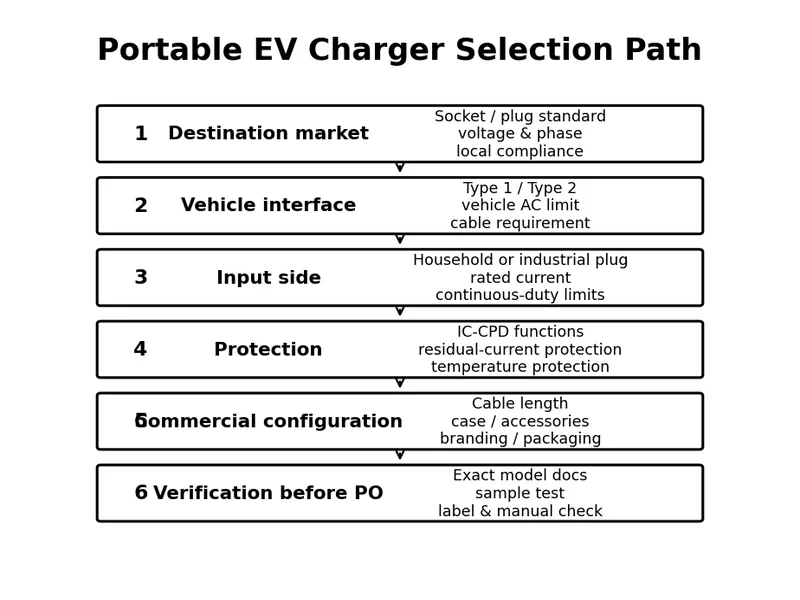
Step 1: Define the sales market
Send the supplier:
- country;
- buyer type;
- expected application;
- vehicle connector;
- input plug preference;
- expected quantity.
Step 2: Confirm the electrical configuration
Ask for:
- input voltage range;
- frequency;
- phase;
- maximum current;
- selectable current;
- rated charging power;
- cable conductor specification;
- input plug rating;
- vehicle connector rating.
Step 3: Confirm the protection architecture
Ask for the exact model’s:
- IC-CPD standard/test basis where applicable;
- residual-current protection functions;
- over-temperature protection;
- over/under-voltage protection;
- over-current behavior;
- ground/earth fault behavior;
- fault indication.
Step 4: Verify physical durability
Request:
- enclosure IP rating;
- operating temperature;
- storage temperature;
- cable length;
- cable flexibility specification;
- connector mechanical life if documented;
- drop/impact test information if applicable;
- product weight.
Step 5: Verify documentation
Before bulk ordering, obtain documents tied to the exact model being quoted.
Possible documents can include:
- product datasheet;
- user manual;
- wiring/electrical specification;
- applicable test reports/certificates;
- declaration of conformity where applicable;
- labeling artwork;
- packing list;
- transport documentation where relevant.
The exact required documentation depends on destination market.
Do not treat a certificate from a related model as proof for the quoted model without checking the scope.
Step 6: Verify the commercial package
Ask whether the quotation includes:
- portable EV charger;
- carrying case;
- wall hook or cable organizer;
- adapters, if permitted;
- printed manual;
- retail box;
- master carton;
- spare input cables;
- spare vehicle-side cables;
- branding;
- barcode/label;
- warranty replacement stock.
Two suppliers can quote the same charger price while offering very different delivered packages.
How to Compare Two Portable EV Charger Quotations
Do not compare quotations until the specification is normalized.
A useful comparison sheet might look like this:
| Comparison item | Supplier A | Supplier B | Buyer action |
|---|---|---|---|
| Exact model | Confirm | Confirm | Do not compare unnamed generic units |
| Input plug | Match? | Match? | Must fit destination market |
| Rated current | Same? | Same? | Normalize current before price comparison |
| Vehicle connector | Same? | Same? | Confirm Type 1 / Type 2 and rating |
| Cable length | Same? | Same? | Longer cable changes cost |
| IP rating | Documented? | Documented? | Request exact datasheet |
| Protection | Detailed? | Detailed? | Compare functions, not marketing terms |
| Test reports | Exact model? | Exact model? | Verify scope and edition |
| Packaging | Retail / neutral / OEM | Retail / neutral / OEM | Normalize commercial package |
| Warranty | Months + process | Months + process | Process matters as much as duration |
| Spare parts | Available? | Available? | Important for distributor support |
| Lead time | Confirmed? | Confirmed? | Include packaging customization time |
| Trade term | EXW / FOB / CIF / DDP | Same basis? | Compare on same Incoterm basis |
A unit that is USD 10 cheaper is not cheaper if it requires new packaging, lacks the required input plug, has weaker documentation or creates a higher warranty burden.
Sample Testing Before a Bulk Order
For a new supplier or new model, a sample should be treated as a validation step—not as a miniature bulk order.
A distributor can build a sample checklist around:
Physical inspection
Check:
- housing finish;
- cable strain relief;
- connector locking;
- plug construction;
- cable markings;
- label quality;
- serial number;
- packing protection.
Functional test
Check:
- power-on behavior;
- current-selection function;
- vehicle handshake;
- charging start/stop;
- fault indication;
- restart behavior;
- display/app functions if included.
Temperature observation
At the intended continuous current, monitor:
- input plug;
- cable;
- control box;
- vehicle connector.
This should be done under appropriate professional conditions and compared with the product’s documented limits.
Documentation check
Confirm that:
- model name on product matches the report/certificate;
- electrical ratings match;
- manual matches the actual controls;
- labels use correct voltage/current;
- plug type in the sample is the ordered plug type.
Packaging check
Ask a basic commercial question:
Can this exact package survive the way you intend to ship and sell it?
For e-commerce, retail distribution and long-distance export, packaging quality can affect return rates.
Certification: What “CE / IEC / UL” Does and Does Not Tell You
One of the weakest supplier conversations is:
Buyer: “Do you have CE?”
Supplier: “Yes.”
That is not enough.
Standards and certifications are linked to:
- a specific product/model;
- specific electrical ratings;
- specific construction;
- specific test standard and edition;
- an applicant/manufacturer;
- sometimes specific plugs, cables or variants.
For Mode 2 IC-CPD products, IEC 62752 is a key technical reference. IEC also publishes test report forms associated with the standard. But an IEC standard is not itself a universal sales approval for every country.
Depending on destination, buyers may also need to consider national/regional conformity systems, electrical-safety rules, EMC requirements, plug/socket standards, product registration or other obligations.
The purchasing rule should therefore be:
Destination market first → exact model second → required documents third.
Not:
“Supplier says CE, therefore the product is acceptable everywhere.”
OEM and Private Label: What Should Be Customized?
Portable EV chargers are attractive to distributors because the product is relatively compact and branding can be visible.
Possible customization can include:
- logo on control box;
- product label;
- user manual;
- retail box;
- carrying bag;
- cable length;
- color;
- app branding on supported platforms;
- QR code;
- barcode;
- warranty card.
However, cosmetic customization should come after the electrical configuration is fixed.
Do not approve packaging for a 16A product and later switch to a 32A configuration without rechecking:
- model number;
- label rating;
- cable specification;
- plug;
- manual;
- certificate/report scope.
A distributor brand is damaged more by technical inconsistency than by a plain box.
Warranty: Ask About the Process, Not Only the Number of Years
“Two-year warranty” sounds clear but leaves many operational questions unanswered.
Ask:
- Is the warranty return-to-China or local replacement?
- Who pays freight?
- Does the supplier provide replacement units in advance?
- Can the distributor keep a spare-unit percentage?
- Are cables and connectors covered the same way as the control box?
- What evidence is required for a claim?
- Are fault logs available?
- Can individual components be replaced?
- What is the response time for technical questions?
For a distributor, warranty is a workflow.
A supplier with a slightly higher unit price but a clear replacement process can be commercially safer than a cheaper supplier that handles every failure case from zero.
Spare Parts and After-Sales Planning
Before the first bulk order, ask what typically fails or is damaged in the field.
Potential service items include:
- vehicle connector;
- input plug;
- cable;
- control box;
- display cover;
- carrying case;
- adapters where applicable.
Ask the supplier:
- which parts can be replaced;
- whether replacement requires opening the control box;
- whether replacement voids compliance/warranty;
- whether spare cables are available;
- whether fault codes are documented;
- whether a technical contact can support installers.
For a reseller selling only a few units, full spare inventory may be unnecessary.
For a distributor planning hundreds of units, the absence of a spare-parts strategy becomes a real commercial risk.
Common Buying Mistakes
1. Buying by kW only
“7kW portable charger” is not a complete specification.
You still need input voltage, current, phase, plug, vehicle connector, cable and protection details.
2. Treating the input plug as interchangeable
A physical adapter does not automatically make the complete electrical system suitable for the new current or market.
3. Assuming every Type 2 vehicle will take the same AC power
The vehicle onboard charger remains a limiting factor.
4. Accepting generic certification claims
Request exact model documents.
5. Ignoring thermal performance
Portable chargers are often used for hours continuously. Temperature rise matters.
6. Buying before confirming packaging and labeling
This creates rework before shipment.
7. Asking only for the lowest MOQ
MOQ matters, but the better trial-order question is:
What is the smallest order that allows me to validate the product, packaging and market response without creating a high after-sales risk?
8. Not defining the warranty workflow
A warranty period without a claim process is incomplete.
RFQ Template for a Portable EV Charger Supplier
A serious buyer can send a request like this:
Market: South Africa / UK / UAE / other specific country
Application: Residential backup / travel / workshop / fleet / reseller
Vehicle connector: Type 1 / Type 2
Input plug: Exact required plug or industrial connector
Input: Voltage, phase and expected maximum current
Charging power: Target range
Cable length: Required length
Current adjustment: Required / not required
Protection: Request detailed IC-CPD and protection specification
Environment: Indoor/outdoor, target IP and operating temperature
Documents: List destination-specific required certificates/reports
Branding: Neutral / private label / OEM packaging
Sample quantity: X units
Trial order: X units
Forecast: Monthly/quarterly estimate if known
Trade term: EXW / FOB / CIF / DDP request
Destination: Port / city / postal code
Warranty: Required term and preferred replacement process
This gives the supplier enough information to quote a specific configuration instead of sending a generic price list.
How ORIDY ENERGY Supports Portable EV Charger Sourcing
ORIDY ENERGY works as a China-side renewable-energy sourcing and supply-chain contact.
For portable EV charger projects, the useful first step is not sending every available model. It is narrowing the request.
A buyer can send:
- destination country;
- vehicle connector;
- input plug;
- required charging power/current;
- quantity;
- branding requirement;
- destination address or port;
- required documentation.
From there, the supply options can be compared on a more equivalent basis.
The objective is to reduce a common sourcing problem: receiving several quotations that look comparable in price but are actually different products.
Need help comparing portable EV charger supply options from China?
Send ORIDY ENERGY your country + plug type + vehicle connector + current/power + quantity + branding requirement so the configuration can be checked before quotation.
FAQ
Is a portable EV charger the same as a wallbox?
No. Both can provide AC charging, but a portable charger is designed to connect through a compatible socket and be moved between locations. A wallbox is generally a fixed installation and can offer deeper site integration.
Is a portable EV charger safe for daily charging?
It can be suitable when the exact product, socket, circuit and installation conditions are appropriate for continuous use. The buyer should verify product protection, current rating, thermal behavior and local electrical requirements.
What is an IC-CPD?
IC-CPD means in-cable control and protection device. IEC 62752 applies to IC-CPDs for Mode 2 charging of electric road vehicles.
Should a distributor choose Type 1 or Type 2?
Choose based on the target vehicles and market, not a generic regional assumption. Imported vehicles can create mixed connector demand.
Is 7kW always better than 3.5kW?
No. Higher power is useful only when the socket/circuit and vehicle can support it and the customer actually needs the faster charging rate.
Can I use one portable charger in multiple countries?
Possibly, but the input plug, voltage, phase, certification, labels and local requirements may differ. “Portable” does not mean “universally compliant.”
What documents should I request from a supplier?
At minimum, request the exact model datasheet and manual, then identify the conformity/test documentation required for your destination market. Verify that the model and electrical ratings on the documents match the quoted product.
Should I start with a sample?
For a new supplier or new configuration, a sample is useful for checking physical quality, electrical function, temperature behavior, documentation and packaging before a larger order.
Final Buying Checklist
Before placing a portable EV charger order, confirm:
- exact destination market;
- exact input plug;
- voltage, frequency and phase;
- continuous current;
- vehicle connector;
- cable length;
- current-adjustment logic;
- IC-CPD/protection functions;
- operating temperature;
- IP rating;
- exact model-level documents;
- label and manual;
- sample results;
- packaging;
- MOQ;
- lead time;
- warranty process;
- spare parts;
- Incoterm and delivery destination.
A portable EV charger is easy to carry. That does not make it a simple procurement product.
The strongest distributor offer comes from matching the electrical configuration, vehicle interface, safety architecture, documentation and after-sales process to the real market before comparing price.
For buyers sourcing from China, that is also the point where a supply-chain partner can add the most value: not by presenting the largest catalogue, but by helping reduce configuration mismatch before the order is placed.
Need help selecting the right EV charger, inverter or battery configuration for your market?
Send ORIDY ENERGY your country, application, required power/capacity and quantity. We can help compare suitable China-side supply options before quotation.
WhatsApp: https://wa.me/8618217811889
Website: https://oridy.net
Contact ORIDY ENERGY: https://oridy.net/contact-us/