
Type 1 vs Type 2 EV Charging Cable: Which Standard Does Your Market Need?
Type 1 vs Type 2 EV Charging Cable: Which Standard Does Your Market Need?
Opening Hook
Picture this. You have just secured a container order for 500 EV charging cables destined for a distributor in Lagos, Nigeria. The invoice is ready, the shipping date is locked, and your client is waiting. Then the email arrives: “These are Type 1 plugs. Our market uses Type 2.” One overlooked specification, and a six-figure deal turns into a logistics nightmare of returns, rework, and lost trust.
This is not a rare story. It plays out every quarter across trading desks in Shenzhen, Istanbul, and Dubai. As EV adoption accelerates worldwide, the fragmentation of charging standards has become one of the single biggest risk factors in EV supply-chain procurement. Choose the wrong standard, and your shipment is dead inventory. Choose the right one, and you position yourself as a reliable, regionally intelligent supplier.
The reality is that no single charging standard has won globally — and none will. Regional regulation, legacy automaker influence, grid architecture, and trade bloc politics have carved the world into distinct charging ecosystems. For importers, distributors, and fleet operators, understanding these boundaries is not optional. It is the difference between a container that clears customs and one that gathers dust in a warehouse.
Featured Snippet Summary
Type 1 (SAE J1772) is the dominant AC charging standard in North America, Japan, and South Korea, using a 5-pin connector with single-phase 120V-240V power up to 80A. Type 2 (IEC 62196) prevails across Europe, Australia, the Middle East, Africa, and most of Asia, featuring a 7-pin connector supporting both single-phase (230V) and three-phase (400V) power up to 63A. For DC fast charging, CCS1 piggybacks on Type 1 while CCS2 extends Type 2. The choice of standard should be driven by your target market’s dominant EV models, local grid configuration, and mandatory certification requirements — not by cable price alone.
Story Hook
But standards are shifting under our feet. North America is in the middle of a historic transition from CCS1 to Tesla’s NACS (now SAE J3400). China’s GB/T standard is riding the wave of Chinese EV exports into Africa, Southeast Asia, and Latin America. And the European Union is tightening its Alternative Fuels Infrastructure Regulation (AFIR), reshaping what “compliant” means for every cable entering the Single Market. If you are sourcing charging cables today, you are not buying for the market as it is. You are buying for the market it will be in 18 months. Keep reading — the details matter.
1. What Exactly Are Type 1 and Type 2 EV Charging Cables?
Quick Answer
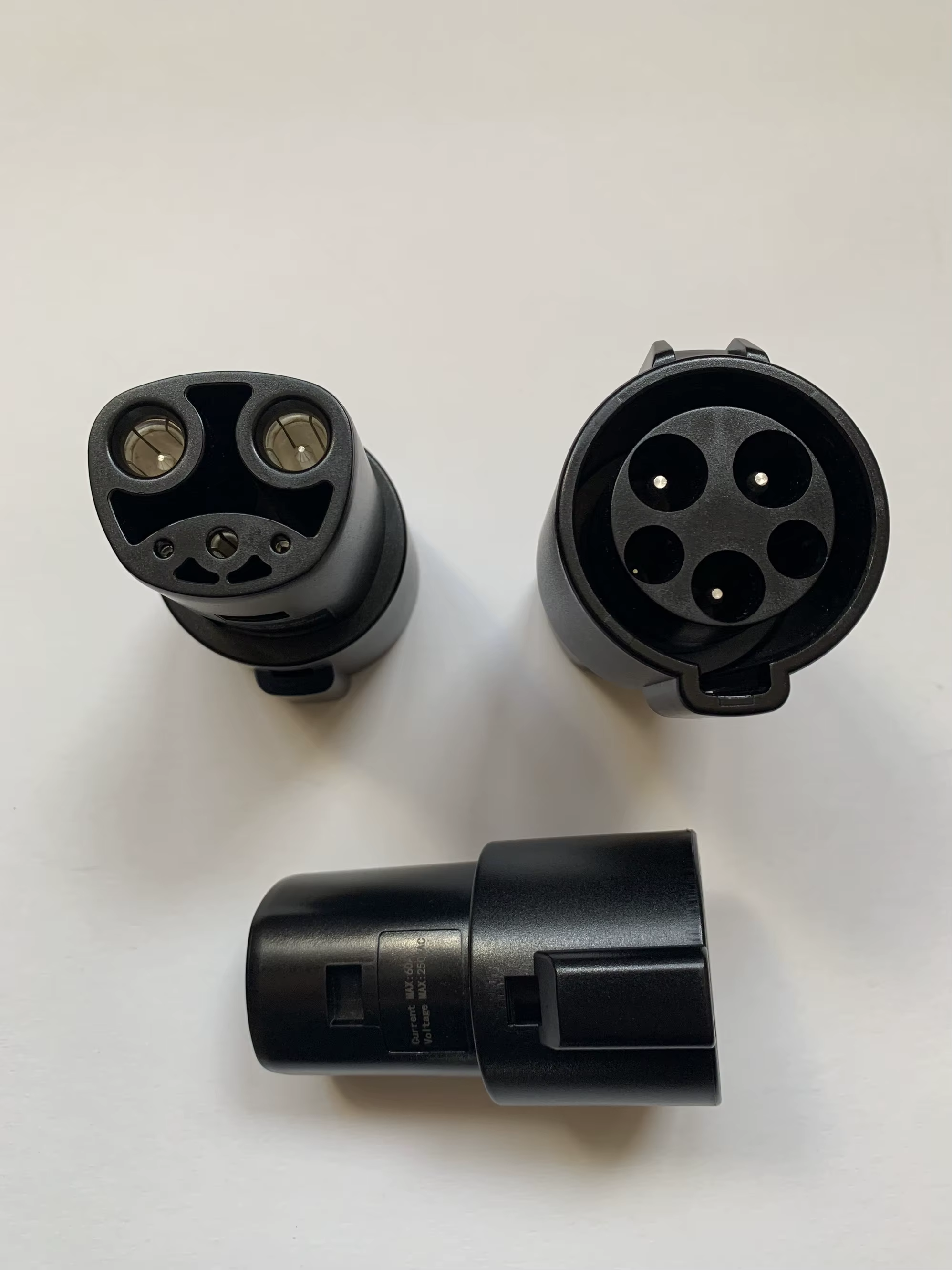
Type 1 and Type 2 are the two globally dominant AC charging connector standards for electric vehicles. Type 1, formally designated SAE J1772, is a 5-pin connector delivering single-phase AC power, predominantly used in North America and parts of East Asia. Type 2, formally designated IEC 62196-2, is a 7-pin connector capable of delivering both single-phase and three-phase AC power, adopted across Europe, Australia, the Middle East, Africa, and most of Asia. The critical technical distinction lies in the three-phase capability: Type 2 can leverage Europe’s widespread three-phase grid infrastructure to deliver up to 43 kW of AC power, whereas Type 1 maxes out at approximately 19.2 kW on a single-phase supply.
Dive Deeper
The Type 1 connector traces its lineage to California in the late 2000s, when the Society of Automotive Engineers (SAE) needed a standard plug for the first wave of mass-market EVs — the Nissan Leaf, the Chevrolet Volt, the Mitsubishi i-MiEV. The J1772 specification defined a round, 43mm-diameter connector with five pins: two for AC power (Line 1 and Neutral), one for protective earth (ground), and two for communication (proximity pilot and control pilot). The proximity pilot tells the vehicle the cable is connected and prevents drive-off. The control pilot handles the digital handshake between the EV and the charging station, negotiating available current and monitoring the connection throughout the charge session.
The genius of J1772 was its simplicity. It worked reliably on North America’s predominantly single-phase, split-phase 120V/240V residential grid. A Level 1 charge on a standard 120V outlet delivered about 1.4 kW — painfully slow but workable overnight. A Level 2 charge on a dedicated 240V circuit could deliver 3.3 kW to 19.2 kW, enough to fully charge most EVs in 4 to 8 hours. This matched North American driving patterns and residential electrical infrastructure perfectly.
But the Type 1 connector has a hard ceiling. With only two power pins, it cannot carry three-phase AC. In a world where much of the industrial and commercial electrical grid runs on three-phase power — and where higher charging speeds are increasingly demanded — this limitation became a strategic vulnerability.
Enter Type 2. The International Electrotechnical Commission (IEC) developed the IEC 62196-2 standard, and the Type 2 connector — often called the Mennekes connector after the German manufacturer that designed the original form factor — became the European answer. Physically larger than Type 1 at roughly 55mm in diameter, the Type 2 connector carries seven pins: four for power (L1, L2, L3, Neutral), one for protective earth, and two for communication (proximity pilot and control pilot). The four power pins unlock something transformative: three-phase AC charging.
On a European three-phase 400V supply at 63A, a Type 2 cable can deliver up to 43 kW of AC power. That is more than double the maximum of any Type 1 installation. More commonly, public AC chargers in Europe operate at 11 kW or 22 kW using three-phase — speeds that are physically impossible with Type 1 hardware. For fleet operators, apartment-building managers, and public charging networks, this three-phase capability is not a luxury. It is the baseline for commercial viability.
It is worth pausing on the grid-architecture angle, because it explains more about global standard adoption than any automaker’s preference. North American residential electricity distribution is built around split-phase 240V: a center-tapped transformer secondary provides two 120V lines 180 degrees out of phase, giving 240V between them. Three-phase power exists at the distribution level but rarely reaches the home. European residential and commercial electricity, by contrast, is overwhelmingly three-phase 400V, with homes commonly receiving all three phases. This is not a minor detail. It means a European home can install a 22 kW three-phase wallbox for roughly the same electrical work as a North American home installing a 19.2 kW single-phase unit. The grid infrastructure essentially pre-selected the connector standard.
What Are the Key Physical Differences Between Type 1 and Type 2 Plugs?
The 5-pin versus 7-pin distinction is the most obvious difference, but it is only the beginning. Type 1 connectors feature a mechanical locking tab on top that secures the connector to the vehicle inlet — functional but prone to wear over tens of thousands of insertion cycles. Type 2 connectors use a more robust internal locking mechanism where a pin inside the vehicle inlet extends into a recess on the connector, controlled electronically by the charging station or vehicle. This means a Type 2 cable cannot be unplugged mid-charge unless the vehicle unlocks it, providing both theft deterrence and electrical safety.
The connector diameters differ meaningfully: Type 1 at approximately 43mm, Type 2 at approximately 55mm. The contact pin diameters also differ, with Type 2 power pins rated for higher continuous current. This is not accidental. The IEC standard was designed from the ground up for the higher thermal loads associated with sustained three-phase charging.
Which Connectors Support DC Fast Charging?
Neither Type 1 nor Type 2 alone supports DC fast charging. DC fast charging requires the Combined Charging System (CCS) extensions:
- CCS1 (Combo 1) adds two large DC pins below the Type 1 AC connector, creating a bulkier combined plug used across North America for DC fast charging at up to 350 kW.
- CCS2 (Combo 2) adds two large DC pins below the Type 2 AC connector, creating the combined plug used across Europe, Australia, and much of the rest of the world for DC fast charging.
The elegance of the CCS approach is backward compatibility: a CCS-equipped vehicle can accept both the combined DC plug and the pure AC plug (Type 1 or Type 2) in the same inlet, with the upper AC portion remaining identical. This is why understanding the underlying AC standard is essential — it determines which CCS variant your market needs.
2. Regional Adoption Map: Who Uses Type 1 and Who Uses Type 2?
Quick Answer
Type 1 (SAE J1772) dominates in the United States, Canada, Japan, and South Korea. Type 2 (IEC 62196) is the mandatory or de facto standard across all 27 EU member states, the United Kingdom, Australia, New Zealand, the Middle East (UAE, Saudi Arabia, Qatar), most of Africa, Southeast Asia, and South Asia including India. The dividing line is not random: it traces the historical spheres of influence of American versus European automotive engineering standards, overlaid on local grid architecture.
Dive Deeper
The global map of EV charging standards is a palimpsest of automotive history, trade policy, and electrical engineering. When Nissan launched the Leaf globally in 2010, it shipped with a Type 1 inlet in North America and Japan, and a Type 2 inlet in Europe. Toyota and Honda followed the Type 1 path for their home market and North American vehicles. This created a self-reinforcing cycle: as more Type 1 vehicles populated Japanese and North American roads, more Type 1 charging stations were deployed, which in turn made Type 1 the obvious choice for new market entrants.
Europe took a more regulatory approach. The European Union’s Directive 2014/94/EU on the deployment of alternative fuels infrastructure effectively mandated Type 2 (and CCS2 for DC) as the common standard across all member states. This was not a suggestion — it was a condition of accessing EU funding for charging infrastructure and, eventually, a requirement for new charging station installations. The United Kingdom carried this regulation forward post-Brexit, retaining Type 2 and CCS2 as its national standards through the Automated and Electric Vehicles Act 2018 and subsequent Public Charge Point Regulations.
The result is a world divided into three major AC charging blocs, plus one rising challenger:
| Region | AC Standard | DC Standard | Key Markets | Approximate EV Fleet (2025) |
|---|---|---|---|---|
| North America | Type 1 (SAE J1772) transitioning to NACS (SAE J3400) | CCS1, transitioning to NACS | USA, Canada, Mexico | 4.5+ million |
| Europe & UK | Type 2 (IEC 62196) | CCS2 | EU-27, UK, EFTA | 10+ million |
| East Asia (Type 1) | Type 1 (SAE J1772) | CHAdeMO / CCS1 | Japan, South Korea | 1.5+ million |
| China | GB/T 20234 | GB/T DC | Mainland China | 20+ million |
| Rest of World (Type 2) | Type 2 (IEC 62196) | CCS2 | Australia, NZ, India, Middle East, Africa, SE Asia | 3+ million |
This table understates the complexity. Let us break down each major region.
Why Does Europe Mandate Type 2 While North America Stuck With Type 1?
The short answer is three-phase grid infrastructure. But the longer answer involves regulatory philosophy. European regulators saw charging standardization as a public-infrastructure question akin to road signage or rail gauge: a network good where interoperability creates enormous positive externalities. The EU mandated a single standard early and enforced it through funding conditions and eventually direct regulation.
North American regulators, by contrast, treated charging standards as a market-competition question. Multiple standards were allowed to compete. CCS1, CHAdeMO, and Tesla’s proprietary connector coexisted for over a decade, with the market — not a regulator — ultimately selecting a winner. That winner, unexpectedly to many, was Tesla’s NACS connector, now standardized as SAE J3400. Ford, GM, Rivian, Mercedes-Benz, Volvo, Polestar, Honda, Toyota, and nearly every major automaker selling in North America have now announced the transition to NACS starting with 2025 model-year vehicles.
This transition has enormous implications for anyone sourcing Type 1 cables today. The North American market is not abandoning AC charging — it is changing the physical connector while keeping the underlying communication protocol (the same J1772 signaling runs over NACS). For importers, this means Type 1 demand in North America has a visible expiration date, probably around 2030-2032, after which the connector will exist only in the legacy fleet.
What Standard Does Africa and the Middle East Actually Use?
This is the question that loses importers money. The answer is: it depends on which automakers are selling into which country.
Middle East (GCC): The Gulf Cooperation Council countries — UAE, Saudi Arabia, Qatar, Kuwait, Bahrain, Oman — follow European automotive homologation standards almost without exception. Every BMW, Mercedes-Benz, Audi, Volkswagen, Porsche, and Land Rover sold in the GCC is built to European specification, which means Type 2 AC inlets and CCS2 DC capability. Even American brands like Ford and Chevrolet often ship European-spec vehicles to the Gulf. The GCC Standardization Organization (GSO) has aligned its EV charging technical regulations with IEC standards. If you are sourcing for the Gulf market, Type 2 is the answer.
Africa: The picture is more complex. South Africa, the continent’s largest EV market by a significant margin, follows European standards — Type 2 and CCS2 predominate. Morocco and Egypt, the next two most significant markets, also lean European. However, the rapid influx of Chinese EVs across the continent is creating a parallel reality. BYD, Geely, SAIC (MG), and Great Wall Motors are shipping vehicles with GB/T or Type 2 inlets depending on the destination market. In Kenya, Ethiopia, Rwanda, and Nigeria, the charging infrastructure is so nascent that the de facto standard is whatever the first major fleet deployment installs. In practice, Type 2 is the safer bet for most of Africa, but any serious importer should verify the specific market at the country level.
How Is China’s GB/T Standard Complicating Global Procurement?
China is the elephant in the room. With over 20 million EVs on its roads and an export machine running at full throttle, China’s GB/T standard (GB/T 20234 for AC, GB/T 20234.3 for DC) is spreading beyond China’s borders. Chinese automakers exported over 4 million vehicles in 2024, a substantial portion of them electric, and many emerging markets are receiving GB/T-equipped vehicles because Chinese OEMs offer them at price points no Western or Japanese competitor can match.
For importers, this creates a trilemma: do you stock Type 1, Type 2, GB/T, or all three? The answer depends on your geographic focus, but the trend is clear — GB/T is no longer a China-only curiosity. It is a legitimate global standard with a growing installed base across Southeast Asia, Africa, Latin America, and Central Asia. Any procurement strategy that ignores GB/T is missing a material and growing segment of the global market.
3. Technical Comparison: Type 1 vs Type 2 Specifications
Quick Answer
Type 1 (SAE J1772) delivers single-phase AC power at 120V (Level 1, up to 16A) or 240V (Level 2, up to 80A), providing a maximum charging rate of approximately 19.2 kW. Type 2 (IEC 62196) delivers single-phase AC at 230V (up to 32A) or three-phase AC at 400V (up to 63A), providing a maximum charging rate of approximately 43 kW on three-phase. Type 2 also supports a higher maximum DC current when part of CCS2 (up to 500A at 1,000V), compared to CCS1 (up to 500A at 1,000V — nominally similar but infrastructure deployment of higher-power CCS2 stations is more advanced).
Dive Deeper
A side-by-side technical comparison reveals why Type 2 has become the default choice for every region that is not locked into Type 1 by legacy fleet considerations.
| Specification | Type 1 (SAE J1772) | Type 2 (IEC 62196-2) |
|---|---|---|
| Standard body | SAE International | International Electrotechnical Commission (IEC) |
| Number of pins | 5 (L1, N, PE, CP, PP) | 7 (L1, L2, L3, N, PE, CP, PP) |
| Phase support | Single-phase only | Single-phase and three-phase |
| Voltage range (AC) | 120V – 240V | 230V – 480V |
| Maximum current (AC) | 80A (nominal), 16A (typical residential) | 63A (three-phase), 70A (single-phase) |
| Maximum power (AC) | 19.2 kW (240V x 80A) | 43 kW (400V x 63A x 3-phase) |
| Typical home charging | 7.2 kW (240V x 30A) | 11 kW (400V x 16A x 3-phase) |
| Connector diameter | ~43 mm | ~55 mm |
| Locking mechanism | Mechanical latch (top) | Electronic pin lock (integrated) |
| Ingress protection | IP44 (typical) | IP44 to IP65 (design dependent) |
| DC fast charge variant | CCS1 (Combo 1) | CCS2 (Combo 2) |
| Communication protocol | J1772 PWM (SAE J1772) | IEC 61851-1 PWM |
| Vehicle inlet standard | J1772 | IEC 62196-2 |
What Are the Practical Implications of 5-Pin vs 7-Pin Architecture?
The extra two pins in Type 2 are not redundant. They are the two additional phase conductors (L2 and L3) that enable three-phase power delivery. This single architectural difference creates cascading practical implications:
Charging speed at public stations. A Type 1 vehicle at a public AC charger is limited to roughly 7.2 kW (32A at 240V) in practice, even if the station hardware could deliver more. Its connector simply lacks the pins to carry additional phases. A Type 2 vehicle at the same station — assuming the station is wired for three-phase, as most European public AC chargers are — can draw 11 kW or 22 kW, cutting charge time by a factor of two to three. For commercial fleet operators turning vehicles around at depots, this difference compounds into hours of additional availability per vehicle per week.
Home charging in three-phase markets. In Germany, France, the Netherlands, and much of Northern Europe, residential three-phase connections are standard. A Type 2 wallbox on a 16A three-phase circuit delivers 11 kW without any electrical upgrade beyond what the home already has. Achieving the equivalent 11 kW on a North American Type 1 setup requires a 48A single-phase 240V circuit — a substantial electrical installation requiring a higher-capacity breaker, heavier-gauge wiring, and potentially a service-panel upgrade. The 7-pin architecture is, in this sense, a better fit for the underlying grid reality of most of the world outside North America.
Balancing and grid friendliness. Three-phase charging draws balanced current across all three phases of the grid, reducing neutral current and minimizing voltage imbalance on the local distribution transformer. Single-phase charging at high currents, by contrast, can create significant phase imbalance, a problem that distribution network operators in single-phase-dominant markets manage through transformer oversizing and careful load planning. As EV penetration increases, the grid-friendliness of three-phase charging becomes a material advantage for utilities and regulators — another reason Type 2 markets are unlikely to ever migrate to a single-phase connector.
How Does the Communication Protocol Differ Between J1772 and IEC 61851?
Both Type 1 and Type 2 use a control pilot (CP) signal based on pulse-width modulation (PWM) for basic communication between the EV and the charging station, as defined by their respective standards. The PWM duty cycle encodes the maximum available current; the EV adjusts its onboard charger draw accordingly. At this basic level, they are functionally equivalent and have proven highly reliable over billions of cumulative charge hours.
The differences emerge at the higher layers of the communication stack. IEC 61851 (governing Type 2) and SAE J1772 (governing Type 1) have diverged in their optional advanced features:
- IEC 61851-1 Annex A defines high-level communication using power-line communication (PLC) over the control pilot line, which is the basis for CCS digital communication during DC charging.
- SAE J1772 similarly uses PLC for CCS1, but the North American ecosystem has additionally layered ISO 15118 “Plug & Charge” capability more aggressively than Europe, driven partly by Tesla’s NACS influence and the Electrify America network’s requirements.
In practice, for an importer sourcing AC-only charging cables (not DC fast chargers), these higher-layer protocol differences are largely irrelevant. A Type 1 or Type 2 AC cable is essentially a passive device: copper conductors, insulation, and a simple resistor network in the plug to signal cable current rating to the vehicle. There is no active electronics in the cable itself. The complexity lives in the charging station and the vehicle’s onboard charger — not in the cable. This is why a well-manufactured AC charging cable from a reputable source will be electrically compatible regardless of which company’s charging station it is plugged into, as long as the physical connector matches.
4. Certification and OEM Requirements by Region
Quick Answer
For the European Union and UK, Type 2 cables must carry CE marking under the Low Voltage Directive (2014/35/EU) and, increasingly, UKCA marking for the UK market. For North America, Type 1 cables require certification from a Nationally Recognized Testing Laboratory (NRTL) such as UL (UL 2594 for EV charging equipment), ETL (Intertek), or CSA. For the Middle East, Gulf Conformity Marking (G-Mark) is required in GCC countries. For Australia, RCM (Regulatory Compliance Mark) is mandatory. Importing uncertified cables into any of these markets risks customs rejection, legal liability, and exclusion from government incentive programs.
Dive Deeper
Certification is where procurement strategy meets regulatory reality. An uncertified charging cable is not just a compliance risk — it is an uninsurable, unfinanceable liability. No reputable distributor will touch it. No fleet operator with a safety department will install it. And no insurer will cover a fire claim traced to uncertified charging equipment.
Here is what certification means in practice for each major market bloc:
European Union (CE Marking): The CE mark is not a certification issued by a testing laboratory. It is a manufacturer’s declaration of conformity, backed by a technical file demonstrating compliance with applicable EU directives. For EV charging cables, the relevant directives include the Low Voltage Directive (LVD) 2014/35/EU, the Electromagnetic Compatibility (EMC) Directive 2014/30/EU, and, for cables incorporating electronics, the Radio Equipment Directive (RED) 2014/53/EU.
Critically, for CE marking, the manufacturer (or the importer placing the product on the EU market) must compile a technical file that includes design documentation, risk assessment, test reports against harmonized standards (principally EN 61851-1 and IEC 62196 for charging cables), and a Declaration of Conformity. In practice, most importers rely on their Chinese or Turkish manufacturers to provide this documentation, but legal responsibility rests with the entity placing the product on the EU market — meaning the importer, not the factory. If a customs authority or market surveillance body (such as Germany’s Bundesnetzagentur or the Netherlands’ NVWA) requests the technical file, the importer must produce it within 10 working days. Failure means product withdrawal, fines, and in serious cases, criminal liability.
Important nuance: EN 61851-1 covers the entire charging system (station, cable, connector). IEC 62196 specifically covers the plug, socket-outlet, vehicle connector, and vehicle inlet. Both sets of standards apply. A cable tested only to IEC 62196 may not satisfy EN 61851-1 requirements, and vice versa. A diligent importer ensures the manufacturer’s test reports cover both.
United Kingdom (UKCA): Post-Brexit, the UK has introduced the UKCA (UK Conformity Assessed) marking as a replacement for CE marking. The UK government has extended transitional periods several times; as of 2025, CE marking alone is still accepted for most products, but the long-term trajectory is clear: UKCA will eventually be mandatory. A cable carrying both CE and UKCA markings is the safest approach for importers serving both the EU and UK markets.
North America (UL / ETL / CSA): The North American certification landscape is fundamentally different from Europe’s. While CE marking is self-declared (though backed by test reports), North American certification requires third-party testing and ongoing factory inspection by an OSHA-recognized Nationally Recognized Testing Laboratory (NRTL).
The key standards are UL 2594 (Standard for Electric Vehicle Supply Equipment), UL 2251 (Standard for Plugs, Receptacles, and Couplers for Electric Vehicles), and CSA C22.2 No. 280 (Canadian standard for EV supply equipment). A cable carrying the UL Listed mark, the ETL Listed mark (Intertek), or the CSA mark meets these requirements. The “UL Recognized” mark is not the same — it applies to components intended for incorporation into end-products, not to finished cables sold directly to end users. This distinction is frequently misunderstood by first-time importers and is a common source of rejected shipments at US customs.
Additionally, for cables intended for the US market, FCC Part 15 compliance for electromagnetic interference may apply if the cable incorporates any active electronics (LED indicators, temperature sensors with microcontroller readout). Most passive AC cables do not trigger this requirement, but it is worth verifying.
Gulf Cooperation Council (G-Mark): Under the Gulf Conformity Marking scheme administered by the GCC Standardization Organization (GSO), EV charging cables (classified under HS codes related to electrical equipment) require G-Mark certification for entry into Saudi Arabia, UAE, Qatar, Kuwait, Bahrain, and Oman. The GSO has adopted IEC 62196 and EN 61851-1 as the basis for its technical regulations, meaning a cable certified to European standards can typically obtain G-Mark certification without retesting — a valuable efficiency for importers serving both markets.
Australia (RCM): The Regulatory Compliance Mark (RCM) is required for EV charging equipment sold in Australia. The relevant electrical safety standard is AS/NZS 4417.2, which references AS/NZS 61851.1 (the Australian adoption of IEC 61851-1). Importers should verify that their manufacturer’s test reports include coverage against the Australian variants of the IEC standards, as some national deviations exist.
Do I Need Different Certifications for Type 1 and Type 2 Cables?
Almost certainly yes, unless your testing laboratory has evaluated both variants under a single certification scheme, which is uncommon. A Type 1 cable tested to UL 2594 for the North American market will not automatically satisfy CE marking requirements under European directives, because the test standards (UL vs. EN/IEC) differ in their test methodologies, pass/fail criteria, and documentation requirements. Similarly, a CE-marked Type 2 cable will not satisfy UL requirements unless the manufacturer has specifically pursued UL certification as a separate exercise.
This means that if an importer is sourcing both Type 1 and Type 2 cables, they should budget for two separate certification tracks. In practice, many Chinese manufacturers maintain parallel certifications — UL for their Type 1 product line, TUV/CE for their Type 2 product line. A competent manufacturer will provide copies of all active certificates, and a competent importer will verify them on the issuing body’s online certificate directory before placing an order.
5. The NACS Transition: What It Means for Type 1 Procurement
Quick Answer
NACS (North American Charging Standard, now standardized as SAE J3400) is Tesla’s connector, originally proprietary, now opened and adopted by virtually every major automaker selling in North America. For AC charging, NACS uses the same J1772 communication protocol as Type 1 but in a smaller, lighter, more ergonomic physical connector. Legacy Type 1 vehicles will persist on North American roads through at least 2040, but new vehicle production is transitioning to NACS beginning with 2025-2026 model years. For importers, this means Type 1 cable demand is in structural decline in North America, while NACS cable demand is in structural growth.
Dive Deeper
The NACS transition is the most significant charging-standard disruption since the EU mandated Type 2 in 2014. Its implications for procurement strategy are far-reaching and often misunderstood.
What actually changed: In November 2022, Tesla published the mechanical drawings and specifications for its charging connector (then called the Tesla Charging Connector) and invited the industry to adopt it, renaming it the North American Charging Standard (NACS). Ford was the first legacy automaker to bite, in May 2023. General Motors followed within weeks. By the end of 2024, every major automaker selling in North America — including Mercedes-Benz, BMW, Volkswagen Group, Hyundai Motor Group, Toyota, Honda, Nissan, Rivian, and Lucid — had announced plans to adopt NACS, either through native inlets on new vehicles or through adapters for existing CCS1 vehicles.
SAE International formally standardized NACS as SAE J3400 in December 2023, giving it the same institutional legitimacy as J1772. This was the watershed moment. Once SAE J3400 existed, charging station manufacturers and electrical inspectors had a recognized standard to design to and approve against. Federal and state funding programs, which previously required CCS1 connectors, began updating their requirements to include J3400.
What it means for cables: The NACS connector uses a fundamentally different physical form factor from Type 1. It is smaller (roughly half the cross-sectional area), lighter, and uses the same pins for both AC and DC power delivery — the vehicle’s onboard systems route the power appropriately depending on what the charging station is providing. For AC charging specifically, the communication protocol is identical to J1772: the same PWM control pilot, the same proximity detection, the same current-negotiation logic. This means a technician-level understanding of J1772 transfers almost entirely to NACS AC charging.
An important detail for cable sourcing: NACS AC cables are functionally similar to Type 1 AC cables in that they carry single-phase power (up to 240V in North America) with the same J1772-derived communication. The difference is entirely in the connector geometry and pin layout at the vehicle end. The infrastructure end of the cable — what connects to the wallbox or charging station — may be NACS on both ends, NACS on the vehicle end and J1772 on the infrastructure end (for legacy stations being retrofitted), or hardwired into the station itself.
Procurement implications: For importers currently holding Type 1 inventory, the NACS transition does not create immediate obsolescence. There are approximately 4.5 million CCS1/Type 1 vehicles on North American roads as of 2025. Those vehicles will need Type 1 cables for their remaining service life — another 15 to 20 years. Additionally, the adapter ecosystem (NACS-to-J1772 and J1772-to-NACS adapters) provides a bridge. Many owners of legacy Type 1 vehicles will continue using their existing Type 1 home chargers and public stations for years.
However, new procurement of Type 1 cables for the North American market should be approached with caution. The growth is in NACS. By 2027, the majority of new EVs sold in North America will have NACS inlets. By 2030, Type 1 inlets will be largely confined to the legacy fleet. An importer building a long-term North American business should be developing NACS sourcing relationships now, while continuing to serve the Type 1 replacement market.
Should I Stop Buying Type 1 Cables Entirely?
No, but adjust your volumes and geography. Type 1 remains the standard in Japan and South Korea, neither of which has shown any indication of transitioning to NACS. The Japanese market, with its CHAdeMO legacy and J1772 AC charging, is a stable, long-term Type 1 market. South Korea similarly maintains Type 1 AC with CCS1 DC — though the Korean government’s EV subsidy program has started nudging toward CCS2 in some scenarios, the installed base of Type 1 infrastructure is enormous and not going anywhere soon.
For importers serving North America, the strategy should shift: maintain Type 1 inventory for the replacement and legacy market, but allocate new procurement dollars disproportionately toward NACS and Type 2 cables. North America’s Type 1 era is not ending overnight, but it has entered its twilight. The importers who adapt their product mix now will be the ones still shipping containers in 2030.
6. Which Standard Has More Growth Potential for Importers and Distributors?
Quick Answer
Type 2 (IEC 62196) offers substantially more addressable-market growth potential than Type 1 over the next decade. The Type 2 standard covers Europe (the world’s second-largest EV market after China), India (the fastest-growing major EV market), Australia, the Middle East, Africa, and most of Southeast Asia — a combined population of over 4 billion people and rapidly electrifying vehicle fleets. Type 1, by contrast, is concentrated in a shrinking North American AC market (due to the NACS transition) and mature East Asian markets (Japan, South Korea) with slowing EV growth rates. For importers seeking to maximize addressable-market size, Type 2 is the clear priority, with NACS as the secondary growth bet and Type 1 as a steady-state legacy business.
Dive Deeper
Growth-potential analysis requires separating three variables: market size, market growth rate, and standard stability.
Market size: The Type 2 market is larger by every metric. Europe alone registered approximately 3 million new EVs (BEV + PHEV) in 2024. India added roughly 1.5 million electric two-wheelers and a rapidly growing four-wheeler EV fleet in the same year. Australia’s EV penetration crossed 10 percent of new car sales. The Middle East, led by the UAE and Saudi Arabia, is investing heavily in EV infrastructure as part of economic diversification strategies. Africa’s EV market is tiny in absolute terms but growing from zero, which means the infrastructure built now will be Type 2. Add Southeast Asia (Thailand, Indonesia, Vietnam — all Type 2 markets) and the addressable-market scale becomes evident.
The Type 1 market, even before the NACS transition, was limited to North America, Japan, and South Korea — roughly 600 million people in wealthy but slow-growing (in EV terms) markets. Japan’s EV adoption has been notably slow relative to its economic peers; hybrids still dominate. South Korea’s EV market is healthy but small in absolute numbers. North America is the bright spot, but the NACS transition means Type 1 procurement for North America is a declining business.
Market growth rate: Europe’s EV market, despite a temporary slowdown in 2024-2025 driven by subsidy reductions in Germany and economic headwinds, is structurally growing due to the EU’s 2035 zero-emission vehicle mandate. India’s EV market is growing from a low base at rates exceeding 50 percent year-on-year in some segments. Africa and the Middle East are wildcard growth markets where infrastructure investment is creating demand for charging cables that did not exist five years ago. By contrast, Type 1’s growth is constrained to replacement demand — cables for new EV buyers in Japan and South Korea, plus the gradual replacement of worn or damaged cables in the existing North American legacy fleet.
Standard stability: Type 2 is a settled standard. No regulatory body within the Type 2 sphere is discussing a transition to a different AC standard. The EU’s AFIR regulation locks Type 2 and CCS2 into European infrastructure for the foreseeable future. India’s Bharat EV standards are harmonized with IEC, reinforcing Type 2. Australia’s standards body has confirmed Type 2 and CCS2 as the national approach. Type 1, by contrast, is in active decline in its largest market (North America) due to the NACS transition.
Where Should a New Importer Allocate Their First Procurement Budget?
A new entrant into the EV charging cable import business should allocate procurement budget in roughly this order of priority:
- Type 2 cables with CE and UKCA certification — This unlocks the entire European market, the UK, and, with minor additional certifications, the Middle East, Australia, and much of emerging Asia and Africa. This is the largest addressable market with the most stable regulatory environment.
- NACS cables with UL/ETL certification — This is the growth bet for North America. The NACS market is young, competition is still forming, and early movers who establish relationships with US distributors and charging-network operators will have a first-mover advantage.
- Type 1 cables with UL/ETL certification — This is the legacy cash-flow business. Demand exists and will persist for years, but growth is limited. Allocate enough to serve existing customers and capture replacement-market share, but do not over-invest.
- GB/T cables (AC and DC) — For importers with risk appetite and a focus on emerging markets (Southeast Asia, Africa, Latin America), GB/T cables offer a differentiated product line aligned with the growth of Chinese EV exports. Certification is more complex (CCC for China domestic, plus destination-market requirements), but the competitive landscape is less crowded than Type 2.
What About Africa’s Mixed Standards — Type 2, GB/T, or Both?
Africa is arguably the most interesting and least-understood charging-standard market globally. The continent is not one market but 54, and charging infrastructure is being built country by country, often project by project, without the coordinating hand of a strong regional regulatory body like the EU.
The practical reality is that Africa imports both European-spec and Chinese-spec EVs, and therefore needs both Type 2 and GB/T charging infrastructure. South Africa, by far the largest EV market on the continent, is firmly in the Type 2 / CCS2 camp, with GridCars and other charging networks deploying IEC-compliant hardware. Morocco and Egypt similarly lean European.
But in East Africa — Kenya, Tanzania, Rwanda, Uganda — and in West Africa — Nigeria, Ghana, Cote d’Ivoire — Chinese EVs are gaining share rapidly. BYD, in particular, is making a concerted push with competitively priced models that compete directly with used Japanese ICE imports on total cost of ownership. These vehicles often arrive with GB/T inlets. The charging infrastructure to support them is being built by Chinese EPC contractors as part of broader Belt and Road infrastructure packages, bringing GB/T charging stations with them.
For a forward-thinking importer, the African opportunity is in dual-standard product lines: cables and stations that can accommodate both Type 2 and GB/T vehicles, either through multi-standard chargers or through a product portfolio that covers both standards. This is a niche today but will be a substantial market within five to seven years.
7. How Oridy Energy Solves the Multi-Standard Sourcing Challenge
Procuring EV charging cables across multiple standards, certifications, and regional requirements is a genuinely complex undertaking. It requires relationships with manufacturers who hold the right certifications, quality-control processes that catch issues before containers ship, and logistics capabilities that can handle multi-destination distribution without turning inventory into a cash-flow drain.
This is where Oridy Energy positions itself as a strategic sourcing partner, not just a transactional supplier.
All standards under one roof. Oridy sources Type 1 (SAE J1772), Type 2 (IEC 62196), NACS (SAE J3400), GB/T, CCS1, and CCS2 cables and charging equipment from a vetted network of manufacturers across China, each selected for its specific certification profile and production specialization. Rather than managing relationships with six different factories across three provinces, an importer or distributor works with one Oridy account team that aggregates the supply chain.
Certification-first sourcing. Every cable Oridy supplies comes with active, verifiable certifications appropriate to the destination market — CE and UKCA for Europe, UL/ETL/CSA for North America, G-Mark for the Gulf, RCM for Australia. Oridy’s quality team verifies certificates against issuing-body databases before shipment and includes complete technical-file documentation with every order. If a product lacks the right certification for your market, Oridy will tell you — and will not ship it.
Market-intelligence layer. Oridy does not just sell cables. It provides market intelligence: which standard is growing in which country, where regulatory changes are creating new certification requirements, which Chinese EV models are flooding which emerging markets and what charging standard those vehicles use. For an importer deciding between allocating container space to Type 2 or NACS cables for Q3 delivery, this intelligence is often worth more than the margin on the cables themselves.
Quality assurance that matters. Every cable undergoes pre-shipment inspection against an Oridy-defined checklist that includes connector fitment testing, insulation-resistance testing (at 1,000V DC minimum), contact-resistance measurement on every pin, cable-flex testing at bend radii matching real-world use, and visual inspection against the relevant standard’s dimensional and marking requirements. Inspection reports are shared with the buyer before the container leaves the factory.
Mixed-container logistics. Oridy’s standard practice is to support mixed containers: one container, multiple cable types, multiple certification sets, multiple destinations. This allows smaller importers to test new markets without committing to full-container quantities of a single SKU — a critical flexibility advantage in the early stages of market entry.
The result is a supply chain that treats EV charging cables not as commodities differentiated only by price, but as regulated products where standards compliance, certification integrity, and market-fit are the true determinants of commercial success. For importers who understand that the cheapest FOB quote is rarely the cheapest landed cost once certification failures, customs holds, and customer returns are factored in, Oridy’s approach offers a compelling alternative.
Frequently Asked Questions
Can I use a Type 2 to Type 1 adapter to make either cable work with any vehicle?
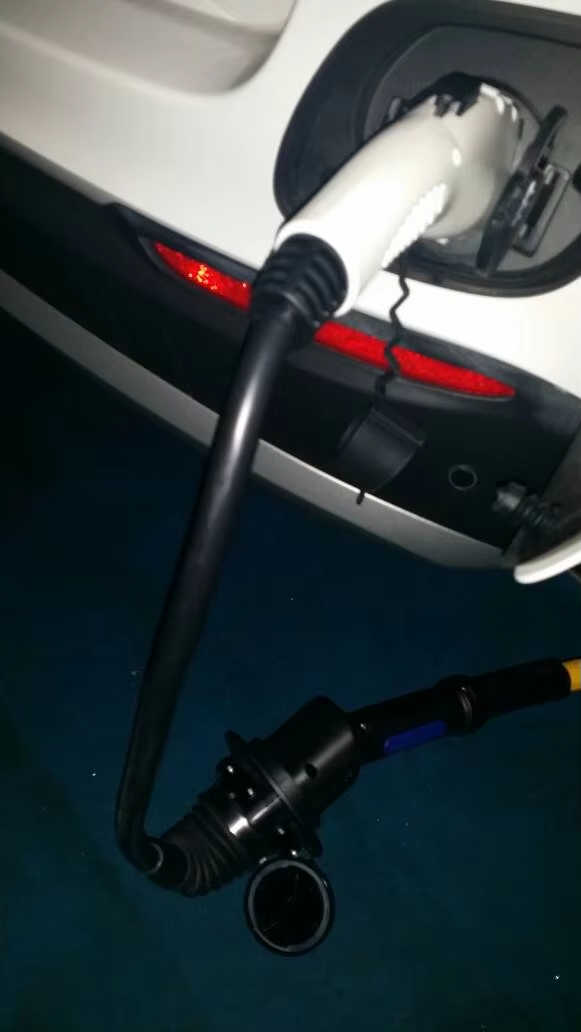
Yes, passive adapters exist that convert Type 2 to Type 1 and vice versa for AC charging only. A Type 2 (infrastructure side) to Type 1 (vehicle side) adapter is common and widely available, allowing a Type 1 vehicle (like an older Nissan Leaf) to charge from a Type 2 station. However, these adapters only pass single-phase power through, so a Type 1 vehicle will never benefit from three-phase charging speeds even when using a Type 2 station. Conversely, a Type 1 to Type 2 adapter exists but is less common. Adapters do not work for DC fast charging — CCS1 and CCS2 are not inter-adaptable with simple passive adapters. Importantly, not all adapters are created equal: uncertified adapters from unverified sources are a fire risk. Only source adapters that carry the same certifications (CE, UL, etc.) as the cables they connect.
Is Type 2 backward-compatible with Type 1?
No, they are physically incompatible without an adapter. The connector shapes, pin counts, and locking mechanisms are entirely different. A Type 1 plug will not fit into a Type 2 vehicle inlet, and vice versa. This physical incompatibility is intentional — it prevents electrical mismatches that could damage the vehicle’s onboard charger or create safety hazards.
Which standard is safer — Type 1 or Type 2?
Both standards meet rigorous safety requirements in their respective jurisdictions. Type 2 is generally considered more robust in certain respects: its electronic locking mechanism prevents removal under load (reducing arcing risk), its larger contact pins provide lower electrical resistance and less heating at equivalent currents, and its IP65-rated variants are better sealed against moisture and dust ingress. However, a properly manufactured and certified Type 1 cable is perfectly safe when used within its rated specifications. The safety of any given cable depends more on manufacturing quality and certification compliance than on the inherent superiority of one standard over the other.
Will Type 1 cables become obsolete?
Not entirely, and not quickly. Japan and South Korea remain committed Type 1 markets with no announced transition plans. Even in North America, where NACS is replacing Type 1 for new vehicles, the existing fleet of 4.5-plus million Type 1 vehicles will require replacement cables, adapters, and service parts for another 15 to 20 years. Type 1 will become a niche / legacy product rather than a growth product, but it will not disappear within any foreseeable procurement horizon. Importers should treat it as a stable, low-growth revenue stream rather than a growth driver.
Do I need different insurance for importing Type 1 vs Type 2 cables?
No, the insurance requirements do not differ by standard. What does matter is product liability insurance coverage that explicitly names EV charging equipment. Standard general liability policies often exclude or limit coverage for “electric vehicle charging equipment” or “electric vehicle supply equipment.” Importers should verify with their broker that their product liability policy covers EV charging cables and accessories, regardless of standard, and that the coverage limits are adequate for the markets they are selling into (US liability exposure being substantially higher than most other jurisdictions).
How do I verify that my supplier’s CE or UL certificates are genuine?
Every major certification body maintains a public online certificate directory. For UL, visit the UL Product iQ database and search by the UL file number printed on the cable or its packaging. For Intertek (ETL), use the Intertek Directory of Listed Products. For TUV Rheinland and TUV SUD, use their respective certificate-checking portals. For CE marking, request the Declaration of Conformity and the technical file, and verify that the listed harmonized standards (EN 61851-1, IEC 62196, etc.) match the product’s specifications and intended use. A legitimate manufacturer will provide these documents without hesitation. A manufacturer that deflects, delays, or offers excuses about “confidential” certification documents should be treated as a red flag. Certificate verification is a five-minute task that can save six figures in rejected-shipment costs.
Contact Oridy Energy for EV Charging Product Sourcing
Choosing the right charging standard for your market is not a one-time decision. It is an ongoing strategic question that shifts with regional regulations, automaker announcements, and trade dynamics. Whether you are procuring Type 1 cables for Japanese distributors, Type 2 cables for European charging networks, NACS cables for the North American transition, or GB/T equipment for emerging markets, Oridy Energy provides the sourcing expertise, quality assurance, and certification integrity that professional buyers demand.
Contact the Oridy Energy sourcing team today to discuss your market, your volumes, your certification requirements, and your timeline. One conversation can save you from the container that arrives with the wrong connector, the wrong certification, or the wrong standard for your customers’ vehicles.
Oridy Energy — Your Partner in Global EV Charging Product Sourcing.
Disclaimer: This article is provided for informational purposes only and does not constitute legal, regulatory, or certification advice. Standards, regulations, and automaker announcements referenced are subject to change. Importers and distributors should verify all requirements with the appropriate regulatory authorities and testing laboratories in their target markets before placing orders.