
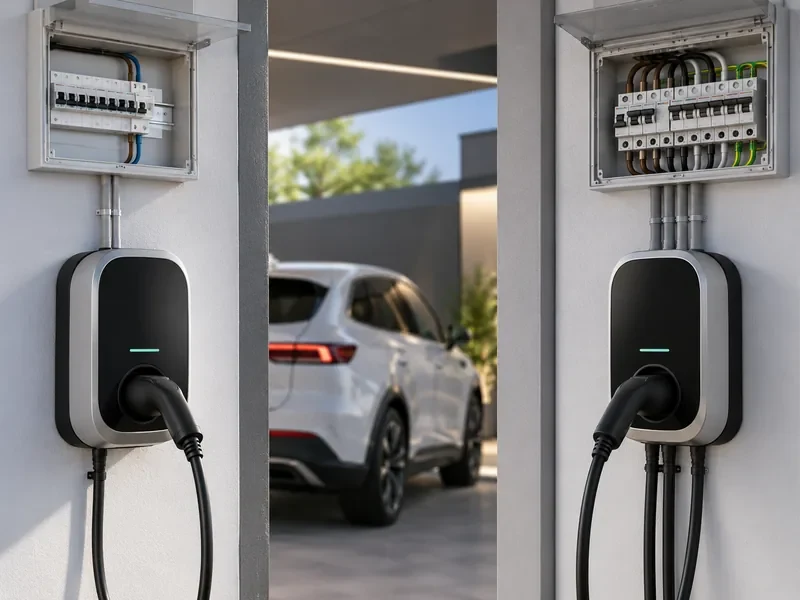
Single-Phase vs Three-Phase EV Chargers: How Installers and Buyers Should Choose
A single phase vs three phase EV charger decision should start with the site electrical supply, not with the maximum kW printed on the wallbox.
Choosing between a single-phase and three-phase EV charger is not simply a question of buying 7kW, 11kW or 22kW.
The real decision starts one level earlier:
What electrical supply is available at the site, how much current can the installation safely provide, and how much AC power can the vehicle actually accept?
A 7kW single-phase charger can be completely adequate for a residential customer who parks overnight. An 11kW three-phase charger can be a better fit for a home or workplace with three-phase supply and an EV that supports 11kW AC charging. A 22kW charger can be useful for compatible vehicles, fleet operations, workplaces or high-turnover parking—but installing 22kW hardware does not mean every EV will charge at 22kW.
For installers, distributors and project buyers, phase selection affects:
- electrical design;
- available charging power;
- cable and breaker sizing;
- distribution-board loading;
- load balancing;
- installation cost;
- vehicle compatibility;
- future expansion;
- product SKU planning.
This guide explains how to compare single-phase and three-phase AC EV charging without reducing the decision to a marketing number.
Quick Answer: Single-Phase or Three-Phase EV Charger?
For many residential installations, single-phase 7kW-class charging is enough if the customer has a suitable dedicated circuit and the vehicle supports the available AC power.
Three-phase charging becomes more attractive when:
- the site already has three-phase service;
- the EV supports 11kW or 22kW three-phase AC charging;
- the project has higher daily energy demand;
- several vehicles share the site;
- shorter dwell times matter;
- the electrical design benefits from distributing load across phases;
- the site is commercial, fleet or multi-user.
The most important rule is:
Do not choose the charger before checking the site supply and the vehicle onboard charger.
A charger can only deliver what the complete electrical path and the vehicle can use.
Why Phase Matters: The Electrical Difference
The practical reason three-phase charging can deliver more power at the same current is electrical.
For a simplified single-phase system:
Power ≈ Voltage × Current
At a common nominal 230V:
- 230V × 16A ≈ 3.7kW
- 230V × 32A ≈ 7.4kW
For a balanced three-phase system:
Power ≈ √3 × line-to-line voltage × current
At a common nominal 400V line-to-line supply:
- √3 × 400V × 16A ≈ 11kW
- √3 × 400V × 32A ≈ 22kW
These are simplified nominal calculations. Actual systems vary by local supply voltage, current setting, charger efficiency, cable conditions and vehicle behavior.
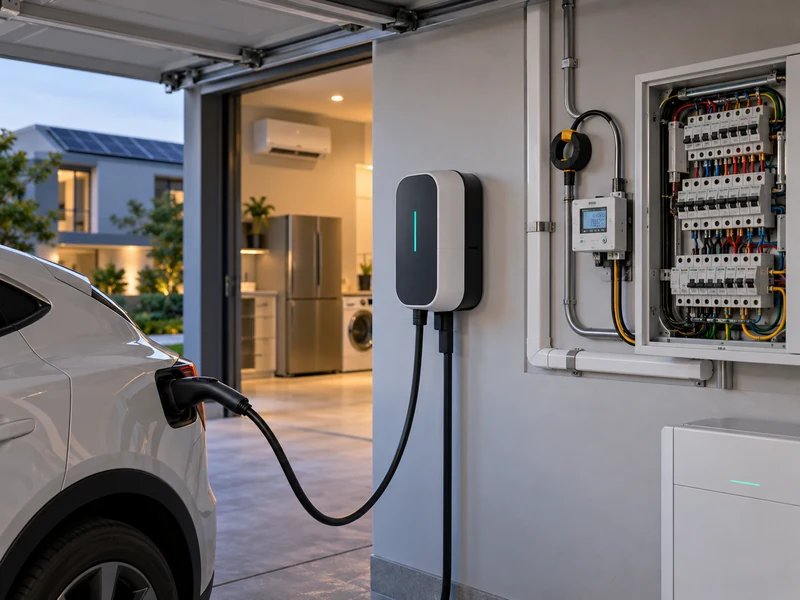
This is why the same 32A current can correspond to roughly 7.4kW on single phase or about 22kW on three phase.
However, the higher theoretical power only matters if the entire system supports it.
The Charger Is Not the Only Power Limit
One of the most common EV charging misunderstandings is:
“If I install a 22kW charger, the car will charge at 22kW.”
That is not necessarily true.
Actual AC charging power is limited by the lowest-capacity part of the complete path:
Grid/service → distribution board → breaker/cable → EV charger → charging cable/connector → vehicle onboard charger
For example:
- Site: three-phase 400V, 32A available
- Charger: 22kW three-phase
- Vehicle onboard charger: 11kW maximum AC input
Result:
The vehicle will normally charge at up to approximately 11kW, not 22kW.
Another example:
- Vehicle: supports 11kW three-phase
- Charger: 11kW
- Site: only single-phase service available
The charger cannot create three-phase supply that does not exist.
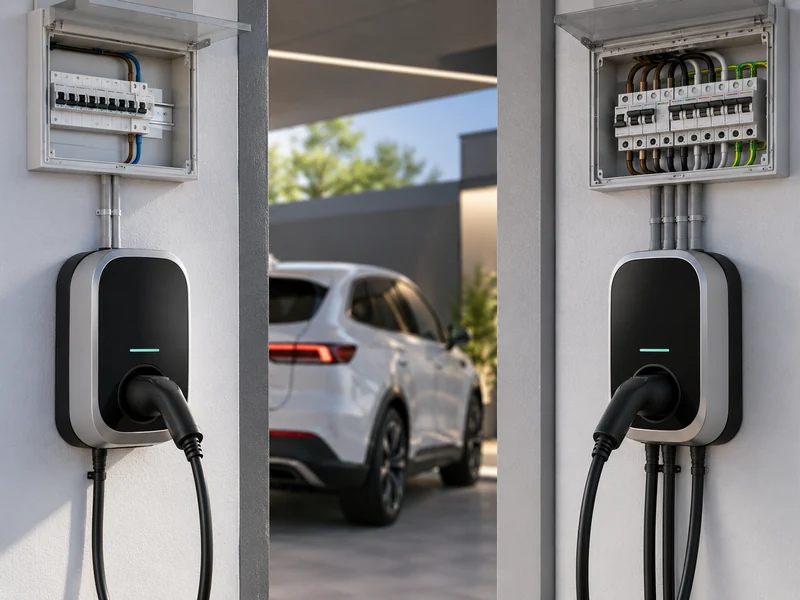
This complete-path logic should be part of every installer survey and distributor sales conversation.
What Is a Single-Phase EV Charger?
A single-phase EV charger uses a single AC phase and neutral, subject to the local electrical system and product design.
Common AC charging configurations include approximately:
- 3.6/3.7kW at around 16A;
- 7/7.4kW at around 32A.
The exact values vary with nominal voltage and product configuration.
Where single-phase charging works well
Single-phase chargers are often a strong fit for:
- detached homes;
- apartments with individual parking;
- customers who charge overnight;
- small offices;
- low-mileage fleet vehicles;
- locations without three-phase service;
- projects where electrical upgrade cost must be controlled.
A customer driving a moderate daily distance may not need 11kW or 22kW AC charging if the car is parked for eight to twelve hours overnight.
The installer should therefore ask:
How much energy does the vehicle actually need to recover during the available parking time?
That is more useful than asking only:
“Do you want the fastest charger?”
What Is a Three-Phase EV Charger?
A three-phase EV charger uses a three-phase supply and can support higher AC power at a given current when the site and vehicle are compatible.
Common European-style configurations include:
- approximately 11kW at 16A three-phase;
- approximately 22kW at 32A three-phase.
Three-phase charging is common in applications such as:
- commercial buildings;
- workplaces;
- fleet depots;
- hotels;
- public parking;
- premium residential properties;
- properties with heat pumps, solar, battery storage and multiple high-power loads.
The value is not only speed. Three-phase infrastructure can also provide more flexibility for larger sites where electrical load is distributed across several phases.
Single-Phase vs Three-Phase EV Charger Comparison
| Decision Factor | Single-Phase Charger | Three-Phase Charger |
|---|---|---|
| Typical common AC power | ~3.7kW / ~7.4kW | ~11kW / ~22kW |
| Typical current examples | 16A / 32A | 16A / 32A per phase |
| Supply requirement | Single-phase service/circuit | Three-phase service/circuit |
| Typical residential fit | Very strong | Strong where three-phase exists |
| Commercial fit | Small/light-duty sites | Stronger for higher-energy-demand sites |
| Vehicle requirement | Vehicle must support the offered single-phase AC power | Vehicle must support three-phase AC charging to use full power |
| Electrical upgrade risk | Usually lower | Can require more site work if three-phase is not already available |
| Future expansion | Suitable for many homes | Often more flexible for higher-power/multi-charger projects |
| Load-management importance | Important at constrained sites | Very important on multi-charger or high-power sites |
| Buyer mistake to avoid | Assuming 7kW is always available from any household supply | Assuming every EV will accept 11kW or 22kW |
This is a project-selection table, not a substitute for local electrical design.
7kW Single-Phase Charging: When It Is Enough
A 7kW-class charger is one of the most common residential AC charging configurations because it offers a useful balance between charging speed and installation complexity where a suitable single-phase circuit is available.
Suppose a vehicle needs 35kWh of energy overnight.
At an idealized 7kW charging rate:
35kWh ÷ 7kW ≈ 5 hours
Real charging time will be longer because charging power can vary and losses occur.
If the vehicle is parked from 7:00 PM to 7:00 AM, that charging window may be more than sufficient.
In this situation, upgrading the property to three phase only to install an 11kW charger may have poor commercial logic unless there are other reasons for the electrical upgrade.
This is why residential charger selection should be based on:
- daily energy consumption;
- parking duration;
- existing supply;
- vehicle AC charging capability;
- future vehicle plans;
- other household loads.
11kW Three-Phase Charging: A Useful Middle Ground
An 11kW charger often makes sense where:
- three-phase power is already available;
- the vehicle has an 11kW three-phase onboard charger;
- daily driving distance is higher;
- shorter overnight charging is useful;
- the site may later add another charger;
- the building has enough spare capacity.
For many modern EVs that support three-phase AC charging, 11kW is a practical upper residential charging level.
But buyers should still verify the exact vehicle.
Some EVs may accept:
- only single-phase AC;
- a lower AC power than the charger rating;
- 11kW but not 22kW;
- different AC capability depending on market version.
A distributor should avoid promising a fixed charging speed for a charger without knowing the customer’s vehicle.
22kW Three-Phase Charging: Where It Makes Sense
A 22kW charger can be commercially attractive when the site has suitable three-phase capacity and the application benefits from higher AC power.
Potential use cases include:
- destination charging with shorter dwell time;
- car dealerships;
- fleet depots;
- hotels;
- workplaces;
- commercial parking;
- municipal facilities;
- properties serving vehicles with 22kW onboard chargers.
However, many EVs do not accept 22kW AC.
For those vehicles, a 22kW charger may function but the vehicle will charge at a lower rate.
The value of a 22kW charger may therefore come from:
- serving a mixed fleet;
- future-proofing infrastructure;
- supporting vehicles with higher AC capability;
- reducing charge time where compatible;
- standardizing hardware across a commercial portfolio.
The business case should be based on vehicle mix and site utilization, not just the maximum number printed on the charger.
Vehicle Onboard Charger: The Specification Buyers Often Miss
The vehicle onboard charger, or OBC, converts incoming AC power into DC power for the traction battery.
It determines how much AC charging power the vehicle can accept.
This means the charger and vehicle interact differently from a DC fast charger.
For AC charging:
EVSE provides the controlled AC supply → vehicle onboard charger performs AC-to-DC conversion
If a vehicle onboard charger is limited to 7kW single phase, connecting it to an 11kW or 22kW three-phase AC charger does not upgrade the vehicle’s internal charger.
Before recommending a charger, ask:
- vehicle make and model;
- model year;
- market version;
- maximum AC charging power;
- single-phase or three-phase AC support;
- connector type.
For a fleet, request a vehicle list rather than checking only one representative car.
Type 2 and Three-Phase AC Charging
Type 2 is widely associated with single-phase and three-phase AC charging in many markets.
IEC 62196-2 covers standardized AC plug, socket-outlet, vehicle connector and vehicle inlet configurations for EV charging. The current IEC 62196-2:2025 edition applies to accessories up to 480V AC and includes ratings up to 63A three phase or 70A single phase.
However, the presence of a Type 2 connector does not mean the vehicle necessarily supports the maximum three-phase charging power.
Connector compatibility and power capability are separate checks.
An installer or distributor should verify:
- physical connector compatibility;
- cable current rating;
- number of phases actually used;
- vehicle onboard charger limit;
- charger configuration.
Electrical Site Survey: What Installers Should Check
Before recommending single-phase or three-phase charging, the installer should inspect the site.
1. Supply type
Confirm:
- single phase or three phase;
- nominal voltage;
- main service rating;
- earthing arrangement;
- available distribution-board space.
2. Existing peak load
Look at significant loads such as:
- air conditioning;
- electric water heating;
- electric cooking;
- heat pumps;
- pool pumps;
- industrial machinery;
- lifts;
- battery storage;
- solar inverters;
- other EV chargers.
3. Spare capacity
A property can have three-phase supply and still lack enough spare capacity for a 22kW charger.
Likewise, a single-phase property can have enough capacity for 7kW charging only under specific load conditions.
4. Cable route
Confirm:
- cable length;
- installation method;
- conductor sizing;
- voltage drop;
- ambient temperature;
- grouping;
- mechanical protection;
- trenching or civil work.
5. Protection requirements
The charger circuit must be designed according to:
- product instructions;
- local electrical regulations;
- required overcurrent protection;
- residual-current protection architecture;
- isolation requirements;
- surge protection requirements where applicable.
IEC 61851-1 provides general requirements for EV supply equipment, but the installation still has to comply with destination-specific regulations.
Dynamic Load Management Can Change the Decision
Sometimes the site does not have enough spare capacity to run a high-power charger continuously.
That does not automatically mean the project must use a smaller charger.
A smart charger with dynamic load management may reduce charging current when building demand rises and increase it again when capacity becomes available.
Example:
- Site service has limited spare capacity during dinner hours.
- EV arrives at 6 PM.
- Cooker, air conditioning and water heating are running.
- Charger temporarily limits power.
- Household demand falls after 10 PM.
- Charger increases available charging current overnight.
This can allow higher-rated hardware without exceeding site limits.
For multi-charger sites, load management becomes even more important.
A workplace may install ten 22kW chargers but deliberately limit total EV charging to a much lower site capacity, distributing available power across connected vehicles.
Therefore:
Charger nameplate power ≠ required simultaneous site load.
The project control strategy matters.
Project Checkpoint: What Should the Buyer Confirm Before Choosing the Phase?
Before moving from a charger catalogue to a quotation, confirm five project facts:
- What electrical supply is actually available at the site? Do not assume three-phase because the building is commercial or assume single-phase because the project is residential.
- What AC charging power can the target vehicles accept? A three-phase wallbox cannot force a vehicle with a lower onboard AC charger limit to charge faster.
- What is the available spare capacity after normal building loads are considered? The main service rating alone is not the same as available EV charging capacity.
- How long do vehicles normally remain parked? A lower-power charger can be commercially sufficient when dwell time is long.
- Will the project grow from one charger to several? A multi-charger project should consider phase allocation, dynamic load management and future feeder capacity from the beginning.
If you are sourcing AC chargers for a specific market, send ORIDY ENERGY the destination country, site phase, target charging power, vehicle mix and expected quantity. That information makes the supplier comparison much more useful than asking only for “7kW / 11kW / 22kW price.”
Website: https://oridy.net/
Contact: https://oridy.net/contact-us/
WhatsApp: https://wa.me/8618217811889
Multiple EV Chargers: Phase Balance Matters
For commercial projects, buying several single-phase chargers can create phase-imbalance problems if they are not distributed correctly.
Example:
A site installs six 7kW single-phase chargers.
If all six are connected to the same phase, the result is very different from distributing them appropriately across a three-phase system.
Project design should consider:
- phase allocation;
- simultaneous charging;
- maximum demand;
- diversity;
- load balancing;
- charger communication;
- expansion.
In some commercial projects, three-phase chargers simplify the product portfolio.
In others, several single-phase chargers distributed across phases provide a cost-effective solution.
There is no universal answer.
Residential Projects: Questions to Ask Before Recommending Three Phase
For a residential buyer, do not recommend a three-phase charger just because the property has three-phase service.
Ask:
- Does the vehicle support three-phase AC charging?
- How much does the customer drive each day?
- How many hours is the vehicle parked overnight?
- Is another EV likely in the next three years?
- Is solar already installed?
- Is home battery storage planned?
- Are there high household loads such as heat pump or electric heating?
- Is dynamic load balancing needed?
- Does the customer expect to change to a vehicle with higher AC charging capability?
The correct decision may still be a 7kW single-phase charger.
Or the site may justify 11kW three-phase.
The value comes from matching the customer, not automatically maximizing power.
Commercial and Fleet Projects: Different Questions
Commercial buyers often have a different objective.
They may care about:
- number of vehicles served per day;
- arrival time;
- departure time;
- average energy required per vehicle;
- simultaneous connected vehicles;
- employee vs public use;
- RFID;
- billing;
- OCPP;
- backend integration;
- dynamic load management;
- solar integration;
- energy tariffs;
- future charger count.
A fleet with vehicles parked for twelve hours may not need maximum charging speed.
A fleet with two-hour turnaround may.
For this reason, charger phase should be evaluated together with dwell time and energy throughput.
Charging-Time Example: Why Dwell Time Matters
Consider an EV that needs 44kWh added before departure.
At approximately 7.4kW
Idealized time:
44 ÷ 7.4 ≈ 5.9 hours
At 11kW
Idealized time:
44 ÷ 11 ≈ 4 hours
At 22kW
Idealized time:
44 ÷ 22 ≈ 2 hours
But the 22kW result is only possible if:
- site can deliver it;
- charger is configured for it;
- cable supports it;
- vehicle can accept 22kW AC.
If the vehicle is limited to 11kW AC, the 22kW charger does not reduce the charging time to two hours.
That is the difference between charger rating and actual system performance.
Installation Cost: Phase Is Only One Part
A three-phase charger is not automatically much more expensive to install.
The installation cost depends on the whole site.
Potential cost items include:
- charger hardware;
- cable size and length;
- breaker/protection;
- distribution-board changes;
- trenching;
- conduit;
- wall mounting or pedestal;
- three-phase service upgrade;
- smart meter/load management;
- networking;
- commissioning.
If three-phase service is already available close to the parking location, an 11kW charger may be straightforward.
If the property needs a major service upgrade, the economics can be very different.
The supplier can provide charger pricing.
The installer must evaluate site cost.
Distributors: Do Not Create Too Many SKUs Too Early
A distributor entering EV charging may be tempted to stock:
- 3.6kW single phase;
- 7kW single phase;
- 11kW three phase;
- 22kW three phase;
- Type 1;
- Type 2;
- tethered;
- socketed;
- RFID;
- app;
- OCPP;
- multiple cable lengths.
That quickly becomes a large inventory.
A better approach is to define the target market.
For example:
Residential-focused distributor
Core demand may be:
- 7kW single-phase;
- Type 2;
- home load balancing;
- Wi-Fi/app;
- tethered or socketed based on market preference.
Installer serving premium homes and SMEs
Core range may be:
- 7kW single-phase;
- 11kW three-phase;
- smart load management;
- optional RFID/OCPP.
Commercial/fleet integrator
The priority may shift toward:
- 11kW / 22kW three-phase;
- OCPP;
- RFID;
- backend compatibility;
- load management;
- pedestal options;
- multiple-user access.
The right product range should follow customer projects, not catalogue size.
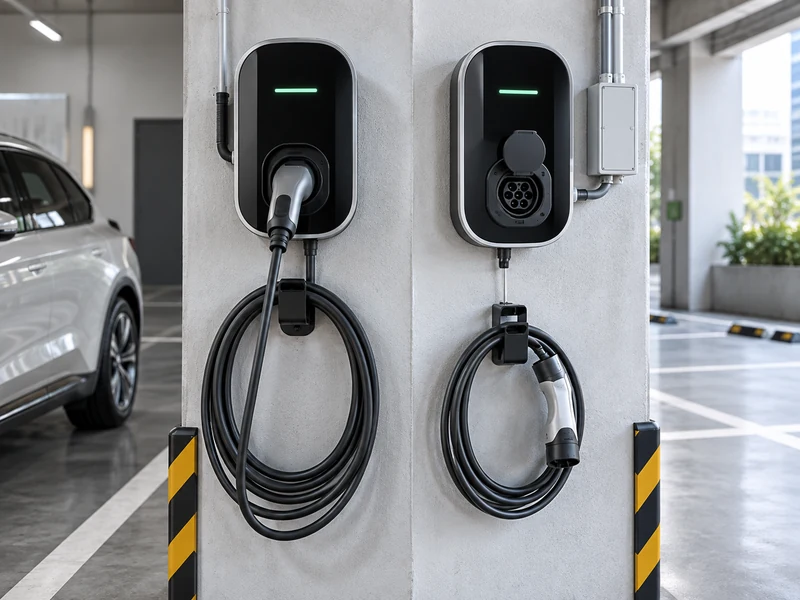
What Distributors Should Ask an EV Charger Supplier
Before comparing quotations, request a structured specification.
Electrical
- rated input voltage;
- frequency;
- single/three phase;
- rated current;
- adjustable-current options;
- rated output power;
- standby consumption where relevant.
Vehicle connection
- Type 1 / Type 2;
- tethered or socketed;
- cable length;
- cable current rating.
Protection
- overcurrent;
- over/under-voltage;
- residual-current protection architecture;
- over-temperature protection;
- surge protection if integrated;
- ground/earth monitoring where applicable.
Smart functions
- Wi-Fi;
- Ethernet;
- 4G;
- Bluetooth;
- RFID;
- OCPP version;
- dynamic load balancing;
- scheduled charging;
- solar-surplus mode.
Mechanical
- IP rating;
- IK rating where specified;
- operating temperature;
- dimensions;
- mounting method;
- pedestal option.
Documentation
Request model-level documents for the destination market.
Do not accept:
“All our chargers have CE / IEC / UL.”
Instead ask:
- Which exact model?
- Which exact standard?
- Which test report/certificate?
- Which rated power?
- Which connector/cable variant?
- Which destination market does this document support?
Commercial
- sample price;
- MOQ;
- private label;
- packaging MOQ;
- production lead time;
- spare parts;
- warranty;
- after-sales process;
- trade term;
- freight.
Certification and Standards: Keep the Claim Specific
For AC EV charging equipment, IEC 61851-1:2017 is a key general reference for conductive EV supply equipment. IEC 62196-2:2022 covers standardized AC plugs, socket-outlets, vehicle connectors and inlets. These references do not prove that a quoted charger is compliant; buyers should verify the exact model, rating, configuration and documentation scope.
EV charging standards cover different parts of the system.
For example:
- IEC 61851-1 covers general requirements for EV supply equipment.
- IEC 62196-2 covers dimensional requirements for standardized AC EV plugs, socket-outlets, vehicle connectors and vehicle inlets.
These standards do not mean one charger is automatically approved for every market.
A project may also have destination-specific:
- electrical installation rules;
- grid requirements;
- safety conformity;
- EMC requirements;
- national plug/socket rules;
- product registration.
For sourcing, the correct process is:
Market → exact model → exact configuration → required documents → verification
not:
Brand → one certificate → assume every SKU is covered
Common Selection Mistakes
Mistake 1: Choosing three phase before checking the vehicle
The site may support 22kW while the EV accepts only 7kW or 11kW AC.
Mistake 2: Choosing 7kW without checking the main supply
A 32A charger circuit can be a significant residential load.
Mistake 3: Treating 22kW as automatically “future-proof”
Future-proofing is useful only if the site architecture, vehicle mix and commercial use justify the additional capacity.
Mistake 4: Ignoring load management
The most valuable upgrade may be smarter control, not more charger kW.
Mistake 5: Comparing charger hardware prices without installation cost
A cheaper 22kW charger can create a more expensive project than a properly selected 7kW or 11kW unit.
Mistake 6: Confusing connector type with charging power
Type 2 does not automatically mean 22kW.
Mistake 7: Assuming commercial projects need maximum power
Many workplace vehicles remain parked for eight hours.
The project may gain more value from more charging points at controlled power than fewer chargers at maximum power.
A Practical Project Selection Matrix
| Project | First option to evaluate | Why |
|---|---|---|
| Apartment / small home, single-phase supply | 3.6–7kW single phase | Usually sufficient for overnight charging |
| Detached home with suitable 32A circuit | 7kW single phase | Strong balance of speed and cost |
| Home with three-phase supply + 11kW-capable EV | 11kW three phase | Faster AC charging without going to 22kW |
| Premium residence with multiple EVs | 11/22kW + load management | Future load and concurrency matter |
| Small office | 7/11kW depending supply | Dwell time is usually long |
| Workplace with many bays | Three-phase infrastructure + load management | Site capacity should be shared intelligently |
| Fleet with overnight dwell | 7/11kW may be enough | Energy requirement matters more than maximum charger rating |
| Fleet with high daily mileage / short turnaround | 11/22kW where vehicles support it | Higher throughput can have operational value |
| Hotel / destination charging | 7/11/22kW based on dwell time | Customer parking duration should drive selection |
RFQ Information to Send Before Asking for Price
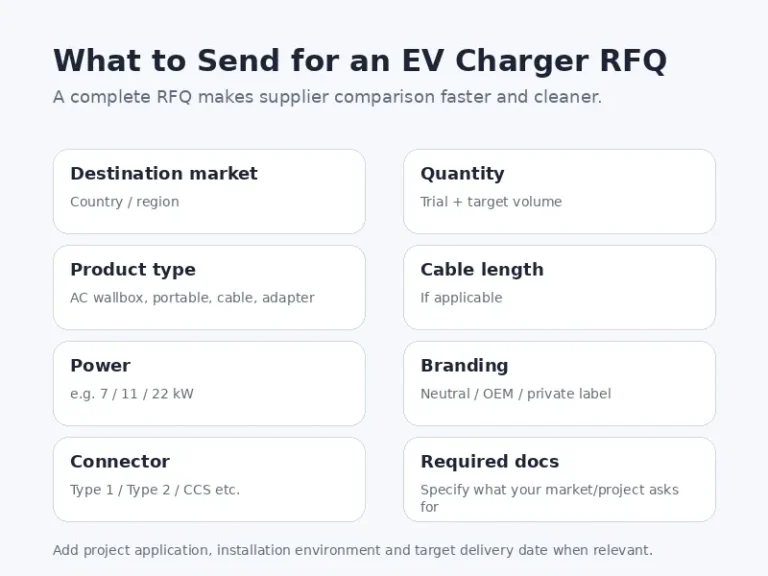
If you are asking a supplier for a charger recommendation, send:
Country:
Project type: Residential / workplace / fleet / public parking / hotel
Site supply: Single phase / three phase
Nominal voltage:
Available current:
Vehicle models:
Vehicle maximum AC charging power:
Required charger quantity:
Preferred power: 7kW / 11kW / 22kW / supplier recommendation
Connector: Type 1 / Type 2
Tethered or socketed:
Cable length:
Load balancing: Yes / No / need recommendation
OCPP: Required / not required
RFID: Required / not required
Mounting: Wall / pedestal
Certification/document requirements:
Branding: Neutral / OEM
Trade term: EXW / FOB / CIF / DDP
Destination: Port / city / postcode
This turns the conversation from:
“Send me your 22kW price.”
into:
“Quote the configuration that fits my project.”
How ORIDY ENERGY Approaches EV Charger Matching
ORIDY ENERGY works as a China-side renewable-energy supply-chain and sourcing contact.
For EV charger projects, the useful first step is to understand the application before comparing products.
If you send:
- destination country;
- site phase;
- available electrical capacity;
- vehicle type;
- expected charger power;
- quantity;
- smart-function requirements;
- installation type;
- required documentation;
the available supply options can be narrowed more efficiently.
For a project where phase is still uncertain, the first question is usually not which charger brand to buy.
It is:
What is the electrical architecture of the site, and what charging power will create real value for the customer?
Need help selecting 7kW, 11kW or 22kW EV chargers for a residential, workplace or fleet project?
Send ORIDY ENERGY your country + site phase + vehicle AC charging limit + quantity + application so the configuration can be checked before quotation.
FAQ
Can a three-phase EV charger work on a single-phase supply?
That depends on the exact charger design. Some models may support more than one input configuration, while others are designed specifically for three-phase supply. Never assume compatibility. Check the exact wiring diagram and manufacturer documentation.
Can an 11kW charger charge a car that only supports 7kW AC?
Yes in many cases if the connector and charging protocol are compatible, but the vehicle will normally limit the actual charging power to what its onboard charger can accept.
Does a 22kW charger always need 32A three-phase supply?
A common nominal 22kW three-phase configuration is around 32A per phase at 400V, but the exact requirement depends on local voltage and charger design. Use the product manual and local electrical calculations.
Is 11kW better than 7kW for home charging?
Not automatically. If the customer has single-phase supply, long overnight dwell time or a vehicle with limited AC charging capability, 7kW may already meet the requirement.
Is three-phase charging more efficient?
Not necessarily in a way that should be generalized. Efficiency depends on the charger, vehicle onboard charger, operating point and electrical system. The clear advantage of three phase is access to higher AC power at a given current and better integration into suitable three-phase sites.
Should a workplace use 22kW chargers?
Maybe, but first calculate vehicle dwell time, energy required, number of simultaneous users and site capacity. Ten load-managed 11kW chargers can be more useful than a smaller number of 22kW units in some projects.
What is the main difference between 11kW and 22kW three-phase charging?
A common 11kW configuration uses around 16A per phase, while a common 22kW configuration uses around 32A per phase at 400V. The vehicle must support the relevant AC power to benefit from it.
What should a distributor stock first?
Stock should follow the target customer base. Residential markets may justify 7kW single-phase as a core SKU, while commercial installers may need 11kW and 22kW three-phase products with load management and OCPP.
Final Decision Framework
Use this sequence:
- Confirm destination market and electrical standard.
- Confirm single-phase or three-phase site supply.
- Check available service capacity.
- Check vehicle onboard charger capability.
- Estimate daily energy requirement and dwell time.
- Choose charger power.
- Decide whether dynamic load management is needed.
- Confirm connector, cable and smart functions.
- Verify exact model-level documentation.
- Compare complete installed/project cost rather than charger price alone.
Single-phase and three-phase EV charging are not competing technologies where one is universally better.
They are different tools for different electrical environments.
For many homes, a well-designed 7kW single-phase installation is completely sufficient. For sites with three-phase supply, higher daily energy demand, multiple vehicles or commercial requirements, 11kW or 22kW three-phase charging can provide a stronger system architecture.
The correct charger is the one that matches the site, vehicle and use case at the same time.
Need Help Comparing AC EV Charger Options?
If you are selecting EV chargers for distribution, installation or project supply, send ORIDY ENERGY your target market, charging power, single-phase or three-phase requirement, connector standard, mounting preference, quantity and certification/documentation needs.
ORIDY ENERGY works as a China-side renewable-energy sourcing and supply-chain partner and can help compare suitable EV charging options for different project requirements.
Website: https://oridy.net/
Contact: https://oridy.net/contact-us/
WhatsApp: https://wa.me/8618217811889
One Comment
Comments are closed.