
Wall-Mounted vs Rack-Mounted Battery: Installer and Distributor Guide
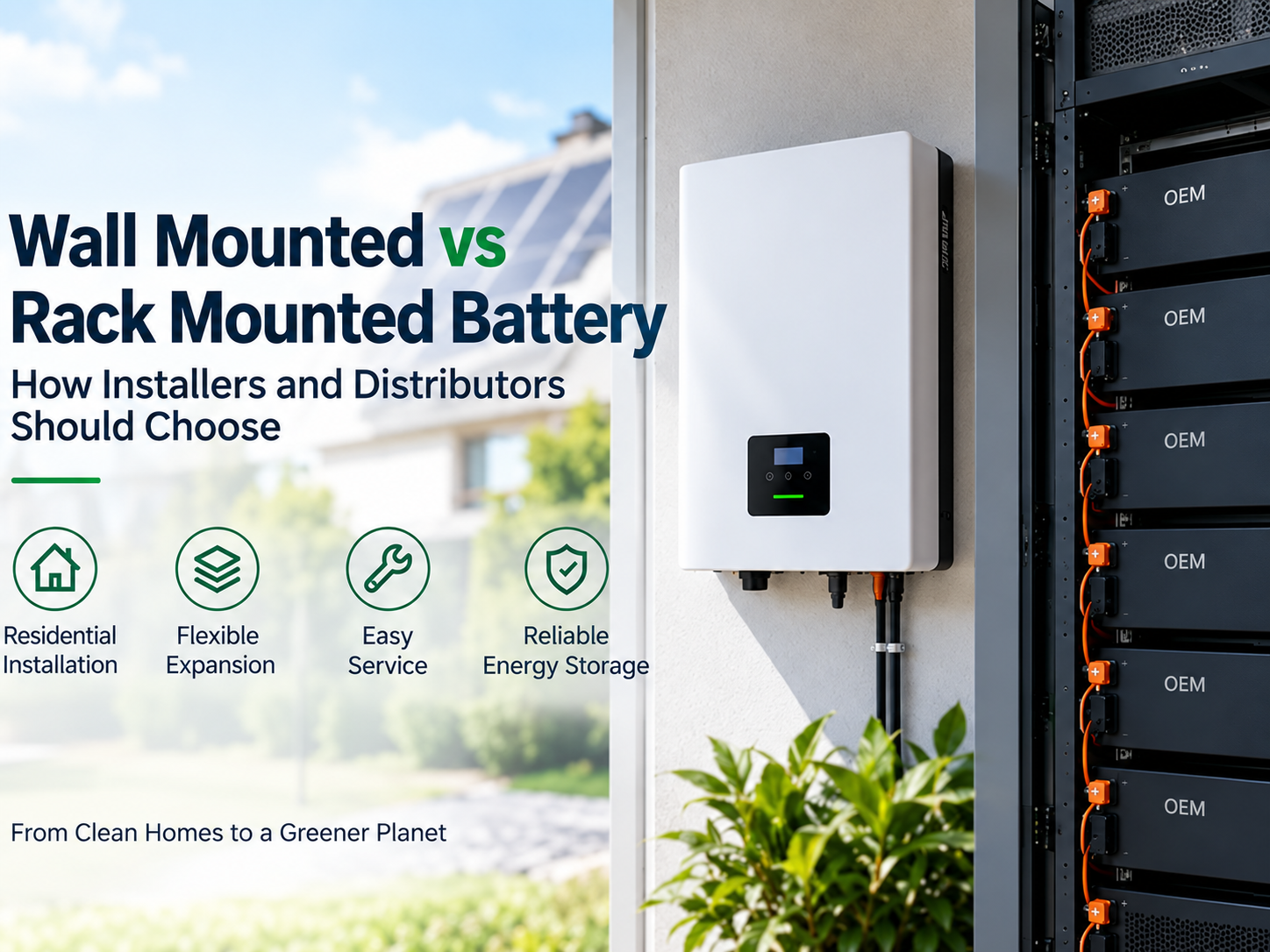
Wall Mounted vs Rack Mounted Battery: How Installers and Distributors Should Choose
A wall mounted vs rack mounted battery decision should not begin with appearance. For a residential energy storage project, the enclosure format changes how the battery is installed, expanded, serviced, transported and stocked—but it does not by itself determine battery quality, safety, usable power or cycle life.
A wall-mounted LiFePO4 battery can be an excellent solution for a finished residential garage or utility area where floor space is limited and the customer wants a clean installation. A rack-mounted battery can be more practical when several modules need to be organized in one cabinet, capacity is likely to grow, or installers need predictable module-level service access.
For distributors and EPC contractors, the decision also affects inventory strategy. A visually finished wall battery may be easier to sell as a complete residential product, while standardized rack modules can make capacity combinations and replacement stock easier to manage.
The correct choice therefore depends on the complete project architecture: available space, structural support, required capacity, inverter power, discharge current, BMS communication, future expansion, service method and destination-market requirements.
Wall Mounted vs Rack Mounted Battery: The Short Answer
| Decision Factor | Wall-Mounted Battery | Rack-Mounted Battery |
|---|---|---|
| Typical application | Residential homes, garages, finished utility areas | Utility rooms, battery cabinets, modular residential or small commercial systems |
| Floor-space use | Preserves usable floor area | Requires cabinet or rack footprint |
| Visual integration | Usually cleaner for visible residential installations | More equipment-oriented |
| Expansion | Depends on wall area and approved parallel architecture | Often convenient for organizing multiple modules |
| Service access | Depends strongly on enclosure and mounting position | Individual rack modules can be easier to identify and replace |
| Handling | Heavy unit may require two-person lifting or mechanical assistance | Smaller modules can distribute total system weight |
| Accessories | Wall bracket and mounting hardware | Rack, cabinet, shelves, busbars and interconnection accessories may be required |
| Electrical quality | Must be evaluated separately from enclosure style | |
The key point: choose the form factor around the installation and service strategy, then evaluate electrical capability separately.
What Actually Changes When You Choose the Battery Enclosure?
Two 10kWh LiFePO4 batteries can look completely different but perform similarly—or look almost identical while having very different electrical limits.
The enclosure format affects mainly:
- mounting method;
- space utilization;
- weight distribution;
- cable routing;
- physical expansion;
- module access;
- shipping volume;
- installer workflow;
- customer-facing appearance.
It does not automatically determine:
- cell quality;
- usable capacity;
- continuous discharge current;
- cycle life;
- BMS capability;
- thermal performance;
- inverter compatibility;
- safety certification.
This distinction matters because buyers sometimes compare a premium-looking wall battery with a simple rack module and assume the wall unit is technically superior. The enclosure can improve installation experience, but the real technical comparison still comes from the datasheet, BMS architecture, cell specification and test documentation.
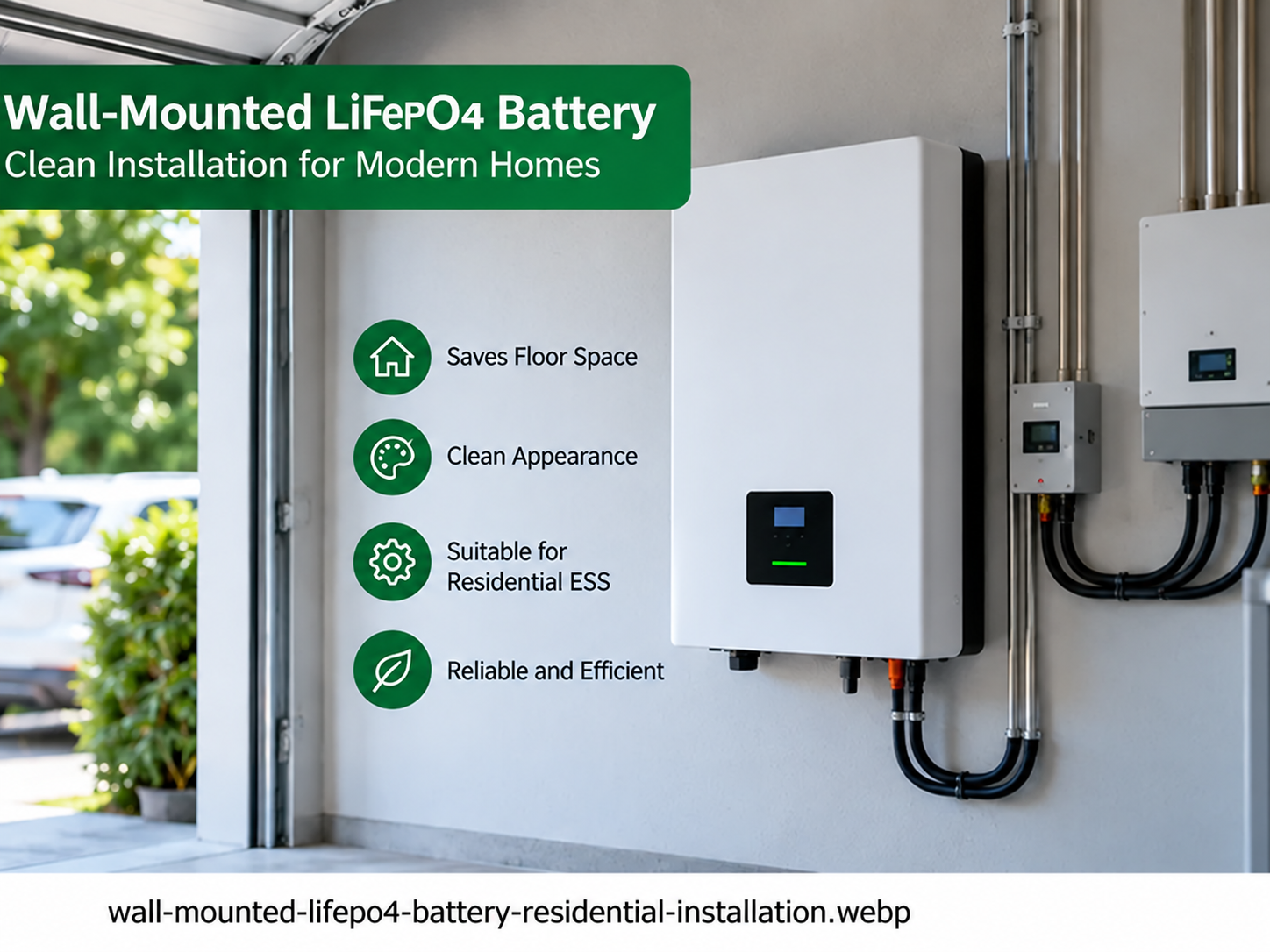
When Does a Wall-Mounted LiFePO4 Battery Make Sense?
A wall-mounted battery is often most attractive when the battery is part of the visible residential installation rather than hidden inside a dedicated equipment room.
Typical use cases include:
- home solar-plus-storage systems;
- garage installations;
- small utility rooms;
- apartments or villas where floor space matters;
- retrofit projects with one or two battery modules;
- installations where customers care strongly about appearance.
1. Floor space is limited
A wall-mounted battery keeps the floor clear and can make a small utility area easier to use.
This is particularly useful where the battery shares space with:
- hybrid inverter;
- distribution board;
- water heater;
- vehicle parking;
- household storage;
- other mechanical equipment.
However, saving floor area does not mean the wall installation is mechanically simple.
The installer still needs to confirm:
- wall construction;
- battery weight;
- mounting-point requirements;
- manufacturer-approved bracket;
- required fixing hardware;
- clearance around the battery;
- cable-entry direction;
- service access.
A 50–100kg battery is not a decorative wall appliance. The mounting surface and fixing system must support the actual equipment according to the manufacturer’s instructions and applicable local installation requirements.
2. The customer wants a finished residential appearance
Wall-mounted batteries are often designed as complete consumer-facing products.
The enclosure may hide:
- busbars;
- cell compression structure;
- BMS electronics;
- internal cabling;
- fuse or protection components;
- communication interfaces.
This can give installers a cleaner final result.
For distributors, appearance can also affect sales. Homeowners purchasing an energy storage system may see the battery every day, so enclosure finish, display design, cable concealment and wall integration can influence perceived product quality.
3. The system will remain relatively compact
Wall-mounted batteries work particularly well where one or two modules provide enough capacity.
For example:
- 5.12kWh starter system;
- 10.24kWh residential system using two compatible modules;
- small backup system;
- solar self-consumption installation.
As the system grows, however, physical wall area and cable management can become limiting factors.
Where Wall-Mounted Batteries Become Less Convenient
The main limitation is usually not electrical—it is physical scaling.
Suppose a customer initially installs one 5.12kWh wall battery and later wants 20.48kWh.
Four battery modules now require:
- four suitable mounting positions;
- consistent cable lengths where required;
- approved parallel connections;
- communication wiring;
- adequate spacing;
- access to every module;
- larger DC protection or busbar architecture where applicable.
A wall installation that looked elegant at 5kWh can become crowded at 20kWh.
This is one reason installers should ask about future capacity before selecting the physical format.
When Is a Rack-Mounted Battery More Practical?
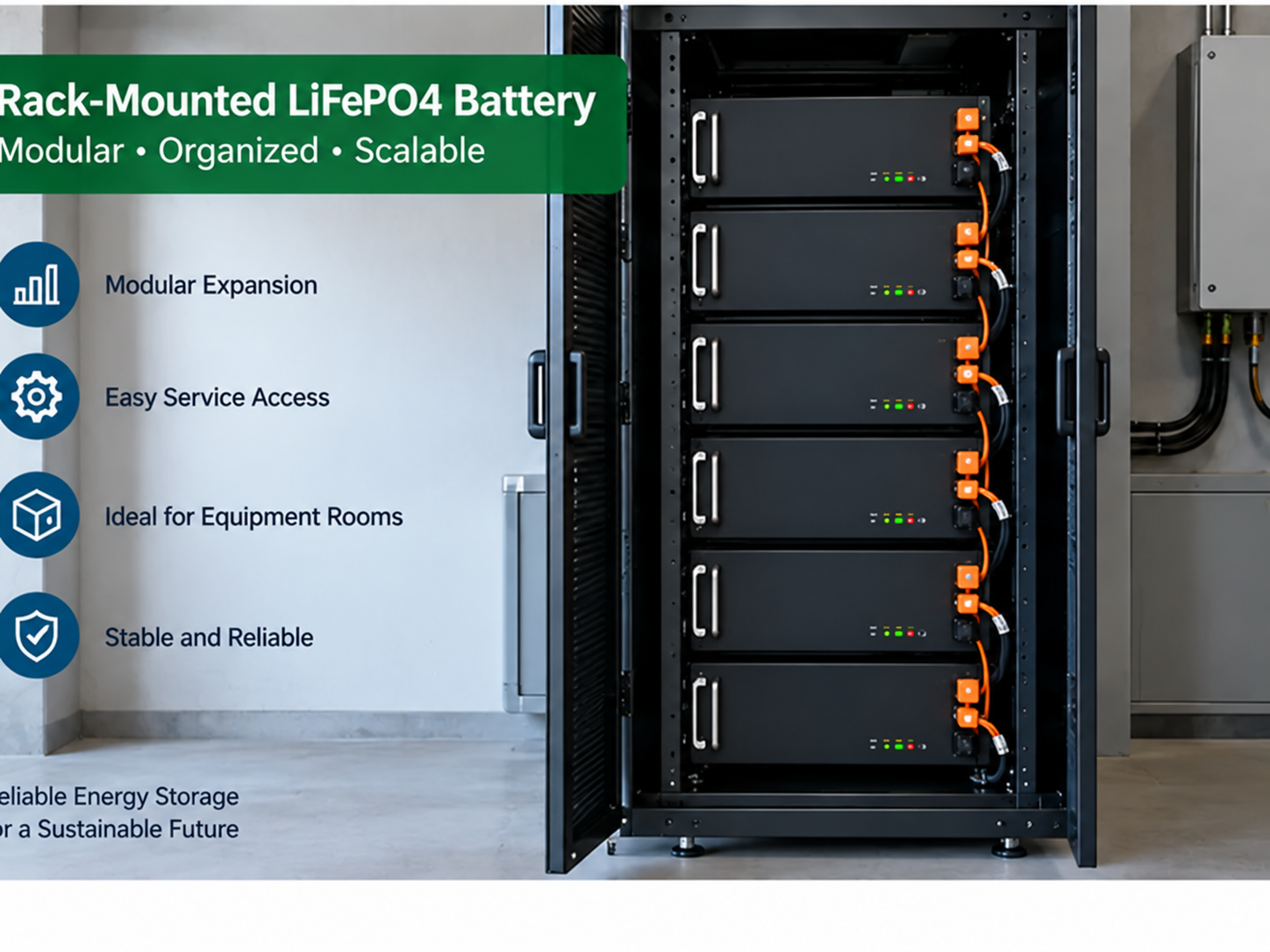
Rack-mounted LiFePO4 batteries are designed around standardized module organization rather than finished wall presentation.
They are commonly used in:
- battery cabinets;
- equipment rooms;
- telecom applications;
- UPS systems;
- residential ESS requiring several modules;
- small commercial storage systems;
- projects where modular service is important.
IEC 62620 specifically covers secondary lithium cells and batteries for industrial applications, including stationary energy storage systems and UPS applications. IEC 62619:2022 addresses safety requirements for secondary lithium cells and batteries used in industrial and stationary applications. Buyers should verify whether the exact quoted battery and its documentation are relevant to the destination application rather than treating an IEC standard number as a generic marketing claim.
Official references:
- IEC 62619:2022 — Safety requirements for industrial secondary lithium cells and batteries
- IEC 62620:2014+AMD1:2023 — Industrial secondary lithium cells and batteries
1. Modular capacity is easier to organize
A rack can provide defined positions for several modules.
Instead of finding four separate wall locations, an installer may organize multiple batteries vertically inside one cabinet.
For example:
| Module Size | Number of Modules | Nominal System Energy |
|---|---|---|
| 5.12kWh | 1 | 5.12kWh |
| 5.12kWh | 2 | 10.24kWh |
| 5.12kWh | 3 | 15.36kWh |
| 5.12kWh | 4 | 20.48kWh |
These calculations describe stored nominal energy only. The actual permitted module count, usable energy and system current must be confirmed from the specific battery architecture.
2. Module-level service can be easier
If a rack contains several independent battery modules, technicians can often identify individual module serial numbers, BMS status and communication addresses more easily.
Depending on the product design, this can simplify:
- fault isolation;
- module replacement;
- firmware management;
- inventory of spare modules;
- capacity expansion.
But this advantage only exists when the manufacturer provides a documented service procedure.
Do not assume every rack battery can be removed or replaced while the remaining system remains operational.
3. Equipment-room installations become more organized
For EPC contractors and professional installers, a battery rack can keep:
- modules;
- communication wiring;
- DC busbars;
- fuses;
- breakers;
- cable routing;
- labels;
- service clearances
within one equipment zone.
This can be valuable in utility rooms and commercial technical spaces where appearance is less important than organization.
Rack-Mounted Does Not Mean “Put Any Battery in Any Rack”
This is an important sourcing mistake.
A battery described as “rack mounted” is not automatically compatible with every 19-inch cabinet or server rack.
Before ordering, confirm:
- module width;
- module height;
- module depth;
- net weight;
- rack load rating;
- shelf or rail requirement;
- front/rear cable clearance;
- airflow requirement;
- connector position;
- DC breaker access;
- communication cable access.
A communications rack designed for switches and servers is not automatically suitable for hundreds of kilograms of battery equipment.
Floor loading also becomes important as battery count increases.
Do Not Compare Battery Formats Before Comparing Power Capability
The physical enclosure is only one layer of the decision.
For most lithium battery projects, the more important electrical questions are:
- nominal voltage;
- operating voltage range;
- usable energy;
- continuous charge current;
- continuous discharge current;
- peak current and duration;
- maximum parallel modules;
- BMS communication;
- inverter compatibility.
For example, consider two nominal 5.12kWh batteries:
| Battery | Nominal Voltage | Capacity | Continuous Discharge Current | Approx. Nominal DC Power |
|---|---|---|---|---|
| Battery A | 51.2V | 100Ah | 100A | ≈ 5.12kW |
| Battery B | 51.2V | 100Ah | 200A | ≈ 10.24kW |
Both batteries store approximately the same nominal energy.
But Battery B can theoretically support approximately twice the nominal DC power if the 200A continuous rating is genuine and the rest of the battery system supports it.
This difference has nothing to do with whether the battery hangs on a wall or sits in a rack.
For a deeper explanation, see ORIDY’s guide to how battery discharge current limits inverter power.
Battery and Inverter Compatibility Comes Before Enclosure Style
A beautifully designed wall battery is useless if it cannot communicate correctly with the inverter.
A modular rack system is equally problematic if its operating voltage or current limit does not match the inverter.
Compatibility should be checked at several levels.
Electrical compatibility
Verify:
- nominal voltage;
- minimum battery voltage;
- maximum charge voltage;
- inverter battery operating range;
- maximum charge current;
- maximum discharge current.
Communication compatibility
CAN and RS485 describe communication interfaces, but they do not guarantee that two products understand each other.
Check:
- BMS protocol;
- CAN IDs or register mapping;
- cable pinout;
- inverter battery profile;
- firmware version;
- master/slave configuration.
ORIDY has a dedicated guide explaining how to check battery and inverter compatibility.
Wall-Mounted vs Rack-Mounted Battery Expansion
Expansion is one of the areas where buyers should go beyond brochure language.
A specification saying:
“Supports up to 16 batteries in parallel.”
does not answer every engineering question.
Ask:
- Is the limit electrical or communication-related?
- Does every module need the same firmware?
- Does one module act as master?
- Is an external communication hub required?
- Are equal-length DC cables required?
- Is an external busbar required above a certain module count?
- What is the maximum system current?
- Can older and newer batteries be mixed?
- What SOC matching procedure is required before adding a module?
For distributors, these questions affect future after-sales support.
A battery that is easy to sell today but difficult to expand later can generate unnecessary customer complaints.
Low Voltage vs High Voltage Is a Separate Architecture Decision
Do not confuse physical format with voltage architecture.
A rack-mounted battery can be low voltage or part of a high-voltage system.
A wall-mounted battery can also belong to different voltage platforms depending on the product family.
For higher inverter power, battery-side voltage can have a major effect on current and cabling.
For example:
10,000W ÷ 51.2V ≈ 195A
while:
10,000W ÷ 200V ≈ 50A
This is why voltage architecture should be evaluated separately from enclosure type.
See ORIDY’s detailed comparison of low-voltage vs high-voltage home battery systems.
Installation: What Changes for Wall-Mounted Batteries?
The installer should evaluate four areas carefully.
Structural support
Confirm the wall can carry the battery’s static load and that the mounting method follows the manufacturer’s requirements.
Working clearance
Leave enough space for:
- cable connections;
- DC isolation;
- communication ports;
- display access;
- service work;
- required ventilation.
Handling
Heavy wall batteries can be awkward to lift because technicians must support the battery while aligning the bracket.
The installation method should be planned before delivery.
Future expansion
If the customer may add batteries later, reserve physical wall space before installing the first unit.
Installation: What Changes for Rack-Mounted Batteries?
Rack systems shift the installation questions toward the cabinet and shared infrastructure.
Confirm:
- rack dimensions;
- rack load capacity;
- module support;
- front and rear access;
- busbar sizing;
- breaker/fuse architecture;
- communication daisy-chain;
- cabinet airflow;
- total weight;
- floor loading.
For larger battery banks, total system weight can become substantial even when individual modules are manageable.
Transport and Packaging Matter More Than Many Buyers Expect
Batteries are heavy, high-value products and shipping damage can directly increase after-sales cost.
Wall-mounted units usually have larger individual enclosures, while rack batteries may distribute the same capacity across several smaller cartons.
Distributors should compare:
- gross weight per carton;
- carton dimensions;
- pallet quantity;
- corner protection;
- internal foam structure;
- wooden-case requirement;
- stacking restrictions;
- container loading quantity.
Lithium batteries are also subject to transport testing requirements. The UNECE Manual of Tests and Criteria includes subsection 38.3 for lithium cells and batteries. Buyers should request applicable transport documentation for the exact battery being shipped.
Official reference: UNECE Manual of Tests and Criteria, Revision 8 and Amendment 1.
Which Format Is Easier for Distributors to Stock?
This depends on the business model.
Wall-mounted battery distribution
Advantages can include:
- easy residential positioning;
- finished appearance;
- simple customer explanation;
- fewer external cabinet accessories.
Potential challenges include:
- larger carton volume;
- higher individual unit weight;
- more SKU variation by capacity;
- wall bracket and accessory control.
Rack-mounted battery distribution
Advantages can include:
- standardized module size;
- modular capacity combinations;
- easier spare-module inventory;
- organized multi-battery installations.
Potential challenges include:
- cabinet/rack selection;
- more accessories;
- busbar and cable coordination;
- installer familiarity.
Mid-Article Buyer Check: Do Not Ask for Price Yet
Before asking a supplier for a wall-mounted or rack-mounted battery price, prepare these project details:
- destination country;
- inverter make and model;
- required usable capacity;
- maximum inverter output;
- required discharge current;
- installation location;
- initial number of batteries;
- future expansion requirement;
- required documentation;
- expected quantity.
Need help comparing residential battery configurations from China?
Send ORIDY ENERGY your country + inverter model + battery capacity + installation type + expected quantity. We can help narrow technically suitable supply options before quotation.
Request a battery sourcing review from ORIDY ENERGY
What Documents Should Buyers Request?
Do not ask only:
“Does this battery have CE or IEC?”
Ask for the exact documentation tied to the exact model and destination market.
Depending on the application and market, relevant technical references can include standards such as IEC 62619 for safety requirements of industrial secondary lithium batteries and IEC 62620 for industrial lithium battery performance requirements. These standards include stationary energy storage applications within their scope. citeturn834400search2turn834400search1
Request:
- exact battery model number;
- datasheet;
- user/installation manual;
- applicable test report;
- certificate/declaration where required;
- UN 38.3-related transport documentation where applicable;
- MSDS/SDS where required;
- packing information;
- warranty terms;
- serial-number and traceability method.
The certificate name alone is not enough. Verify that the model, applicant/manufacturer, ratings and standard listed in the documentation correspond to the product being quoted.
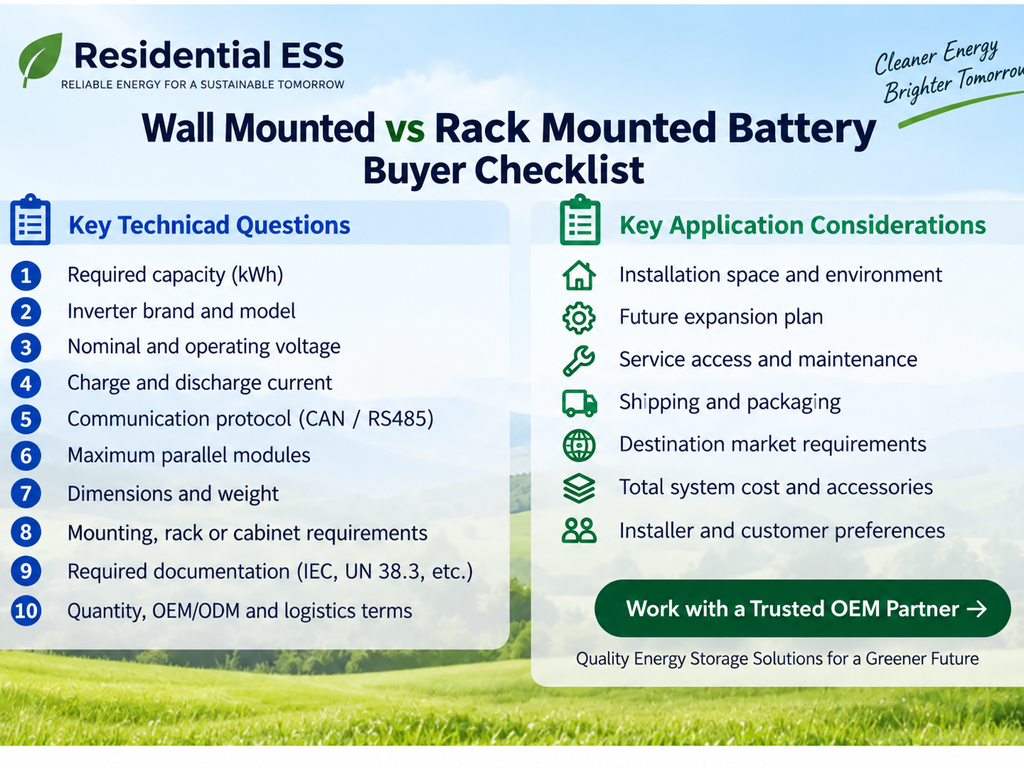
Wall-Mounted vs Rack-Mounted Battery: Buyer RFQ Checklist
- Destination market: country and intended installation type.
- Application: residential backup, solar self-consumption, off-grid or small commercial.
- Inverter: exact brand and model.
- Battery voltage: nominal and operating range.
- Capacity: required nominal and usable kWh.
- Discharge current: continuous and peak requirement.
- Charge current: maximum required charging current.
- Communication: CAN/RS485 and supported inverter protocol.
- Expansion: initial and future module quantity.
- Installation: wall, rack or cabinet.
- Dimensions: available physical space.
- Weight: module and system weight.
- Accessories: cables, breaker, bracket, rack, busbars and terminators.
- Documentation: exact model-level compliance and transport documents.
- Commercial terms: sample, MOQ, OEM/ODM, lead time and warranty.
- Logistics: EXW, CIF or DDP requirement and delivery destination.
Common Buying Mistakes
Mistake 1: Choosing by appearance
A premium enclosure does not prove higher cell quality or a stronger BMS.
Mistake 2: Comparing kWh but ignoring current
A 10kWh battery can still restrict inverter output if its BMS discharge-current limit is too low.
Mistake 3: Assuming rack systems are automatically easier to expand
Expansion depends on the exact electrical and communication architecture.
Mistake 4: Ignoring system weight
Four rack modules may be easier to handle individually but can create a very heavy cabinet.
Mistake 5: Forgetting accessories
Rack, busbars, cables, brackets and communication accessories can materially change landed project cost.
Mistake 6: Treating CAN or RS485 as proof of compatibility
The physical interface is not the same as a supported communication protocol.
Mistake 7: Accepting generic certification statements
Documentation must be checked against the exact quoted product and destination.
FAQ
Is a wall-mounted battery better than a rack-mounted battery?
No. The better format depends on installation space, capacity, expansion strategy, service access and customer preference. Electrical quality must be evaluated separately.
Are rack-mounted batteries only for commercial systems?
No. Rack-mounted modules can also be used in residential energy storage, especially where several battery modules are installed in a dedicated utility room or cabinet.
Can wall-mounted batteries be connected in parallel?
Many can, but the permitted number of modules, wiring arrangement, BMS communication and current limits are model-specific. Check the manufacturer’s approved architecture.
Can I mix different battery capacities in one system?
Do not assume this is allowed. Battery model, capacity, firmware, state of charge and age requirements depend on the manufacturer’s design.
Does a rack-mounted battery need a cabinet?
Some installations use cabinets, while others use open or dedicated battery racks. Follow the exact product’s mechanical and electrical installation instructions.
Which option is better for a 5kW inverter?
Either can work if the battery voltage, BMS communication and discharge-current capability match the inverter. The enclosure format is a secondary decision.
Which format is easier to expand to 20kWh?
Rack systems can often organize several modules more conveniently, but some wall-mounted product families also support straightforward parallel expansion. Compare the approved system architecture rather than the enclosure name.
Final Decision: Choose the Architecture, Not the Box
The wall mounted vs rack mounted battery decision becomes much easier when buyers separate physical installation from electrical performance.
Choose a wall-mounted battery when:
- floor space is limited;
- residential appearance matters;
- the system is relatively compact;
- the mounting structure is suitable.
Choose rack-mounted batteries when:
- multiple modules need to be organized;
- capacity expansion is likely;
- the project has a dedicated equipment area;
- module-level service and inventory flexibility matter.
Then separately verify:
- battery voltage;
- usable energy;
- BMS current limits;
- inverter compatibility;
- communication;
- parallel architecture;
- safety documentation;
- transport documentation;
- warranty;
- complete landed system cost.
Need help comparing wall-mounted and rack-mounted LiFePO4 batteries from China?
Send ORIDY ENERGY your destination country, inverter model, required battery capacity, installation format and expected quantity. We can help compare technically suitable supply options, confirm the information that should be checked with the relevant supplier, and coordinate commercial and logistics requirements.
Website:
https://oridy.net/
Request a Quote:
Contact ORIDY ENERGY
WhatsApp:
Chat with Zoey on WhatsApp