Portable EV Charger Supplier Guide: What Distributors Should Check Before Buying
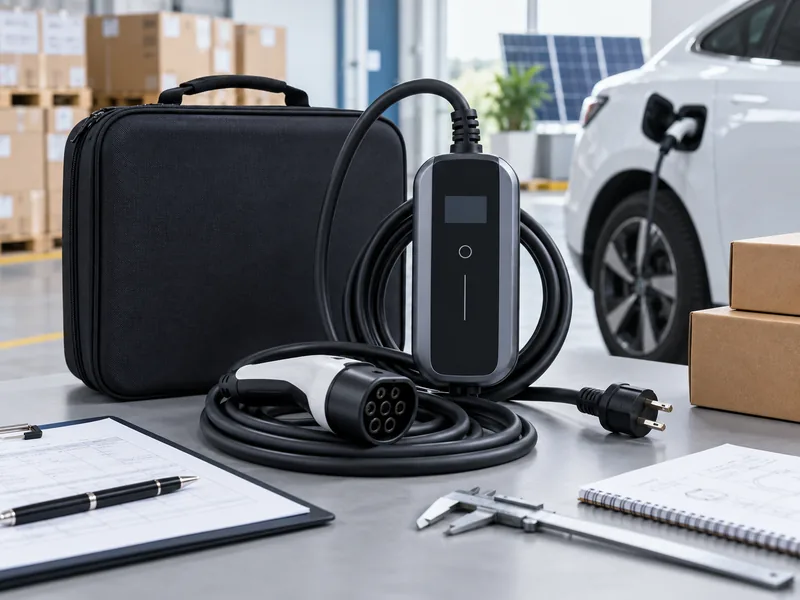
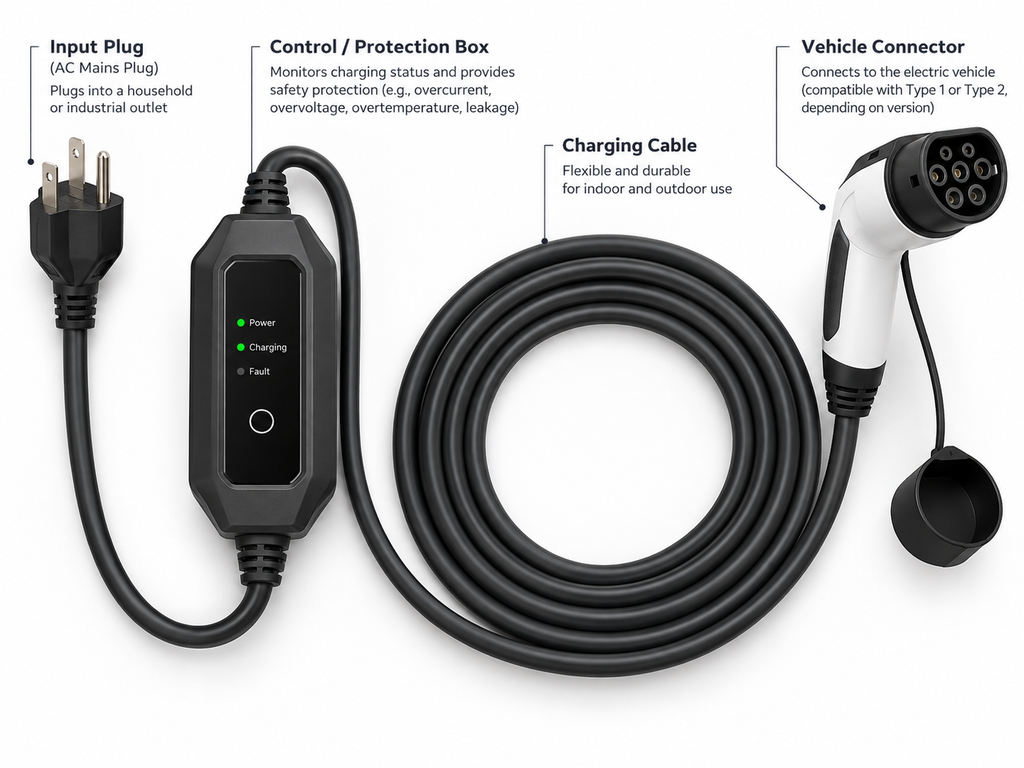
A portable EV charger supplier should be evaluated on far more than the headline power rating. A portable charger may look simple—a control box, cable, vehicle connector and mains plug—but two products both described as “7kW Type 2” can differ significantly in plug configuration, conductor size, current settings, temperature protection, leakage protection, enclosure sealing, connector quality, cable length, firmware, documentation and after-sales support.
For a distributor or importer, the useful question is not simply:
“What is your cheapest portable charger?”
It is:
“Which exact configuration can operate safely and commercially in my target market, and what documentation supports that configuration?”
A portable EV charger should be treated as EV supply equipment, not as a simple cable. It controls the charging current, communicates with the vehicle and must respond correctly when abnormal conditions occur.
Portable EV Charger Supplier: The Short Answer
When evaluating a portable EV charger supplier, confirm the complete electrical and commercial configuration before comparing price.
At minimum, verify:
- input plug and supply voltage;
- single-phase or three-phase design;
- adjustable-current range;
- vehicle connector;
- cable conductor specification;
- cable length;
- leakage/residual-current protection architecture;
- over-temperature protection;
- enclosure and connector IP claims;
- operating-temperature range;
- exact model documentation;
- warranty process;
- spare parts;
- OEM/private-label options;
- packaging;
- sample and wholesale MOQ.
A 32A label alone does not prove that a charger can continuously deliver 32A in a hot garage, through a long cable, or from an unsuitable wall socket.
The safest wholesale approach is:
define the market first → define the electrical configuration → verify the exact product → compare price last.
1. Start With the Wall Supply, Not the Vehicle Connector
Many EV charger inquiries begin with:
“Type 1 or Type 2?”
That matters, but for a portable charger the mains-side plug can be equally important.
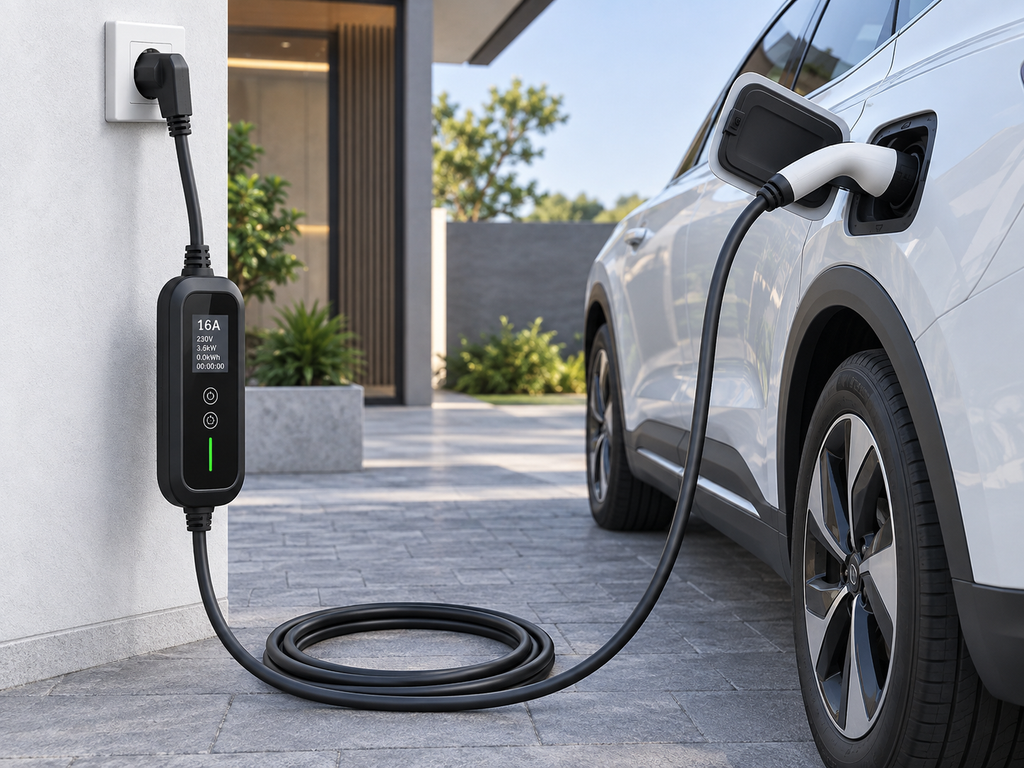
A portable charger may be offered with different input arrangements, including:
- domestic socket plugs for lower-current charging;
- industrial single-phase plugs for higher current;
- industrial three-phase plugs where the product and site support it;
- market-specific plug configurations;
- adapters that change the physical connection but do not increase the rating of the upstream circuit.
The distributor should request the exact:
- rated input voltage;
- frequency;
- phase;
- maximum continuous current;
- plug type;
- permitted current settings.
Descriptions such as “EU plug” or “industrial plug” are too vague for a wholesale purchase order.
Why a 32A charger may not belong on a normal domestic socket
At 230V single phase, the simplified electrical relationship is:
230V × 32A ≈ 7.36kW
But the upstream:
- socket;
- branch circuit;
- breaker;
- conductor;
- installation method;
- local electrical requirements
must all support the continuous load.
A charger capable of 32A does not make a lower-rated domestic outlet suitable for 32A charging.
Portable products create a special after-sales risk because users can move the charger between locations. A serious supplier should therefore be able to explain:
- which input plugs are paired with which current limits;
- whether current can be manually adjusted;
- whether plug-specific current limits are locked;
- whether plug or control-box temperature is monitored;
- what happens if temperature rises above the design threshold;
- whether the manual clearly warns customers about circuit capacity.
For a deeper explanation of how charger power relates to installation and vehicle limits, see ORIDY’s 7kW vs 11kW vs 22kW EV Charger guide.
2. Match the Vehicle Connector to the Destination Market
On the vehicle side, Type 1 and Type 2 remain common AC connector families in international markets.
Do not assume that connector shape alone answers the purchasing question.
Confirm:
| Item | What to Verify |
|---|---|
| Vehicle connector | Exact Type 1 or Type 2 configuration |
| Rated current | Continuous rating of connector and cable |
| Phase support | Single-phase or three-phase where applicable |
| Cable length | Exact usable length |
| Contact design | Supplier data and temperature-rise evidence where available |
| Mechanical durability | Mating-cycle data if documented for the exact model |
| Environmental protection | IP rating and the conditions under which it applies |
If you are still deciding which connector standard fits a particular country, see ORIDY’s Type 1 vs Type 2 EV Charging Cable guide.
For distributors building a broader EV charging range, ORIDY’s EV Charging Equipment page can also help compare product categories before narrowing a supplier request.
3. Adjustable Current Is Useful, but It Does Not Replace Circuit Design
Portable chargers often advertise selectable current steps such as:
- 8A;
- 10A;
- 13A;
- 16A;
- 20A;
- 24A;
- 32A.
The exact settings depend on the product.
Adjustable current can be useful when:
- the customer travels between properties with different circuit limits;
- the available supply is weak;
- charging is intentionally reduced overnight;
- a temporary site cannot support the maximum charger rating.
But the distributor should test how current is controlled.
Ask:
- Is current adjusted by button, display or app?
- Can the setting be changed during charging?
- Does the charger remember the last setting after power loss?
- Does the input-plug version impose a safe maximum?
- Can firmware change the available current range?
- Is the current limit visible in the user manual?
Request the manual before ordering the sample.
A clear manual often reveals whether the product has been developed as a finished consumer/professional product or merely assembled around a headline specification.
4. Thermal Design Is One of the Most Important Quality Differences
Portable EV charging is a long-duration, relatively high-current application.
Heat management therefore matters.
Potential hot spots include:
- mains plug contacts;
- internal terminals;
- relay or contactor;
- cable-to-control-box connection;
- vehicle connector contacts;
- undersized conductor sections;
- poorly crimped terminations.
Ask the supplier what temperature sensors are installed and where they are located.
Some designs may monitor only the control box. Others may include monitoring at the household plug or other critical points.
The better procurement question is not:
“Does it have over-temperature protection?”
Ask instead:
“Where is temperature measured, at what threshold does the charger reduce current or stop charging, and how does it recover after the fault?”
This is especially relevant for Mode 2 portable charging.
IEC 62752:2024 applies to in-cable control and protection devices (IC-CPDs) for Mode 2 charging of electric road vehicles. The 2024 edition includes requirements related to temperature detection in the current-carrying parts of household plugs.
That does not mean every portable charger automatically complies with IEC 62752:2024.
For procurement, verify the exact:
- model;
- electrical rating;
- test report/certificate;
- standard edition;
- configuration covered by the documentation.
5. Leakage Protection and Electrical Protection Must Be Model-Specific
Portable EV chargers can include different residual-current and fault-protection architectures depending on the model.
Suppliers may use terms such as:
- RCD;
- Type A;
- Type B;
- DC leakage detection;
- 6mA DC detection;
- ground fault protection.
Do not convert those marketing labels into universal claims.
For the exact charger, request:
- protection architecture stated in the manual;
- relevant test documentation;
- over-voltage response;
- under-voltage response;
- over-current response;
- over-temperature response;
- earth/ground fault behaviour;
- DC leakage detection specification if applicable;
- restart behaviour after a fault.
IEC 61851-1:2017 covers general requirements for EV supply equipment, including operating conditions, connection with the EV and electrical-safety requirements.
However, the upstream installation may still require additional protection under local rules.
A supplier should never imply that one built-in protective function automatically replaces the entire site electrical-protection design.
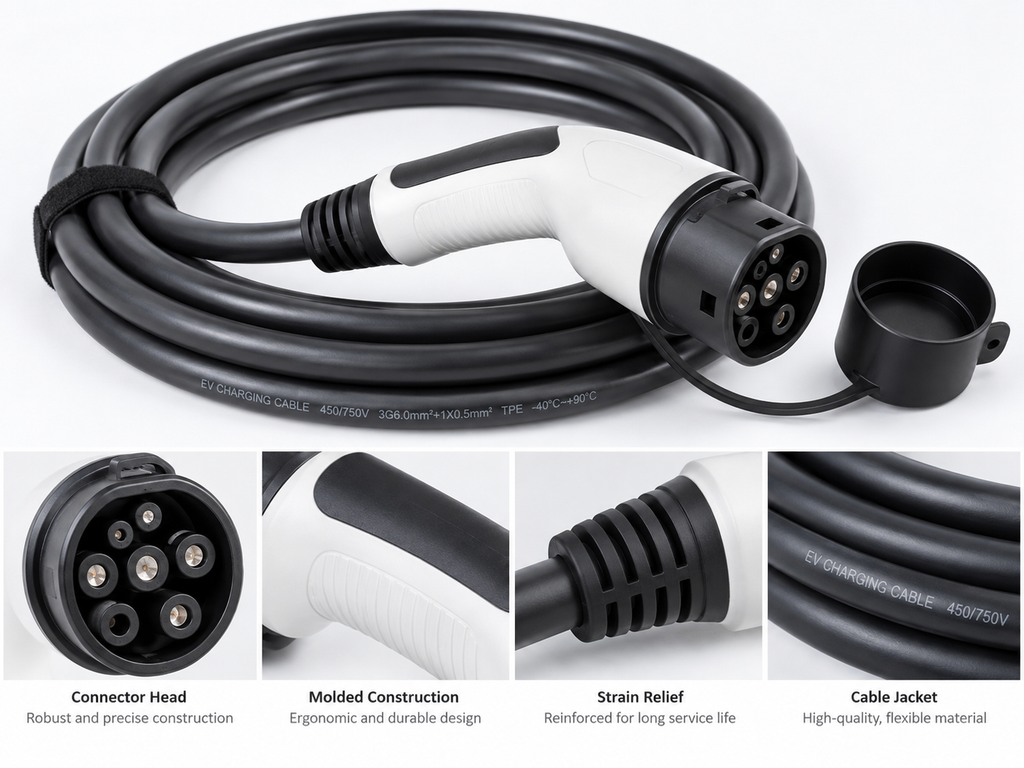
6. Cable Size and Cable Length Affect Real Product Cost
Portable chargers are price-sensitive products, which makes cable specification a common area for quotation differences.
When comparing suppliers, normalize:
- conductor material;
- conductor cross-sectional area;
- total cable length;
- outer jacket material;
- flexibility at low temperature where relevant;
- UV/weather resistance;
- connector overmould quality;
- strain relief.
A lower quotation may simply contain:
- shorter cable;
- smaller conductor;
- different jacket;
- cheaper connector construction.
Cable length also changes the user experience.
Five metres may be enough for a predictable home parking position. A longer cable can offer more flexibility for mixed parking layouts, but it adds:
- copper cost;
- weight;
- packaging volume;
- shipping cost;
- voltage-drop considerations.
7. IP Rating Needs Context
A portable charger may be used outdoors, but an IP65 or IP67 statement should not be copied into marketing without checking what component and condition the rating covers.
Ask whether the stated rating applies to:
- control box;
- vehicle connector when mated;
- vehicle connector when unmated;
- mains plug;
- complete assembled product.
These may not have the same rating.
Also check operating temperature.
A charger intended for a mild indoor garage and one used outdoors in a hot African or Middle Eastern market face different environmental conditions.
The correct sourcing question is:
“What is the verified environmental specification for the exact configuration we are ordering?”
Need Help Comparing Portable EV Charger Supply Options?
If you are sourcing portable EV chargers for distribution, installation, retail or fleet use, send ORIDY ENERGY the project details before comparing unit price.
Useful information includes:
- destination country;
- input plug;
- supply voltage and phase;
- Type 1 or Type 2;
- required current / charging power;
- cable length;
- smart-function requirements;
- quantity;
- OEM/private-label requirement;
- required certification or documentation.
We can help compare China-side supply options on a technically equivalent basis and identify the questions that should be resolved before a sample or bulk quotation.
Website: https://oridy.net/
Request a Quote: https://oridy.net/contact-us/
WhatsApp: Chat with ORIDY ENERGY
8. Smart Features Should Be Selected by Use Case
Portable chargers can include:
- display;
- Wi-Fi;
- Bluetooth;
- app control;
- timers;
- scheduled charging;
- energy information;
- charging history.
More features are not automatically better.
For a basic travel or backup charger, buyers may prefer:
- local current adjustment;
- clear status indicators;
- simple offline use;
- no mandatory account registration.
For a premium consumer SKU, app functions may add value.
Before purchasing a smart version, test:
- app availability in the target country;
- Android and iOS support;
- account registration;
- language quality;
- firmware update process;
- cloud dependence;
- OEM/private-label options;
- behaviour when the cloud service is unavailable.
For distributors building their own brand, long-term software support can matter more than logo customization.
9. Certification: Ask for the Exact Model and Configuration
Portable EV chargers are sold into markets with different electrical-safety, EMC, plug and product requirements.
ORIDY should not make a broad claim such as:
“Our portable chargers are CE / IEC / UL certified.”
Instead, use a model-level verification process.
Step 1: Identify the destination market
Confirm country and sales channel.
Step 2: Define the exact configuration
Confirm:
- input plug;
- voltage;
- current;
- phase;
- vehicle connector;
- cable;
- control box.
Step 3: Determine the required documents
Requirements can differ by destination and product type.
Step 4: Request exact evidence
Check:
- certificate/report number;
- model number;
- applicant/manufacturer;
- standard;
- edition;
- issue date;
- product description.
Step 5: Check whether changes affect coverage
A different:
- plug;
- cable;
- current rating;
- enclosure;
- firmware;
- connector
may affect the relevance of the original documentation.
The commercial principle is simple:
The documents must match the product being shipped.
10. Sample Testing Before a Wholesale Order
A distributor should not move directly from PDF catalogue to bulk purchase.
Use the sample to verify the exact SKU you intend to sell.
Physical inspection
Check:
- plug moulding;
- connector moulding;
- cable flexibility;
- strain relief;
- enclosure fit;
- display readability;
- label durability;
- serial-number traceability.
Functional inspection
Check:
- every current setting;
- charging start/stop;
- fault indication;
- scheduled charging where applicable;
- app pairing where applicable;
- power-loss recovery;
- connector-lock behaviour where applicable.
Electrical and thermal evaluation
This should be carried out by qualified personnel using appropriate equipment and procedures.
The purpose is not simply to prove that the charger powers on.
It is to confirm that the exact sample behaves as represented before a commercial order is finalized.
11. Packaging Matters More for Portable Products
Unlike a permanently installed wallbox, a portable charger may be:
- transported frequently;
- carried inside a vehicle;
- sold through e-commerce;
- returned by courier;
- stored with adapters and cables.
Packaging therefore affects:
- perceived quality;
- shipping damage;
- customer experience;
- warranty rate.
Common packaging considerations include:
- carrying case;
- cable storage;
- dust caps;
- adapter organization;
- user manual;
- warning labels;
- carton strength;
- barcode / serial label;
- OEM colour box;
- spare plug or connector options.
For e-commerce distributors, request:
- carton dimensions;
- gross weight;
- master-carton quantity
before calculating fulfilment or freight.
12. Portable EV Charger Wholesale RFQ Checklist
Instead of sending:
“Send price for portable charger.”
send a structured request.
Include:
- Destination country.
- Application: retail / distributor / installer / fleet / emergency charger.
- Vehicle connector: Type 1 / Type 2.
- Input plug.
- Input voltage / frequency.
- Required maximum current.
- Single-phase or three-phase.
- Cable length.
- Smart or non-smart.
- Display requirement.
- IP/environment requirement.
- Required certification/documentation.
- OEM/private-label requirement.
- Sample quantity.
- Target wholesale quantity.
- Packaging requirement.
- Warranty expectation.
- Trade term.
- Destination city / port / postcode.
Then ask the supplier to return:
- model-specific datasheet;
- exact quotation;
- documentation list;
- lead time;
- sample terms.
This turns the RFQ from a catalogue request into a real supplier-comparison tool.
13. Common Portable EV Charger Buying Mistakes
Mistake 1: Comparing only maximum kW
A 7kW headline does not describe:
- input plug;
- cable;
- thermal behaviour;
- protection;
- vehicle compatibility.
Mistake 2: Treating “portable” as permission to use any socket
Charging current must still match the branch circuit and outlet.
Mistake 3: Assuming an adapter defines safe current
An adapter changes the mechanical connection.
It does not upgrade the upstream circuit.
Mistake 4: Copying certification logos from a catalogue
Verify the exact model and destination requirement.
Mistake 5: Ordering smart chargers without testing the app
A poor app can create more returns than a reliable basic product.
Mistake 6: Ignoring replacement accessories
Ask whether replacement:
- cables;
- control boxes;
- connectors;
- plug assemblies
are available.
Mistake 7: Comparing EXW price before normalizing the configuration
Two portable chargers at different prices may not contain the same:
- plug;
- cable length;
- conductor;
- connector;
- protection;
- packaging;
- accessories.
Normalize specifications first.
14. How ORIDY ENERGY Supports Portable EV Charger Sourcing
ORIDY ENERGY works as a China-side renewable-energy sourcing and supply-chain partner.
Our role is not to assume that one charger suits every country.
For portable EV charger projects, useful starting information includes:
- country / market;
- input plug;
- electrical supply;
- Type 1 or Type 2;
- required current / power;
- cable length;
- smart-function requirements;
- quantity;
- OEM/private-label requirement;
- certification / documentation requirement;
- delivery term.
From there, China-side supplier options can be narrowed and compared on a more equivalent basis.
That helps reduce a common sourcing problem:
receiving several quotations that look comparable in price but represent different products.
Frequently Asked Questions
Is a portable EV charger the same as an EV charging cable?
No.
A charging cable mainly provides the electrical connection.
A portable EV charger / portable EVSE also contains control and protection electronics that communicate with the vehicle and manage charging current.
Buyers should therefore evaluate:
- control box;
- input plug;
- cable;
- vehicle connector;
- protection architecture
as one complete product.
Can a portable 7kW charger be used from any household socket?
No.
A charger capable of approximately 7kW may require around 32A on a 230V single-phase supply.
The outlet, circuit, wiring and protection must be suitable for the continuous load.
Always follow local electrical requirements and the exact product manual.
What should distributors test first on a portable charger sample?
Start with the exact configuration you intend to sell:
- input plug;
- maximum current;
- vehicle connector;
- cable length.
Then evaluate:
- current adjustment;
- prolonged charging behaviour;
- temperature rise;
- fault response;
- smart functions;
- labeling;
- packaging.
Is the cheapest portable charger usually the best wholesale SKU?
Not necessarily.
Small differences in:
- copper;
- connector quality;
- temperature sensing;
- relay/contact design;
- enclosure sealing;
- software;
- packaging;
- spare-parts support
can create much larger differences in warranty cost.
Should a distributor stock Type 1 and Type 2 portable chargers?
That depends on the target vehicle population.
Do not build inventory only from broad regional assumptions. Check the actual vehicles in your target channel and whether imported vehicles create mixed connector demand.
Is a higher-current portable charger always better?
No.
Higher current only creates value when:
- the site circuit supports it;
- the input plug supports it;
- the charger is designed for the continuous load;
- the vehicle can use the available AC power.
Final Decision: Compare the Complete Charger, Not Only the kW Rating
A reliable portable EV charger purchasing decision is built around the complete charging path:
wall supply → input plug → protection/control box → cable → vehicle connector → onboard charger
For distributors, importers and installers, the strongest product is not necessarily the one with:
- the highest current;
- the most app features;
- the lowest EXW price.
The better product is the one whose:
- input plug matches the destination electrical system;
- current settings match the intended circuit;
- cable and connector support the required continuous load;
- thermal protection is clearly documented;
- electrical-protection architecture is specified;
- environmental claims match the real application;
- exact model documentation can be verified;
- packaging suits the sales channel;
- spare parts are available;
- warranty procedures are workable.
Before comparing final quotations, normalize these specifications first.
A small difference in unit price can quickly disappear if the cheaper charger creates:
- unsuitable plugs;
- poor thermal behaviour;
- software problems;
- weak packaging;
- missing documentation;
- higher warranty returns.
Looking for a Portable EV Charger Supplier in China?
If you are a distributor, importer, installer, EV accessory wholesaler, fleet buyer or project buyer, send ORIDY ENERGY:
- destination country;
- input plug standard;
- Type 1 or Type 2;
- required current / charging power;
- single-phase or three-phase;
- cable length;
- smart-function requirements;
- estimated quantity;
- OEM/private-label requirements;
- required certification/documentation;
- delivery city or port.
We can help you compare China-side supply options, narrow technically suitable configurations and identify the questions that should be resolved before sample testing or bulk quotation.
Website: https://oridy.net/
Request a Quote: https://oridy.net/contact-us/
WhatsApp: https://wa.me/8618217811889
If you already have a target specification or supplier quotation, send it together with your destination market and expected quantity. We can help compare the configuration before you move to a sample or bulk order.