How to Import EV Chargers from China: A Complete Guide for Distributors
How to Import EV Chargers from China: Shipping, Customs & Documentation Guide
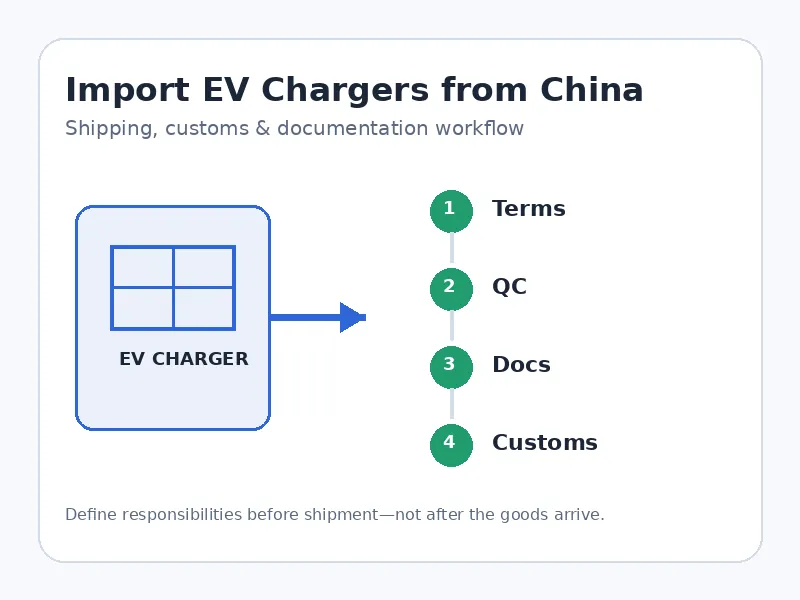
Once you have selected an EV charger product and supplier, the next risk is no longer supplier discovery—it is execution. Importers need to confirm the exact product scope, agree the correct Incoterm, verify payment details, complete pre-shipment quality checks, prepare commercial and transport documents, confirm customs classification, and make sure the destination-side importer and broker know what is arriving.
This guide focuses on the import process after supplier selection. If you are still comparing suppliers, model-specific conformity documents or sourcing options, first read our EV charger sourcing and compliance guide.
Quick answer: To import EV chargers from China, define the exact model and quantity, agree the Incoterm and named place/port, verify beneficiary and payment details, complete pre-shipment QC, prepare commercial and transport documents, confirm the HS classification with your customs broker or destination authority, and send the document set to the importer/broker before arrival. Do not assume that DDP, FOB or a specific HS code is automatically right for every shipment.
1. Confirm the Product Scope Before You Book Shipping
Before a freight booking is made, confirm that the commercial order and the physical shipment describe the same product. This sounds basic, but many import problems start with a quotation that says “22kW wallbox” while the packing list, label, connector type or accessories describe something slightly different.
- Exact model / SKU
- Quantity
- Rated power and electrical configuration
- Connector / socket configuration
- Cable length, if applicable
- Included accessories
- Packaging and carton markings
- Neutral, OEM or private-label requirements
- Destination country and delivery point
- Required commercial and product documents
If the project is still at product-selection stage, see our AC EV charger sourcing page before moving into logistics.
2. Choose the Incoterm Before Comparing the Final Landed Cost
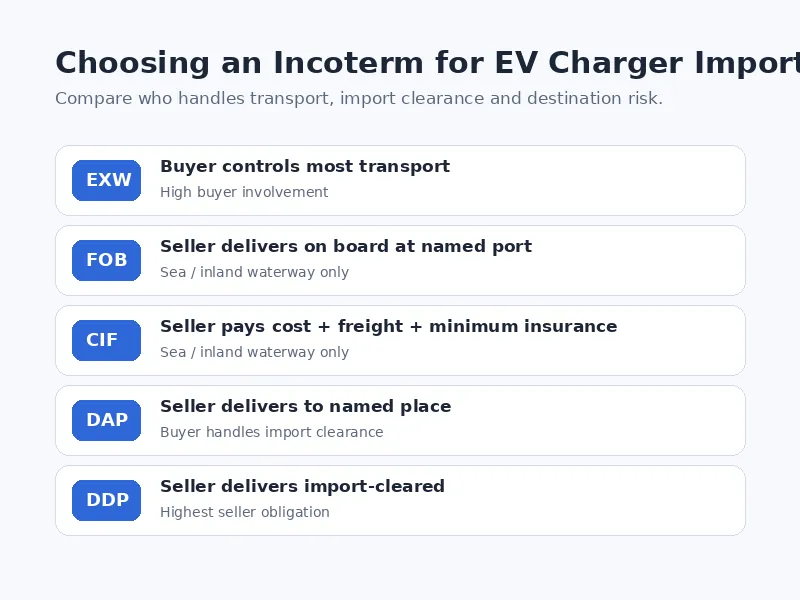
Incoterms define key delivery, cost and risk responsibilities between seller and buyer, but they do not replace the sales contract, payment terms, product warranty or destination-country customs requirements. The International Chamber of Commerce publishes the Incoterms® 2020 rules and explanatory notes.
International Chamber of Commerce — Incoterms® 2020
| Term | Practical meaning for the buyer | Important point |
|---|---|---|
| EXW | Buyer takes on most transport coordination from the named place. | Export handling can be difficult if the buyer does not have a China-side logistics setup. |
| FOB | Seller delivers the goods on board the nominated vessel at the named port. | FOB is intended for sea or inland waterway transport; containerized cargo may sometimes be better handled under FCA depending on the actual delivery point. |
| CIF | Seller arranges cost, freight and minimum insurance to the named destination port. | Risk and cost do not necessarily transfer at the same point; read the exact rule and insurance scope. |
| DAP | Seller brings the goods to the named destination place. | Buyer normally handles import clearance and import charges. |
| DDP | Seller has the broadest delivery obligation and delivers import-cleared at the named place. | Confirm who can legally act as importer, how duties/taxes are handled and whether the structure is compliant in the destination country. |
Do not select DDP simply because it feels easiest, and do not select FOB simply because it appears cheaper. Ask who will act as importer of record, who appoints the customs broker, who pays duties and taxes, when risk transfers, what destination charges are excluded, and who is responsible if clearance is delayed.
For a deeper comparison of logistics terms, you can also review our DDP vs FOB shipping guide. The product is different, but the responsibility framework is useful for renewable-energy imports generally.
3. Verify Payment Details Before Sending the Deposit or Balance
Payment risk is not solved by one “safe” percentage. A 30/70 structure, staged payment, letter of credit or another arrangement may be appropriate depending on order size, supplier relationship, production requirements and banking cost. The important point is to make the payment process verifiable.
- Confirm the legal supplier name on the quotation and contract.
- Check whether the beneficiary name and bank account are consistent with the agreed commercial entity.
- Investigate any last-minute request to change bank details.
- Define what evidence is required before the balance payment—such as inspection results, packing photos, quantity confirmation or shipping documents.
- For larger transactions, discuss appropriate trade-finance options with your bank rather than assuming one method fits every order.
If payment instructions change after the order is confirmed, stop and re-verify through a known communication channel before transferring funds.
4. Define Pre-Shipment QC Before Production Is Finished
“QC passed” is only meaningful when both sides understand the inspection scope. Agree the checklist before production ends so the supplier, buyer and any third-party inspector are checking the same requirements.
- Model and quantity
- Connector / socket configuration
- Cable length and included accessories
- Label and nameplate consistency
- Packaging and carton marks
- Visible workmanship
- Basic functional checks agreed for the product
- Manuals and documentation included in the shipment
- Sample size and acceptance criteria if a formal inspection is used
Need Help Coordinating an EV Charger Shipment from China?
Send us your destination country, selected product/model, quantity, preferred shipping term and required delivery date. Oridy can help coordinate China-side quotations, supplier communication, documentation and pre-shipment requirements depending on the project.
5. What Documents Are Commonly Needed for an EV Charger Import Shipment?
The exact document package depends on the product, transport mode, Incoterm, destination country and customs requirements. Commercial documents, transport documents and product conformity documents should not be treated as the same thing.
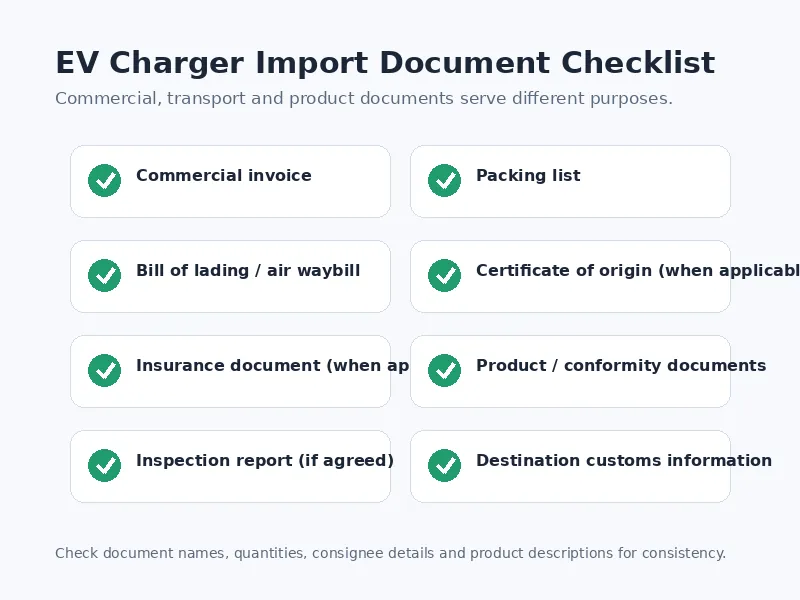
| Document | Why it matters |
|---|---|
| Commercial Invoice | Describes seller/buyer, product, quantity, value and agreed trade terms for customs and payment purposes. |
| Packing List | Shows package count, weights, dimensions and shipment contents. |
| Bill of Lading / Air Waybill | Transport document issued for sea or air movement, depending on shipment method. |
| Certificate of Origin | May be requested for customs, trade-agreement or customer purposes depending on destination. |
| Insurance Document | Relevant when insurance is part of the agreed transport arrangement. |
| Product / Conformity Documents | Model-specific technical or conformity evidence requested by the market, project or authorities. |
| Inspection Report | Used when buyer and seller agreed a pre-shipment or third-party inspection. |
Before documents are released to the broker, check that product descriptions, quantities, model numbers, consignee information and package counts are consistent across the invoice, packing list and transport documents.
6. How Should You Handle HS Classification?
Do not copy an HS code from another supplier, another product page or a previous shipment without checking the exact product. The World Customs Organization explains that the Harmonized System is an international product nomenclature based on six-digit codes, while final import classification is applied through the relevant national tariff schedule.
World Customs Organization — What is the Harmonized System?
An EV charging cable, wall-mounted AC charger, portable EVSE and DC charging equipment may not be classified in the same way. Product design, principal function and destination-country tariff rules matter. Ask your customs broker or the destination customs authority to confirm the classification before shipment, especially for a new product or first import.
7. Choose the Freight Method Based on Shipment Size and Urgency
| Method | Typical use case | Buyer should confirm |
|---|---|---|
| Courier / Express | Samples and very small urgent shipments | Chargeable weight, destination duties/taxes, restricted items and delivery terms |
| Air Freight | Higher-value or time-sensitive commercial shipments | Airport handling, customs broker, dimensions, chargeable weight and final delivery |
| LCL Sea Freight | Commercial cargo that does not fill a container | Origin/destination handling charges, consolidation schedule and local fees |
| FCL Sea Freight | Larger volume shipments | Container loading plan, port charges, free time, demurrage/detention terms and inland delivery |
There is no universal “best” freight method. Compare total landed cost, lead time, local handling fees, customs requirements and inventory urgency rather than freight price alone.
8. What Should Be Checked Before the Shipment Arrives?
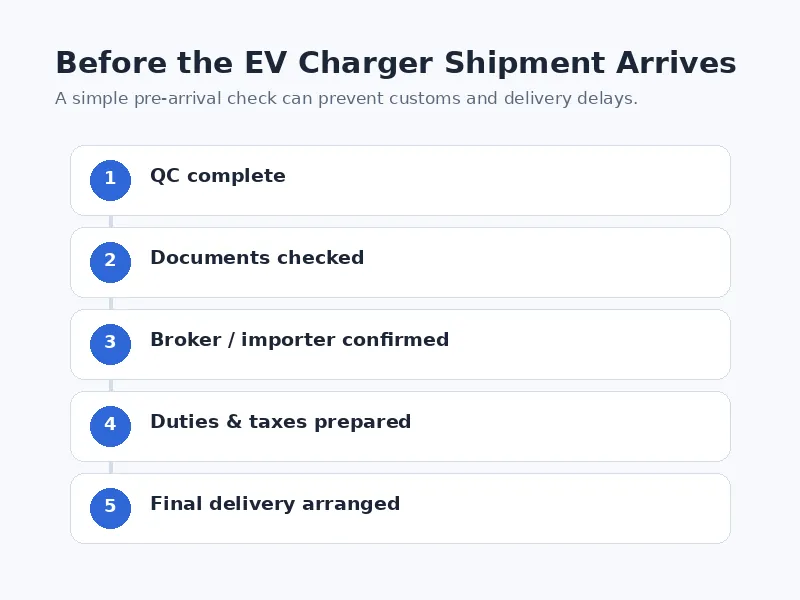
- Confirm final QC / shipment release is complete.
- Send the document set to the customs broker or importer early enough for review.
- Check consignee and importer information.
- Confirm the HS classification and estimated duties/taxes with the destination-side professional.
- Verify the vessel/flight and arrival information.
- Confirm who is responsible for destination terminal charges and customs clearance.
- Arrange final-mile delivery and unloading requirements.
The goal is to find document or responsibility gaps before the goods arrive, when there is still time to correct them without storage or delay costs.
9. Common EV Charger Import Mistakes
- Comparing FOB and DDP quotations as if they include the same scope. They do not.
- Booking freight before QC is complete. A fixed departure date can pressure the buyer to release goods that still need correction.
- Using a copied HS code without destination verification. Final classification follows the relevant national tariff schedule.
- Assuming product certificates replace shipping documents. They solve different requirements.
- Ignoring beneficiary changes. Any bank-detail change should trigger re-verification.
- Sending documents to the broker too late. Early review reduces avoidable clearance issues.
- Leaving importer-of-record responsibility unclear under a delivered-price quotation. Confirm the legal and tax structure before shipment.
10. What Information Should You Send Oridy for Import Coordination?
If you already know which EV charging product you want, sending a structured request helps us determine what China-side coordination is needed.
- Destination country and city / port
- Selected product or exact model, if already chosen
- Quantity
- Supplier status: already selected or still comparing
- Preferred Incoterm, if known
- Expected delivery date
- Required product / project documentation
- Whether third-party inspection is requested
- Whether you have your own freight forwarder / customs broker
How Oridy Supports China-Side EV Charger Import Coordination
Oridy Energy Solutions works as a China-side renewable-energy supply chain, sourcing and project-coordination partner. Depending on the project, we can help coordinate supplier communication, specification confirmation, quotation comparison, document collection, sample or inspection arrangements, and shipping handover. The exact scope depends on the selected supplier, product, destination market and commercial agreement.
Frequently Asked Questions
Is DDP always the easiest way to import EV chargers from China?
No. DDP gives the seller broad delivery responsibilities, but the buyer should still confirm who can legally act as importer, how import taxes and customs formalities are handled, what charges are included, and whether the arrangement works under the destination country’s rules.
Should I use FOB for an EV charger shipment?
FOB may be suitable for some sea shipments, but it is not automatically the best choice for every shipment. The ICC notes that FOB is for sea or inland waterway transport and that FCA may be more appropriate where goods are handed to a carrier before being placed on board, such as at a container terminal.
What HS code should I use for an EV charger?
Do not use one universal code for every EV charging product. Classification depends on the exact product and the destination tariff schedule. Confirm it with your customs broker or destination customs authority before shipment.
When should pre-shipment inspection happen?
The inspection should be scheduled early enough to allow corrective action before shipment release. Define the inspection scope, sample size and acceptance criteria before production is completed.
Planning an EV Charger Import Shipment from China?
Send us the destination market, product/model, quantity, required documents and preferred shipping arrangement. We can help you organize the China-side sourcing and import-coordination steps before shipment.
Website: https://oridy.net/
Contact: https://oridy.net/contact-us/
WhatsApp: Chat with Oridy on WhatsApp