
LiFePO4 Home Battery Wholesale: The Complete Buyer’s Guide for 2026
LiFePO4 home battery wholesale is the fastest-growing segment in global energy storage — 85% of home batteries sold in 2026 use this chemistry. Three years ago, that figure was under 40%. The shift is not a trend. It is a fundamental restructuring of the residential energy storage market. Distributors who move now can secure supplier relationships at today’s pricing. Those who wait will compete against established supply chains with shrinking margins. The question is not whether LiFePO4 will dominate home storage. The question is who will own the distributor relationships when it does.
According to the International Energy Agency, the global home battery market crossed $22 billion in 2025. It is projected to reach $45 billion by 2030. Europe leads in residential attachment rates. Africa and Southeast Asia lead in off-grid and backup applications. The Middle East is the fastest-growing premium market. Every one of these markets needs LiFePO4 batteries. Every distributor in every one of these markets is looking for reliable wholesale supply. This LiFePO4 home battery wholesale guide gives you the specifications, the pricing, the supplier evaluation framework, and the market intelligence to build your battery distribution business on a solid foundation.
Featured Snippet: What should I look for when buying LiFePO4 home batteries at wholesale?
When buying LiFePO4 home batteries wholesale, verify five things: (1) Grade A automotive cells with documented cycle life of 4,000+, (2) a quality BMS with cell-level monitoring and communication protocols, (3) valid UN38.3 and IEC 62619 certifications from accredited labs, (4) OEM branding capability at your volume level, and (5) DDP shipping terms with a written delivery timeline. Wholesale pricing for 5 kWh wall-mounted units runs $850–$1,350 FOB China at 50-unit volumes. Verified Chinese manufacturers offer the best price-to-quality ratio.
Below, we break down everything — the technology, the specifications that matter, the real wholesale pricing, the supplier verification process, and the market segments where demand is strongest. Whether you are an electrical distributor adding storage to your product line, a solar installer buying in bulk for project pipelines, or an entrepreneur launching a home battery brand, this guide is built for your business.
1. Why LiFePO4 Home Battery Wholesale Has Won the Global Market
Quick Answer: LiFePO4 dominates because it solves the three problems that killed earlier home battery chemistries. First, it is safe — no thermal runaway below 200°C, which means it can be installed inside a family home without expensive fire suppression. Second, it lasts — 4,000–6,000 cycles at 80% depth of discharge, translating to 10–15 years of daily use. Third, its cost per cycle is $0.04–$0.08/kWh, undercutting lead-acid by 5–10 times. No other commercially available chemistry delivers this combination at the $100–$150/kWh cell price that Chinese manufacturers achieved in 2026.
What makes LiFePO4 different from other lithium battery types?
The key is the cathode material. Lithium iron phosphate (LiFePO4) has an olivine crystal structure. This structure is inherently stable. The iron-phosphate-oxygen bond is strong. It does not release oxygen when heated. As a result, the cathode does not decompose exothermically until temperatures exceed 200°C. This is 150°C higher than the decomposition point of the nickel-manganese-cobalt (NMC) cathodes used in EV batteries and early Tesla Powerwalls.
The practical consequence matters enormously for home installation. A LiFePO4 battery mounted on a garage wall does not require a dedicated fire-rated enclosure. It does not require active liquid cooling. It does not create an insurance headache for the homeowner. For a distributor, this means fewer installation barriers. It means faster sales cycles. It means a product you can sell to a family with children sleeping in the next room without a moment of hesitation about safety.
How does LiFePO4 compare to lead-acid for residential use?
Lead-acid dominated home solar storage for decades. It was available. It was cheap to buy. But the financial case has collapsed as LiFePO4 prices have fallen. Consider a typical home installation requiring 10 kWh of usable storage:
Table: 10 kWh Usable Storage — LiFePO4 vs Lead-Acid (2026)
| Parameter | Lead-Acid (VRLA) | LiFePO4 |
|---|---|---|
| Rated capacity needed | 20 kWh (50% DoD) | 11 kWh (90% DoD) |
| Wholesale cost | $2,000 ($100/kWh) | $2,200 ($200/kWh) |
| Cycle life | 600 cycles | 4,000 cycles |
| Lifespan (1 cycle/day) | ~2 years | ~11 years |
| Replacements over 10 years | 4–5 times | 0 (still at 70%+ capacity) |
| 10-year total cost | $8,000–$10,000 | $2,200 |
| Weight (10 kWh usable) | ~350 kg | ~110 kg |
| Installation complexity | Vented enclosure required | Wall-mounted, plug-and-play |
Wholesale pricing: China FOB, Q2 2026. Lead-acid pricing based on 12V/200Ah VRLA deep-cycle batteries. LiFePO4 pricing based on 48V wall-mounted units with integrated BMS.
The numbers tell a clear story. LiFePO4 costs roughly twice as much to buy upfront. However, it costs one-quarter as much over its service life. For a homeowner, the choice is straightforward. For a distributor, it is even clearer. You build your business on products that your customers will be satisfied with for a decade — not products that fail after two years and generate warranty claims.
What about NMC batteries — should distributors still stock them?
NMC (nickel manganese cobalt) batteries offer higher energy density than LiFePO4. A 10 kWh NMC battery weighs about 80 kg versus 110 kg for LiFePO4. This weight advantage matters in electric vehicles where every kilogram affects range. In a stationary home installation, it does not matter at all. The garage wall does not care how much the battery weighs.
Meanwhile, NMC’s disadvantages for residential use are significant. Its thermal runaway threshold is much lower — roughly 150–200°C versus 200°C+ for LiFePO4. It requires more sophisticated (and expensive) thermal management. It degrades faster under high ambient temperatures. And critically for distributors, its cobalt content makes it subject to supply chain volatility. Cobalt prices have swung between $30,000 and $95,000 per metric ton in the past five years. The result is that LiFePO4 cells have fallen below $100/kWh at wholesale while NMC cells remain at $130–$160/kWh for comparable quality. The market has spoken. For home storage, LiFePO4 is the answer.
🔋 Sourcing LiFePO4 Home Batteries at Wholesale? We Can Help.
Verified Grade A cells. CE/UN38.3 certified. OEM with your brand. DDP delivery. MOQ from 20 units. Get a Quote →
2. What LiFePO4 Home Battery Specifications Actually Matter for Wholesale Buyers?
Quick Answer: When evaluating LiFePO4 home batteries for wholesale purchase, prioritize five specifications: (1) cell grade — demand Grade A automotive cells with documented capacity test reports, (2) BMS quality — the battery management system must provide cell-level monitoring, balancing, and communication, (3) cycle life warranty — require a written 4,000+ cycle warranty at 80% DoD, (4) inverter compatibility — the battery must communicate with the major inverter brands in your target market, and (5) certifications — UN38.3 and IEC 62619 are the minimum baseline. A battery with Grade A cells and a weak BMS will still fail. A battery with a premium BMS and recycled cells will also fail. Both components must be verified independently.
How do you verify that cells are truly Grade A — not relabeled Grade B?
This is the single most important supplier verification question. The price gap between Grade A and Grade B LiFePO4 cells is 30–50%. This creates a powerful incentive for unscrupulous suppliers to relabel Grade B cells as Grade A. The result looks identical from the outside. The performance difference emerges over months and years — shorter cycle life, faster capacity fade, inconsistent cell balancing. By the time your customers discover the problem, the supplier’s sales representative has changed jobs and you are left holding warranty claims.
There are four verification methods. First, demand the cell manufacturer’s original test report. Grade A cells come with a factory test report showing capacity, internal resistance, and voltage for each individual cell. The report should list the cell manufacturer’s name — CATL, EVE, REPT, Gotion, CALB, or another recognized Tier-1 producer. If the supplier cannot provide this report, the cells are not Grade A.
Second, verify the QR code. Every Grade A cell from a legitimate manufacturer carries a unique QR code. You can scan this code and verify the cell’s production date, factory, and test data against the manufacturer’s database. Relabeled cells will have missing, damaged, or unverifiable QR codes. Ask the supplier to send you photos of the QR codes on a sample batch. Then ask them to walk you through the verification process on a live video call. A supplier who hesitates on either request is not selling Grade A cells.
Third, perform a capacity test on random samples. Order 2–3 sample units. Discharge them at 0.5C to the specified cut-off voltage. Measure the actual delivered capacity. Grade A LiFePO4 cells should deliver 100–102% of rated capacity when new. Consistently lower readings — 95% or below — indicate Grade B cells or aged inventory. The test equipment costs a few hundred dollars. The information it provides is worth millions in avoided warranty liabilities.
Fourth, ask for the manufacturer’s production line video. Not a marketing video. A real-time video call walking the production floor. You should see automated cell sorting and grading equipment. You should see the formation and aging process. You should see quality control stations with personnel performing capacity and internal resistance testing. A supplier who shows you a clean showroom but will not show you the production line is a trading company, not a manufacturer. Trading companies have their place, but they cannot guarantee cell grade because they do not control the production process.
What should a quality BMS include?
The BMS is the brain of the battery. A well-designed system protects the cells. A poorly designed system allows them to be destroyed. Here is what to require in a wholesale LiFePO4 home battery purchase:
- Cell-level voltage monitoring: The BMS must monitor the voltage of every individual cell in the pack — not just the total pack voltage. A single over-discharged or over-charged cell in a series string can fail catastrophically while the pack voltage appears normal. This is a non-negotiable safety requirement.
- Active or passive balancing: Over time, individual cells drift apart in voltage. Balancing corrects this. Passive balancing burns excess energy as heat through resistors. It is cheap but slow and wasteful. Active balancing transfers energy from higher-voltage cells to lower-voltage cells. It is more expensive but faster and more efficient. For home batteries cycling daily, active balancing pays for itself in extended pack life.
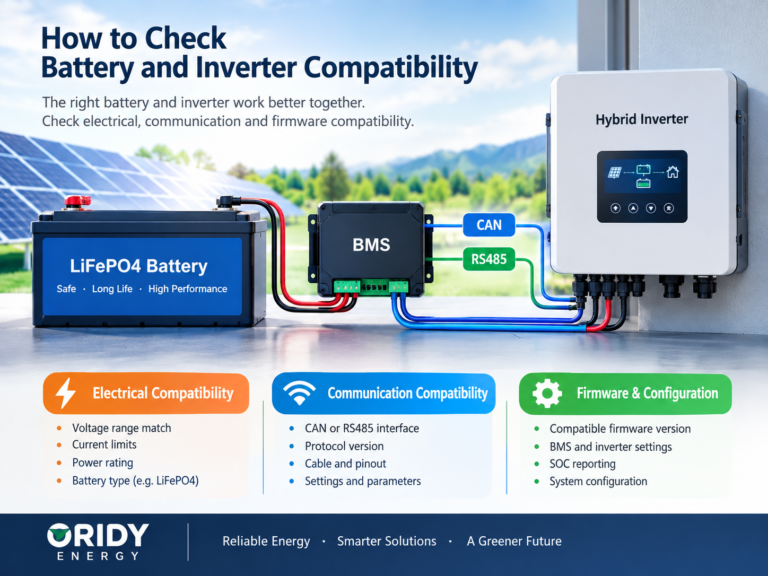
- Communication protocol: The BMS must communicate with the inverter. The dominant protocols are CAN bus and RS485. The BMS must support at least one of the open protocols (not a proprietary protocol) and be documented. Confirm compatibility with the inverter brands that dominate your target market.
- Protection functions: Over-voltage protection (charge cutoff), under-voltage protection (discharge cutoff), over-current protection (short circuit), over-temperature protection (charge and discharge), and low-temperature charge cutoff (charging LiFePO4 below 0°C causes permanent lithium plating damage). Each protection function must trigger at the correct threshold with an appropriate response time.
3. How Much Does LiFePO4 Home Battery Wholesale Cost in 2026?
Quick Answer: Wholesale LiFePO4 home battery pricing in 2026 falls into three bands. Budget units (Grade B cells, basic BMS): $120–$180/kWh, MOQ 50–100 units. Mid-range (Grade A cells, quality BMS with communication): $180–$250/kWh, MOQ 20–50 units. Premium (Grade A+ cells, advanced BMS with active balancing, IP65, smart app connectivity): $250–$350/kWh, MOQ 10–30 units. All prices FOB China. For a typical 5 kWh wall-mounted unit in the mid-range band, expect to pay $900–$1,250 per unit. For a 10 kWh unit, expect $1,800–$2,500. OEM branding adds 8–12% to the unit price at standard MOQs.
What is the cost breakdown of a wholesale LiFePO4 battery?
Understanding where your money goes helps you negotiate intelligently. A 5 kWh wall-mounted LiFePO4 battery at $1,050 FOB breaks down approximately as follows:
Table: Cost Breakdown — 5 kWh LiFePO4 Wall-Mounted Battery (FOB China, Q2 2026)
| Component | Cost (USD) | % of Total |
|---|---|---|
| LiFePO4 cells (16× 3.2V 100Ah, Grade A) | $480–$550 | ~50% |
| BMS board (16S, 100A, with CAN/RS485) | $80–$120 | ~10% |
| Metal enclosure + mounting bracket | $90–$130 | ~11% |
| DC breaker, wiring, connectors, display | $70–$100 | ~9% |
| Assembly labour + testing | $60–$90 | ~8% |
| Packaging + manual | $30–$45 | ~4% |
| Manufacturer margin | $80–$120 | ~8% |
| Total FOB price (approximate) | $890–$1,255 | 100% |
Based on 50-unit order volume. Cell pricing at ~$100/kWh for Grade A prismatic LiFePO4 from Tier-1 Chinese manufacturers. Actual pricing varies with order volume, specification, and supplier relationship.
Notice that cells account for half the cost. This is why cell grade verification matters so much. A supplier offering a 5 kWh unit at $650 is almost certainly using Grade B cells. The BMS alone costs $80–$120. The enclosure costs $90–$130. These costs do not disappear at lower price points. The only variable that can be cut deeply enough to reach $650 is the cells. When cells are cut, your customers pay the difference in failed batteries and your business pays in lost reputation.
How do volume discounts work at different order quantities?
LiFePO4 battery pricing is volume-sensitive. Here is a realistic pricing curve for a mid-range 5 kWh wall-mounted unit:
- Sample order (1–5 units): $1,400–$1,700/unit. This is evaluation pricing. The manufacturer is not making money at this volume. They are investing in your potential as a repeat buyer.
- Trial order (10–30 units): $1,100–$1,350/unit. You are a real customer now. The manufacturer begins to offer competitive pricing. This is the right volume for your first market test.
- Standard wholesale (50–100 units): $900–$1,200/unit. This is the sweet spot. You get volume pricing without committing to a full container. Most distributors operate at this level.
- Container volume (150–300 units): $800–$1,050/unit. You fill a 20-foot or 40-foot container. The manufacturer gives you their best standard pricing. You also save on per-unit freight.
- OEM annual contract (500+ units/year): $750–$950/unit. You commit to an annual volume. The manufacturer gives you priority production slots, dedicated BMS configuration, and the deepest pricing.
4. Which Home Battery Capacities Sell Best in Each Market?
Quick Answer: The 5 kWh and 10 kWh wall-mounted form factors are the global volume leaders, accounting for roughly 70% of residential battery sales. However, market preference varies significantly. European markets favor 5–10 kWh units with solar integration and smart energy management. African markets need 5–15 kWh units optimized for backup power and off-grid capability. Middle Eastern markets buy 10–15 kWh premium wall-mounted units for villa installations. Southeast Asian markets prefer 5 kWh portable or wall-mounted units at accessible price points. Stock the capacity range that matches your target market — a Nigerian distributor stocking 5 kWh units will outsell one stocking 15 kWh units, and vice versa for a UAE distributor.
Which markets are buying the most LiFePO4 home batteries right now?
The global market is fragmented by application. Here is how the demand breaks down by region and use case in 2026:
Europe — Solar self-consumption: Germany, Italy, the UK, and the Netherlands lead. The driver is high retail electricity prices (€0.30–€0.45/kWh) and generous feed-in tariff phase-outs. When the grid pays €0.08/kWh for exported solar but charges €0.35/kWh for imported electricity, the incentive to store solar in a battery is overwhelming. The typical European installation pairs 5–10 kWh of battery storage with a 5–10 kWp rooftop solar array. The preferred form factor is the wall-mounted indoor unit with IP20 rating, smartphone app connectivity, and compatibility with hybrid inverters from SMA, Fronius, or Kostal.
Africa — Backup power and off-grid: Nigeria, South Africa, and Kenya lead. The driver is grid unreliability. South Africa experienced over 280 days of load shedding in 2023. Nigeria’s grid collapsed over 200 times in 2024. For these markets, the battery is not an optimization tool. It is survival infrastructure. Installations range from 5 kWh for a small home to 30 kWh for a business or clinic. Solar pairing is common but not universal. Some customers buy batteries with grid-charging capability and add solar later. The preferred form factor is the wall-mounted or rack-mounted unit with IP54 or better rating, wide operating temperature range, and generator input compatibility.
Middle East — Premium villa installations: The UAE and Saudi Arabia lead. The driver is new construction and sustainability mandates. Dubai’s Green Building Regulations and Saudi Arabia’s Vision 2030 are pushing developers to include solar-plus-storage in new villa communities. The typical installation is 10–15 kWh paired with 10–20 kWp of solar. These buyers are quality-first. They want IP65 rating for outdoor installation, extreme temperature tolerance (0–65°C), and a premium aesthetic that complements luxury architecture. Price sensitivity is lower than in any other global market.
Southeast Asia — Backup and off-grid: Vietnam, Indonesia, and the Philippines lead. The driver is grid instability in outer islands and rural areas. Installations are typically smaller — 2.5–5 kWh — and budget-conscious. The preferred product is a portable power station or a compact wall-mounted unit at the $200–$300/kWh retail price point. This is a volume-over-margin market.
Which battery capacities should a distributor stock first?
Start with two SKUs: a 5 kWh unit and a 10 kWh unit in the same product family. The 5 kWh unit is your volume driver. It hits the price point that converts the broadest customer base. The 10 kWh unit is your margin driver. It serves customers with higher energy needs who are willing to pay for capacity. Both units should share the same BMS platform, the same communication protocol, and the same physical mounting system. This reduces your support complexity. It also allows customers who bought a 5 kWh unit to add a second unit in parallel when their needs grow. Parallel capability is a feature that costs little to include and adds significant sales potential.
🚀 Ready to Build Your Home Battery Product Line?
Tell us your target market and volume. We quote within 24 hours. DDP worldwide. Contact Oridy Energy →
5. How to Evaluate a LiFePO4 Home Battery Wholesale Supplier from China
Quick Answer: A systematic supplier evaluation prevents the most expensive mistake in battery importing — committing to a manufacturer who cannot deliver consistent quality. The process has five steps: (1) Verify the supplier is a manufacturer, not a trading company, through live video factory tour, (2) Confirm certifications — ISO 9001, UN38.3 test reports, and IEC 62619 certification from accredited laboratories, (3) Order and test 2–3 sample units for capacity, build quality, and BMS function, (4) Check references — speak with three existing customers in your region who have ordered similar volumes, and (5) Conduct a trial order of 10–20 units before committing to container volumes. Skipping any of these steps creates an avoidable risk.
What red flags should make you walk away from a battery supplier?
Some warning signs are obvious. A supplier who refuses a live video call is hiding something. A supplier whose price is 30% below the market median is using Grade B cells. A supplier who cannot provide a verifiable UN38.3 test report with their company name on it does not have certified products. But other red flags are subtler and equally dangerous:
- The “we can do everything” supplier: They claim to manufacture batteries, inverters, solar panels, and EV chargers — all under one roof. Real manufacturers specialize. A single factory producing every category of new energy equipment is almost certainly a trading company sourcing from multiple factories and consolidating shipments. This is not inherently dishonest, but it means you are paying a middleman margin and you have no direct quality control relationship with the factory that actually produces your batteries.
- The certificate collector: They send you a zip file with 47 certificates — CE, RoHS, FCC, UL, TUV, ISO, and obscure certifications you have never heard of. But when you check the issuing bodies, several certificates are from unaccredited laboratories or have expired. Check every certificate. Verify it on the issuing body’s website. A certificate from an unaccredited lab is worth less than no certificate at all because it creates false confidence.
- The perpetual discount: Every conversation includes a new, limited-time discount. “Special price this week only.” “My manager approved an extra 8%.” “This pricing expires Friday.” Professional manufacturers have stable pricing that moves with cell costs and order volumes. Perpetual discounts signal that the initial price was inflated — and that everything in the relationship is negotiable, including quality.
How should a trial order be structured to minimize risk?
A well-structured trial order is your insurance policy. Do not skip it, even if you feel pressure to move faster. Here is a framework that protects you while demonstrating serious buyer intent:
Order 10–20 units of a single SKU. Do not diversify across three products. Test one product thoroughly before expanding. Include at least two units earmarked for destructive or semi-destructive testing — capacity measurement, thermal camera inspection during charge/discharge, and physical disassembly to inspect cell labeling and internal construction. The cost of these units is a small fraction of the cost of a container of defective batteries.
Specify and pay for DDP delivery to your warehouse. This tests the supplier’s logistics capability as much as their product quality. If they cannot deliver 20 units door-to-door without complications, they cannot deliver 200. The DDP premium on a trial order is modest and buys you a full end-to-end test of their supply chain.
Document every specification in the purchase order. Cell brand and grade. BMS model and firmware version. Communication protocol. Enclosure material and IP rating. Connector types. Packaging specification. Warranty terms. If it is not in writing, it does not exist. A professional supplier will welcome a detailed specification. A supplier who resists written specifications is planning to substitute cheaper components.
Open and inspect every single unit. Do not spot-check a trial order. Inspect every battery. Measure the voltage of every unit. Check that all accessories and documentation are present. Photograph the packaging before and after opening. Document any discrepancy. This is your leverage if the order does not match the specification. It is also the basis for your ongoing quality control process at larger volumes.
6. How to Build Your Own LiFePO4 Home Battery Wholesale Brand Through OEM
Quick Answer: OEM branding transforms a commodity battery into a branded product that commands higher margins and customer loyalty. The practical starting point is logo + colour customization at MOQs of 50–100 units. This gives you a visually distinctive product with your brand identity while using a proven, certified hardware platform. The manufacturer handles certification compliance, BMS firmware, and production quality. You handle branding, marketing, distribution, and local support. The branded unit retails for 20–35% more than an equivalent unbranded unit. More importantly, your brand creates a competitive moat — customers cannot reverse-image-search your product and find the factory listing because the product carries your identity, not the manufacturer’s.
What is the step-by-step OEM process for home batteries?
The process is straightforward. But each step requires attention to detail:
Step 1 — Platform selection: Choose a base product from the manufacturer’s existing certified product line. This is the hardware platform you will brand. The platform should already have valid UN38.3 and IEC 62619 certifications. Do not attempt to develop a custom battery platform for your first OEM order. The engineering cost, certification timeline, and technical risk are not justified at entry volumes.
Step 2 — Branding specification: Provide your logo in vector format (AI or EPS file). Specify your Pantone colour codes for the enclosure. Provide your packaging artwork — retail box design, foam insert layout, quick-start guide content with your company name and local contact information. Specify the user manual language or languages. Provide your warranty terms for inclusion in the manual. The manufacturer will compile these into a branding specification document for your approval.
Step 3 — Sample approval: The manufacturer produces 1–3 branded pre-production samples. These are built on the production line using your specified branding. You evaluate the samples for build quality, colour accuracy, logo placement and quality, packaging presentation, and manual accuracy. Approve in writing before mass production begins. Any changes requested after approval will delay production and may add cost.
Step 4 — Production and inspection: Mass production proceeds. You have the right — and should exercise it — to arrange pre-shipment inspection. An independent inspection agency (SGS, Bureau Veritas, AsiaInspection) will check a random sample of finished units against your specification and photograph the production lot. This typically costs $300–$500 and is the best money you will spend in the OEM process.
Step 5 — Shipment and market launch: The branded units ship under your company’s certifications. The SONCAP or CE documentation lists your company as the brand holder. You are now a battery brand, not a battery reseller. Price accordingly. Market accordingly. Support your product with local warranty service, and you build a brand that competitors cannot easily undercut.
7. What Are the Key Certifications for Wholesale LiFePO4 Home Batteries?
Quick Answer: Three certifications form the minimum viable compliance package for LiFePO4 home batteries in international trade: UN38.3 (transport safety, mandatory for all lithium battery shipments by sea or air), IEC 62619 (safety requirements for secondary lithium cells and batteries for industrial applications), and CE marking (EU conformity for products sold in the European Economic Area). Additional certifications may be required depending on your target market: UL 1973 (United States), UKCA (United Kingdom), PVoC/SONCAP (Kenya/Nigeria), SASO (Saudi Arabia). Verify that every certification document lists the manufacturer’s actual company name, is issued by an accredited laboratory, and is within its validity period.
Which certifications are mandatory versus nice-to-have?
The certification landscape is fragmented by region. Here is what you need to know for each major market:
Mandatory everywhere: UN38.3. Without it, shipping lines will not accept your cargo. The test covers eight assessments including altitude simulation, thermal cycling, vibration, shock, and overcharge. The test report is valid for the specific battery model tested. Each new model or significant design change requires a new test. Budget $2,000–$4,000 per model for UN38.3 testing at an accredited Chinese laboratory.
Mandatory for Europe: CE marking to the applicable directives — Low Voltage Directive (LVD) 2014/35/EU and Electromagnetic Compatibility (EMC) Directive 2014/30/EU. For batteries specifically, compliance with IEC 62619 demonstrates conformity. CE marking is self-declared by the manufacturer, but the technical file must be available for inspection. Reputable manufacturers have complete CE technical files. Avoid suppliers who cannot produce theirs.
Mandatory for specific African markets: SONCAP for Nigeria, PVoC for Kenya. These are destination-market conformity programmes. They require inspection and certification in the country of export before shipment. The cost is modest — typically 0.5–0.75% of FOB value. The penalty for non-compliance is severe — container rejection at the destination port.
Nice-to-have but valuable: TUV Rheinland or TUV SUD certification (German technical inspection associations). TUV certification is not legally required in most markets. However, it is the most recognized independent quality mark in the global battery industry. A TUV-certified battery commands instant credibility with institutional buyers, insurers, and technically sophisticated customers. The certification process costs $5,000–$15,000 per model and takes 3–6 months. For premium-market distributors, the investment is justified.
Frequently Asked Questions About LiFePO4 Home Battery Wholesale
1. What is the minimum order quantity for wholesale LiFePO4 home batteries?
Standard MOQs start at 20–50 units for stock wall-mounted batteries and 50–100 units for OEM-branded units. First-time buyers can negotiate trial orders of 10–20 units at slightly higher per-unit pricing. A full 20-foot container holds approximately 50–80 units depending on packaging. LCL (Less than Container Load) shipping is available for smaller orders but adds cost and handling complexity. For most new distributors entering LiFePO4 home battery wholesale, a 20-unit trial order by LCL or shared container is the right starting point.
2. How long does LiFePO4 home battery production and shipping take?
Stock units ship within 7–15 days of order confirmation. OEM-branded units require 25–40 days for production. Sea freight adds 20–35 days to European ports, 25–40 days to North American ports, 20–30 days to Middle Eastern ports, and 28–38 days to West African ports. Budget 45–75 days total from order to delivery for a first OEM order. Stock orders can arrive in 30–45 days. Always build a 4–6 week buffer into your inventory planning. A stockout costs more in lost sales than the working capital tied up in buffer inventory.
3. Can LiFePO4 home battery wholesale shipments go by air freight?
No. IATA dangerous goods regulations prohibit air freight for lithium batteries exceeding 100 Wh (Watt-hours) per cell or battery. A typical 5 kWh home battery contains 5,000 Wh — fifty times the limit. All wholesale home battery shipments move by sea freight under IMDG Code Class 9 (Miscellaneous Dangerous Goods) declaration. This requires UN38.3 test certification, an MSDS (Material Safety Data Sheet), and a dangerous goods declaration on the bill of lading.
4. What warranty should a wholesale LiFePO4 home battery include?
A professional LiFePO4 home battery warranty covers: (a) manufacturing defects — typically 3–5 years from date of manufacture or installation, (b) capacity retention — typically 70% of rated capacity at 10 years or 4,000 cycles (whichever comes first) at 25°C, and (c) a defined claims process with replacement or repair within a specified timeframe. Require the warranty terms in writing before placing your order. Also confirm whether the manufacturer provides a warranty reserve — 2–3% extra units included at no charge to cover potential DOA (dead on arrival) units in each shipment.
5. Which inverter brands are compatible with wholesale LiFePO4 batteries from China?
Most Chinese-manufactured LiFePO4 home batteries support communication with the dominant global inverter brands: Deye, Growatt, Luxpower, SRNE, Voltronic, and SunSynk (the leading brands in Africa, Southeast Asia, and the Middle East), as well as SMA, Fronius, Victron, Studer, and GoodWe (dominant in Europe). The communication protocol is typically CAN bus or RS485. Before ordering, provide your manufacturer with the exact inverter brand and model you intend to pair with. Request a compatibility test report or a written confirmation of compatibility. If the battery and inverter cannot communicate, the system will operate in “dumb” voltage-controlled mode. It will charge and discharge, but you lose SOC monitoring, automatic generator start, and smart load management.
6. How do I handle after-sales for LiFePO4 home battery wholesale?
Build your after-sales infrastructure before your first container arrives. Train one technician per market on battery diagnostics — BMS fault code interpretation, voltage measurement, capacity testing. Stock spare BMS boards, displays, and connectors for the models you sell. Establish a written warranty claim procedure with your manufacturer that includes: how the customer reports a fault (photos + BMS readout), how you diagnose remotely (WhatsApp video call with the customer), how the manufacturer authorizes a replacement, and how the replacement unit is shipped and who pays. The distributor who provides responsive local warranty support owns the customer relationship. The distributor who directs customers to email a factory in China loses the customer — and their friends — permanently.
Build Your Home Battery Business With Oridy Energy
From a 20-unit trial order to a full container of OEM-branded 10 kWh batteries, we deliver verified LiFePO4 quality — DDP to your warehouse.
Grade A cells. CE/UN38.3 certified. OEM branding. Quote within 24 hours.Request Your Wholesale Quote →
📧 info@oridy.net | 📱 WhatsApp
Disclaimer: This guide is for informational purposes. Product specifications, pricing, certifications, and shipping regulations are subject to change. Verify all specifications, certifications, and warranty terms with your supplier before placing orders. Battery importation involves dangerous goods shipping regulations. Ensure compliance with all applicable laws in your jurisdiction.
One Comment
Comments are closed.