Battery Storage in South Africa: What Installers and Distributors Should Know in 2026
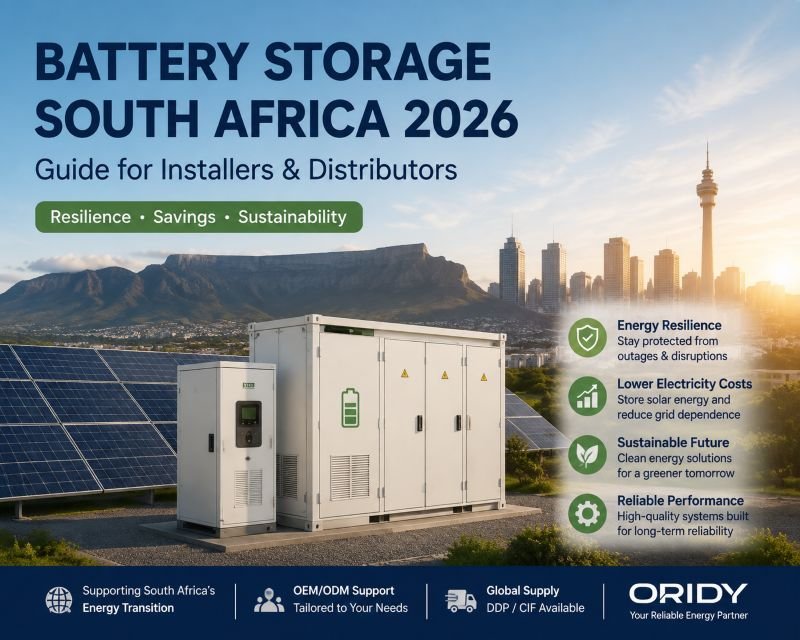
Battery storage in South Africa is entering a different phase in 2026. The market is no longer driven mainly by national load shedding. For installers, distributors and project developers, storage is increasingly about solar self-consumption, electricity-cost management, backup resilience and commercial continuity.
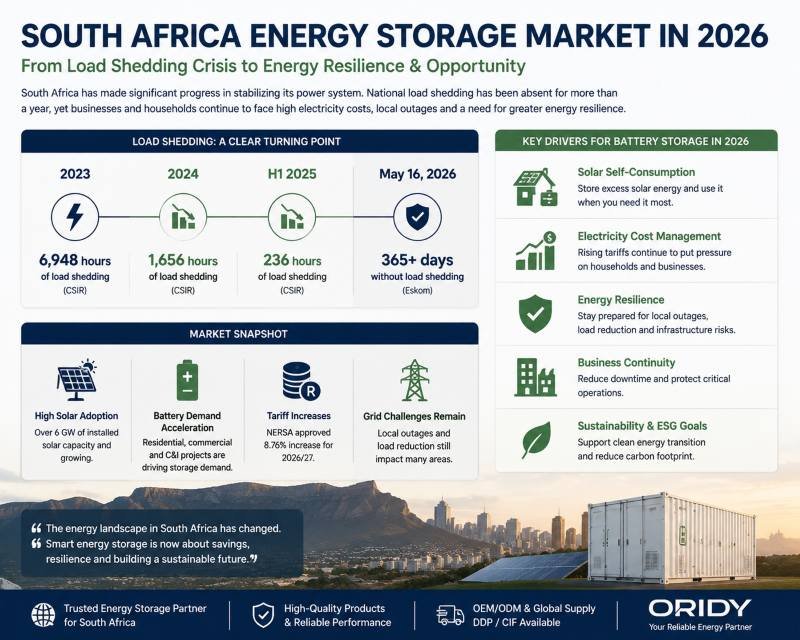
South Africa’s battery-storage market can no longer be explained by one sentence about endless Eskom blackouts. National load shedding has been absent for more than a year, according to Eskom and government updates available in August 2026. That is a substantial change from the emergency conditions of 2023.
Battery demand has not disappeared; the buying logic has become more selective. Households may want backup for local interruptions and greater use of their rooftop solar. Businesses may value continuity, solar energy shifting, tariff management, or less generator use. Installers need dependable battery–inverter integration. Distributors need products that suit the inverter ecosystems, price expectations, service requirements, and inventory cycles of their actual channels.
For the South African market in 2026, the relevant question is not “When will the next blackout happen?” It is “What measurable job will this battery perform, and can the complete system perform it safely and economically?”
Is Load Shedding Still Happening in South Africa?
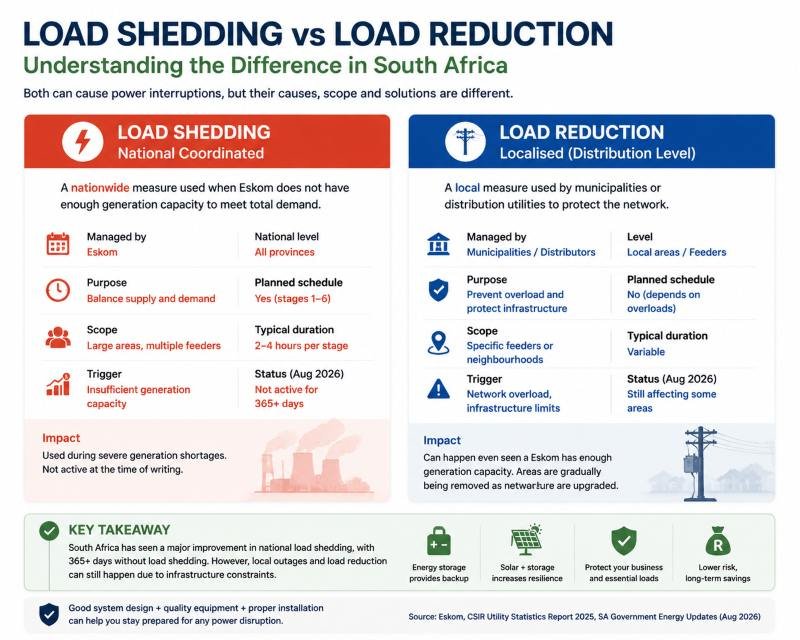
National load shedding was not active when this article was reviewed on 19 August 2026. Eskom marked 365 consecutive days without load shedding in May 2026, and the South African Government reported 441 consecutive days in early August. That makes any claim that rotational cuts have continued without interruption since 2023 factually wrong.
The improvement did not happen overnight. CSIR’s electricity statistics show that load shedding peaked at 6,948 hours in 2023, then fell to 1,656 hours in 2024 and 236 hours in the first half of 2025. Eskom’s 2026 winter outlook described improving generation availability and lower unplanned losses. By 24 July 2026, Eskom reported a financial-year-to-date Energy Availability Factor of 66.22%, while its daily figure had briefly reached 80.24%.
Those figures support a clear conclusion: the 2023 crisis should be treated as historical context, not as the present-tense opening of a sales article. They do not prove that every customer now receives perfect power, nor do they guarantee that national load shedding can never return.
Load reduction is a different problem
South African buyers may still use “load shedding” as a loose label for any interruption, but installers and suppliers should be precise. In March 2026, the Department of Electricity and Energy stated that load reduction is not load shedding. Load reduction is a local network-protection measure used where distribution infrastructure is at risk from sustained overloading, including conditions associated with illegal connections, meter bypass, tampering, and vandalism. It is not evidence of a national generation shortfall.
The distinction matters commercially. A household on a load-reduction feeder has a different problem from a commercial site assessing solar self-consumption, and both differ from a factory exposed to a local network fault. The required battery power, energy, transfer behavior, operating schedule, and return calculation can all differ.
Eskom reported in July 2026 that more than one million customers had been removed from load-reduction schedules, while remaining affected areas were concentrated mainly in Gauteng and KwaZulu-Natal. The situation was improving but had not been eliminated nationally. Installers should therefore use current local feeder and utility information instead of a national slogan.
Why Are South Africans Still Buying Batteries?
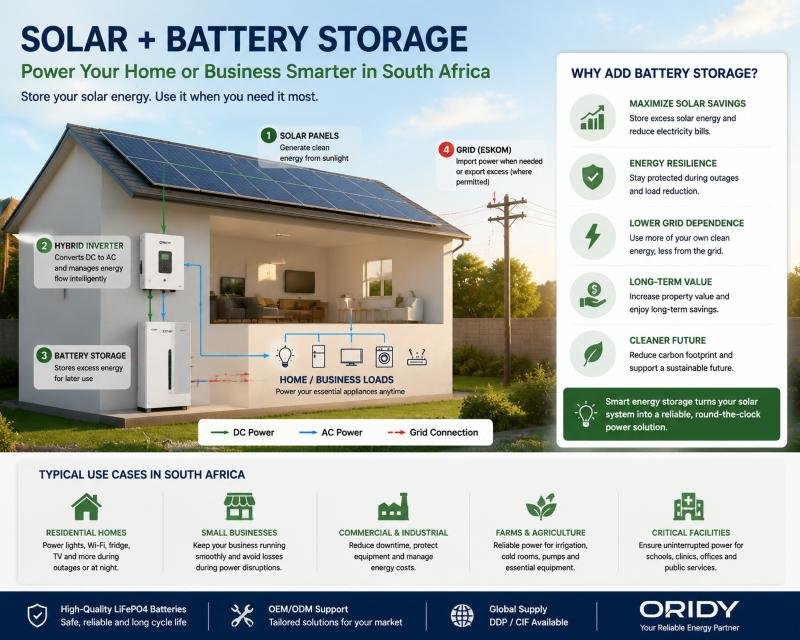
Storage still solves real problems even when national load shedding is suspended. The strongest 2026 use cases are energy resilience, solar self-consumption, electricity-cost management, critical-load continuity, and integration of additional renewable generation.
| Demand driver | What the battery does | What must be measured first |
|---|---|---|
| Local outage or load reduction | Supplies selected loads while the grid is unavailable | Critical-load kW, outage duration, surge loads, recharge opportunity |
| Solar self-consumption | Stores midday PV for evening or overnight use | Half-hourly or interval load and PV profiles, export rules, usable battery energy |
| Electricity-cost pressure | Shifts energy or reduces exposure where the applicable tariff rewards it | Exact tariff structure, time periods, demand charges, losses, cycle cost |
| Business continuity | Keeps defined processes, communications, security, or refrigeration operating | Critical process power, duration, transfer tolerance, restart current |
| Generator optimisation | Reduces inefficient generator runtime or coordinates charging | Generator rating, minimum loading, fuel logic, inverter support, control sequence |
| Future system expansion | Adds energy capacity as loads or PV grow | Supported module count, BMS topology, inverter limit, expansion rules |
Solar self-consumption is now a central use case
South Africa has a substantial installed rooftop-solar base. The government’s Integrated Resource Plan 2025 estimated about 6 GW of rooftop PV. Solar generation is concentrated in daylight hours, while many residential loads increase in the evening. A battery can shift surplus daytime energy into later hours, subject to system losses, battery limits, tariff design, and customer behavior.
This does not make every battery investment automatically economical. An installer should compare the customer’s import price, export compensation, load profile, available PV surplus, expected cycling, and the total installed system cost. A customer who exports valuable energy under a favorable arrangement may reach a different conclusion from one who receives little value for export.
Eskom’s March 2026 small-scale embedded generation update also shows why compliance cannot be an afterthought. Registration and metering requirements depend on the supply authority and system arrangement. Battery suppliers should not promise that a product certificate by itself completes grid-connection approval.
Electricity cost remains commercially relevant
Power reliability improved, but electricity did not become cheaper. NERSA’s 2026/27 retail-tariff decision approved an average adjustment of 8.76% for Eskom direct standard tariffs and 9.01% for municipal categories, with actual charges varying by customer class and tariff. CSIR reported that the national average tariff had risen much faster than inflation over the preceding decade.
Tariff pressure creates interest in self-generation and storage, but the savings case must be calculated for the specific account. A battery cannot reduce a charge that is unrelated to its operating strategy. For commercial sites, a proper assessment may require interval data, maximum demand, time-of-use periods, contracted capacity, PV output, battery dispatch constraints, and degradation assumptions. Marketing phrases such as “cut your bill by 80%” should not be used without a project model.
Grid-scale growth confirms storage’s wider role
South Africa’s storage story is also larger than residential backup. The public Battery Energy Storage IPP Procurement Programme is procuring grid-connected capacity for grid services and renewable integration. The IPP Office’s Q3 2025/26 report recorded 513 MW under Bid Window 1 in construction and further preferred-bidder capacity under Bid Windows 2 and 3.
These utility projects are not evidence of residential battery sales, and they should not be used to invent a wholesale market-size figure. They do, however, demonstrate that storage now serves system flexibility and renewable integration—not only blackout backup.
Residential and Commercial Demand Are Not the Same
A distributor should not treat “South Africa battery demand” as one uniform segment. Residential buyers, small businesses, commercial properties, and EPC projects buy different outcomes and carry different technical and service risks.
| Segment | Typical decision | Main technical checks | Main commercial risk |
|---|---|---|---|
| Residential retrofit | Add backup or solar shifting to an existing inverter | Compatibility, usable kWh, continuous current, essential loads, expansion | Callback caused by mismatched protocol or unrealistic runtime |
| New residential solar-plus-storage | Select an integrated system | PV array, hybrid inverter, battery voltage, backup output, tariff and SSEG rules | System sold on capacity without adequate power or commissioning support |
| Small business | Protect defined operations and use PV more fully | Load profile, surge, three-phase arrangement, transfer behavior, generator interface | Lost operations despite a battery being present because critical loads were not defined |
| Commercial and industrial | Model energy and continuity outcomes | Interval data, demand profile, EMS controls, PCS power, fire and site design | Payback claims that ignore tariff structure, degradation, or operating limits |
| Distributor stock | Cover repeatable installer configurations | Local inverter ecosystem, module sizes, current capability, firmware, documentation | Slow inventory or high warranty exposure from an unvalidated product range |
Residential products should not be presented as suitable for commercial duty solely because enough modules can be connected. Commercial systems may require different architecture, controls, protection, thermal management, documentation, and project engineering.
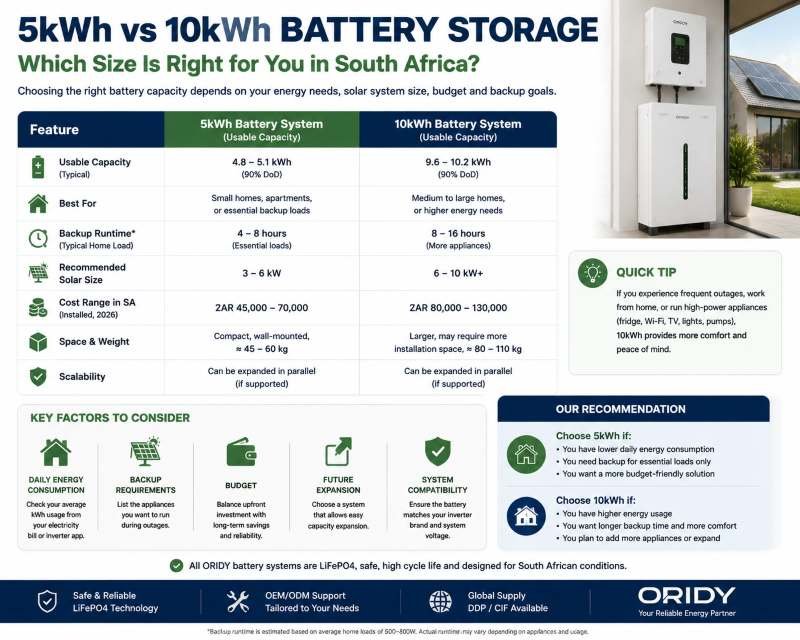
Is a 5kWh or 10kWh Battery Better?
Neither size is inherently better. A suitable capacity follows from critical energy consumption, required autonomy, PV recharge, permitted depth of discharge, conversion losses, battery power, and future expansion.
For an initial energy estimate:
Required nominal battery energy ≈ critical-load energy ÷ usable fraction ÷ assumed system efficiency
Consider a simplified example in which selected loads average 800 W for five hours. Their energy requirement is:
0.8 kW × 5 hours = 4 kWh
If a planning exercise assumes 90% usable battery energy and 90% conversion efficiency:
4 kWh ÷ 0.90 ÷ 0.90 ≈ 4.94 kWh nominal
This example illustrates the method; it is not a product recommendation or a runtime guarantee. Real performance depends on variable loads, inverter efficiency, battery limits, temperature, system condition, and reserve settings. A refrigerator, pump, gate motor, or compressor can also create a starting-power requirement that an average-energy calculation does not capture.
| Question | 5kWh-class system may fit when… | 10kWh-class system may fit when… |
|---|---|---|
| Critical energy | The protected load and duration are limited | More energy or longer autonomy is required |
| Solar shifting | Evening surplus and loads are modest | More daytime surplus can be shifted into evening use |
| Budget allocation | The buyer prioritises essential circuits | The buyer values longer coverage or more usable solar energy |
| Expansion | The platform supports an additional matched module later | Immediate demand justifies more capacity and reduces near-term expansion |
| Inverter power | Battery current still supports the inverter load | Additional modules may support more current only if the design permits it |
Capacity in kWh and power in kW must remain separate. A nominal 5.12 kWh battery does not automatically supply a 5 kW inverter continuously. At a nominal 51.2 V, 5 kW of DC power corresponds to approximately 97.7 A before allowing for voltage variation and losses:
5,000 W ÷ 51.2 V ≈ 97.7 A
The cells, BMS, terminals, protection, cables, and complete battery bank must support the required current under documented conditions. The inverter’s maximum charge current must also remain within the battery system’s permitted charge limit.
Battery capacity is only one part of system sizing. Installers should also verify battery and inverter compatibility before confirming a configuration.
Which Battery Specifications Matter Most?
Installers should evaluate the complete operating system, while distributors should also consider whether the specifications can be supported consistently across batches. Capacity and price alone are insufficient.
Voltage and inverter architecture
Confirm the battery’s full operating-voltage range against the exact inverter battery-input range. A “48 V” or “51.2 V” label is not the complete operating window. Low-voltage and high-voltage architectures are not interchangeable, and high-voltage stacks may require an approved master controller, contactors, module sequence, and pre-charge process.
Continuous and peak current
Request continuous charge and discharge limits, peak limits with permitted duration, and any temperature-dependent derating. Determine whether the rating applies to one module or the complete supported bank. Verify that the inverter settings and maximum possible charging sources cannot exceed the battery limit.
BMS and communication
The battery management system (BMS) monitors cells and pack conditions and may transmit SOC, voltage, temperature, alarms, and dynamic charge or discharge limits. CAN or RS485 connector presence does not prove protocol compatibility. Confirm the exact protocol profile, cable pinout, bitrate or baud rate, inverter setting, firmware versions, and tested functions.
Usable energy and operating conditions
Nominal energy is voltage multiplied by ampere-hours. Usable energy depends on the permitted operating window, BMS settings, temperature, system reserves, and product-specific limits. Request performance conditions rather than comparing a headline kWh number alone.
Expansion rules
Confirm the maximum supported module count, power and communication topology, master/follower configuration, cable arrangement, protection, firmware requirements, and rules for adding a new battery to an older bank. “Parallel capable” is not a complete expansion specification.
Installation environment and documentation
Review documented indoor or outdoor suitability, enclosure rating, permitted temperature and humidity, clearances, mounting, ventilation, cable requirements, isolation, protection, and commissioning instructions. An enclosure rating does not by itself make every installation location acceptable.
What About Deye- and Sunsynk-Type Systems?
A battery should be described as compatible with a Deye, Sunsynk, or any other inverter only when the exact battery and inverter models have a documented, supported integration. Brand-level compatibility is too broad.
For a defensible compatibility record, obtain:
- exact inverter model and regional variant;
- exact battery model and BMS or hardware revision where relevant;
- battery and inverter firmware versions;
- low-voltage or high-voltage architecture;
- supported CAN or RS485 protocol profile;
- documented communication cable and pinout;
- inverter battery-profile setting;
- continuous and peak charge/discharge limits;
- supported number of modules and master/follower configuration;
- functions verified during testing, including SOC, dynamic limits, alarms, shutdown, and recovery;
- written warranty and technical-support treatment for the combination.
A matching RJ45 socket only confirms that two ports use the same connector shape. It does not confirm pinout or protocol. Open-loop voltage-mode operation, where supported by both manufacturers, is also not equivalent to closed-loop BMS integration. The inverter may lose accurate SOC reporting, dynamic current limits, and coordinated fault behavior.
For distributors, a sample should be tested with the exact inverter model and firmware found in the target installer channel. A compatibility list without revision dates or model numbers should be treated as preliminary evidence, not final approval.
What Should Be Confirmed Before Importing LiFePO4 Batteries from China?
Import procurement should begin with the application and evidence package, not a price-per-kWh comparison. The South African buyer or its appointed specialist must confirm the current customs classification, duties, restricted-goods position, product requirements, installation rules, and transport arrangements for the specific goods.
SARS states that importers must register and that a foreign importer must nominate a registered South African agent. Customs classification matters because duties and controls follow the actual tariff heading. Do not reuse a lead-acid or inverter classification for a lithium storage battery without professional verification.
Technical RFQ checklist
| RFQ field | What to request |
|---|---|
| Application | Residential backup, solar shifting, small business, commercial, or another defined use |
| Battery identity | Chemistry, exact model, nominal and usable energy, cell and BMS identification where contractually required |
| Voltage | Nominal and complete operating range; charging and discharge limits |
| Current and power | Continuous and peak charge/discharge current, duration, derating conditions |
| Inverter integration | Exact tested inverter models, protocol, cable, pinout, settings, and firmware |
| Expansion | Supported module count, communication topology, current sharing, mixed-age rules |
| Safety and product evidence | Applicable standards, certificates, test reports, declarations, manuals, labels, and model linkage |
| Transport | Current UN 38.3 test summary and other dangerous-goods documents required by the chosen mode and carrier |
| Installation package | Manuals, wiring diagrams, protection requirements, commissioning procedure, fault codes |
| Quality control | Agreed incoming and pre-shipment checks, serial/version traceability, change control |
| Commercial terms | Quantity, packaging, OEM scope, quotation validity, lead time, warranty process, spare strategy—confirmed for the actual order |
IEC 62619:2022 covers safety requirements and tests for secondary lithium cells and batteries used in industrial applications, including stationary applications. Its relevance does not mean that an IEC reference alone proves South African market access or suitability for a complete installed system. Buyers should verify the exact report, issuing body, model coverage, edition, and destination-market requirements.
Lithium batteries are also regulated for transport. The UN Manual of Tests and Criteria contains subsection 38.3 for lithium cells and batteries, and the test summary must be available in the supply chain. Transport compliance can also depend on battery configuration, state of charge, packaging, marks, labels, documentation, mode, and carrier rules. A PDF named “UN38.3” should be checked for the correct manufacturer and model rather than accepted by filename.
Verify evidence before a bulk order
- Check that each certificate or report identifies the exact product or a traceable model family.
- Compare the datasheet, label, manual, quotation, test report, and packing list for consistent model names and ratings.
- Test a representative battery–inverter combination with the intended firmware and cable.
- Record SOC, charging, discharging, current limits, alarms, shutdown, restart, and multi-module behavior.
- Agree how hardware, cells, BMS, firmware, or protocol changes will be disclosed and re-approved.
- Define diagnostic evidence, replacement responsibility, return logistics, and support contacts before shipment.
- Verify packaging and dangerous-goods documentation with the freight forwarder and carrier for the actual route.
Neither a low factory quotation nor a generic compatibility logo compensates for weak version control and after-sales evidence.
How Should Distributors Plan Stock in 2026?
The emergency-buying cycle rewarded whatever could provide immediate backup. A more stable market rewards fit, support, and inventory discipline. Distributors should use their own sales and installer data to choose a range rather than assume that every household wants the same 5 kWh or 10 kWh product.
Useful inputs include:
- inverter models already installed in the channel;
- frequency of low-voltage versus high-voltage projects;
- residential versus small-commercial demand;
- typical critical-load power and desired autonomy;
- attach rate to new PV installations;
- demand for wall-mounted, floor-standing, or rack formats;
- expansion frequency;
- installer commissioning capability;
- returns and fault causes by model and firmware;
- landed cost, local competing prices, inventory days, and support cost.
South African customers may already have strong local distributor options. Direct sourcing from China is not automatically cheaper after freight, customs, finance, inventory, service, spares, and warranty handling. A China-sourcing strategy is more defensible when it offers a verified configuration, differentiated product or packaging, a sustainable supply path, or an OEM opportunity that the channel can support.
Start with a controlled technical and commercial trial when appropriate. Do not publish a universal MOQ, sample quantity, price, lead time, or warranty term; these depend on the exact product, supplier, customization, and order.
Which South Africa Battery Claims Should Be Retired?
The following statements should not appear in current ORIDY content unless new, dated evidence changes the facts:
- “Eskom’s blackouts never stop.”
- “South Africa has had continuous load shedding since October 2023.”
- “Every home loses power for up to 12 hours a day.”
- “Battery demand is caused only by load shedding.”
- “The economic cost is more than R300 billion every year.”
- “Any 48 V battery works with a 48 V inverter.”
- “CAN-compatible means Deye- or Sunsynk-compatible.”
- “A 10 kWh battery can supply 10 kW.”
- “Buying from a Chinese factory is always cheaper than buying locally.”
- “One certificate makes the battery legal and suitable everywhere in South Africa.”
Replace absolutes with a dated market fact, a customer-specific calculation, or a product-specific verification step.
Build the Battery Offer Around the Job
South Africa’s electricity market has moved beyond the peak load-shedding crisis, but storage still supports resilience, solar self-consumption, cost management, commercial continuity, and a changing power system. The opportunity is more durable when batteries are selected for a measured use case rather than sold through fear of an outage schedule.
If you are evaluating battery products for South African projects or distribution, send ORIDY ENERGY the intended application, exact inverter models, required energy and power, estimated quantity, installation environment, expansion plan, and required documentation. As a China-based renewable-energy supply-chain and technical-coordination partner, ORIDY ENERGY can help organise supplier, configuration, compatibility, and sourcing questions before a final quotation. Product suitability and market compliance must be confirmed for the exact models and project.