
EV Charger Solar Battery Saudi Arabia Wholesale: Vision 2030 Sourcing Guide 2026
EV charger solar battery Saudi Arabia wholesale is the single largest procurement opportunity in the Middle East — because Vision 2030 is not a policy paper, it is a construction schedule. Saudi Arabia is building six new cities, deploying 50,000 public EV chargers by 2030, and mandating solar-plus-storage in new government and commercial buildings exceeding 5,000 square metres. The Public Investment Fund has committed more than 100 billion dollars to clean energy and EV manufacturing, including the Ceer EV brand — a Foxconn-BMW joint venture targeting 170,000 vehicles a year. Tenders are being awarded right now. The hardware that wins them must be SASO-certified, 65°C-rated, and priced for volume. This guide covers all three requirements and shows you how to source the equipment that qualifies.
For distributors, this market behaves differently from Europe or North America. Saudi buyers do not chase the cheapest unit price; they chase specification compliance, because a non-compliant shipment is rejected at the port of Dammam or Jeddah and must be re-exported or destroyed. The SASO (Saudi Standards, Metrology and Quality Organization) enforces mandatory conformity for every EV charger and battery entering the Kingdom. Layer on a climate where summer ambient temperatures exceed 50°C in Dammam, Riyadh, and Jeddah, where fine desert dust strips enclosures rated below IP65 within a single sandstorm season, and where UV radiation degrades non-stabilised polymers in under two years — and you have a market where equipment that works in a German basement fails within a single Saudi summer.
The gap between what a general supplier offers and what a Saudi tender actually requires is exactly where a sourcing agent earns its fee. In this guide we break down the Vision 2030 demand drivers, the exact specifications that win, the SASO certification path, the Dammam and Jeddah import logistics, and the products Oridy Energy sources and ships DDP double-clearance to your door.
Featured Snippet: What is EV charger solar battery Saudi Arabia wholesale?
It is the bulk supply of SASO-certified Type 2/CCS2 EV chargers and LiFePO4 solar storage batteries for Saudi Arabia’s Vision 2030 market. Winning equipment is 65°C-rated, IP65 or better, OCPP 2.0 compatible, and shipped with Arabic documentation. Wholesale buyers import through Dammam or Jeddah at 5% duty plus 15% VAT, ideally on DDP double-clearance terms. Oridy Energy sources certified product and delivers door-to-door.
1. Why Is Saudi Arabia’s Vision 2030 Creating Unmatched Demand for EV Chargers and Solar Batteries?
Quick Answer: Vision 2030 turns government money into installed hardware. The Kingdom is building six new cities, funding the Ceer EV brand at 170,000 vehicles a year, and targeting 50,000 public EV chargers by 2030. Solar-plus-storage is mandatory in new government and commercial buildings over 5,000 square metres, and the Public Investment Fund has committed over 100 billion dollars to clean energy and EV manufacturing. For distributors, this is a decade of guaranteed demand — not a subsidy-driven spike.
What exactly does Vision 2030 commit to for EVs and charging infrastructure?
The headline number is 50,000 public charging points by 2030, but the real signal is the supporting ecosystem being built alongside it. Saudi Arabia is not importing its EV transition — it is manufacturing it. Ceer, the Kingdom’s first domestic EV brand, is a joint venture between the Public Investment Fund and Foxconn, using BMW-licensed component technology, with a stated capacity of 170,000 vehicles per year. That scale of domestic assembly creates a localised charging network that must be built, installed, and maintained by suppliers — which means continuous demand for AC wallboxes, DC fast chargers, and the storage batteries that buffer solar generation for them. For a wholesale distributor, a domestic automaker of Ceer’s size is a guaranteed anchor customer for charging hardware for a decade, not a one-off tender.
Why is Ceer such an important signal for equipment buyers?
Because Ceer removes the chicken-and-egg problem that stalled EV adoption in other markets. Most countries wait for vehicle sales to justify chargers, or for chargers to justify vehicle sales. Saudi Arabia is financing both sides of the equation at once, through the same sovereign fund. When a government-owned automaker targets 170,000 vehicles annually while the state simultaneously commits to 50,000 public chargers, neither side can quietly stall — the state owns the outcome. That is why forward-looking distributors treat the Saudi charger market as contracted future volume rather than speculative demand. The chargers that will populate that network are Type 2 for AC and CCS2 for DC, the European standard adopted across the Gulf, which means one certified product line serves the entire GCC, not just one city.
How large is the solar-plus-storage opportunity alongside EV charging?
It is the same construction boom wearing a second hat. The mandate for solar-plus-storage in new buildings over 5,000 square metres applies to offices, malls, hospitals, and government facilities — every one of which will also need EV charging in its car park. The home market mirrors it: Saudi villa owners are quality-first buyers who pair rooftop solar with 10 to 20 kWh LiFePO4 batteries and hybrid inverters, with Sungrow, Huawei, and SMA as the dominant inverter brands. Each villa installation that adds a home EV charger becomes a three-product sale: panels, storage, and charging. Distributors who can supply the storage and the charger together capture the highest-value customer relationship, which is precisely why “EV charger + solar battery” is the winning bundle in this market.
2. Which EV Charger and Solar Battery Specifications Win Saudi Tenders?
Quick Answer: Saudi-spec EV chargers are Type 2 for AC and CCS2 for DC, with OCPP 2.0 for national network interoperability. AC wallboxes run 7 to 22 kW with IP65 minimum, RFID authentication, and a 65°C operational rating. DC fast chargers run 60 to 120 kW CCS2, with liquid-cooled cables at 120 kW and above. Home batteries are 10 to 20 kWh LiFePO4, IP65 outdoor-rated, hybrid-inverter compatible, with a minimum 10-year warranty. Climate compliance — not price — is the first filter.
What connector and protocol standards does Saudi Arabia require?
The Kingdom has adopted the European charging standard across the entire GCC: Type 2 for AC charging and CCS2 for DC fast charging. North American Type 1 and CCS1 equipment is not compatible and cannot be legally installed. On top of the physical connector, Saudi Arabia requires OCPP 2.0 — the Open Charge Point Protocol version 2.0 — so that chargers from any manufacturer can communicate with the national charging network and with any charge-point operator’s back office. A charger that is Type 2 and CCS2 but still running the older OCPP 1.6 will be excluded from network tenders that mandate 2.0. Confirm protocol version at the firmware level before you quote, because retrofitting an older charger to OCPP 2.0 is often more expensive than sourcing the correct unit from the start.
Which climate ratings does the 65°C desert environment demand?
Saudi ambient temperatures exceed 50°C, and surface temperatures on sun-exposed enclosures climb higher still — which is why the operative rating that matters is a 65°C ambient operating range, not the 40°C maximum common in European equipment. Enclosures must be IP65 minimum, with IP67 preferred for dust-heavy coastal and desert sites; fine Saudi dust defeats IP54 within a single season. UV-stabilised polymers are non-negotiable for any outdoor installation, because unstabilised plastic embrittles and fades in 18 to 24 months under Gulf sunlight. The practical test for a distributor is simple: if the datasheet says “IP54, 0 to 40°C, indoor use,” it is a European product being mis-sold into a Gulf climate, and it will fail — taking your warranty liability with it.
How do you choose between AC wallboxes and DC fast chargers?
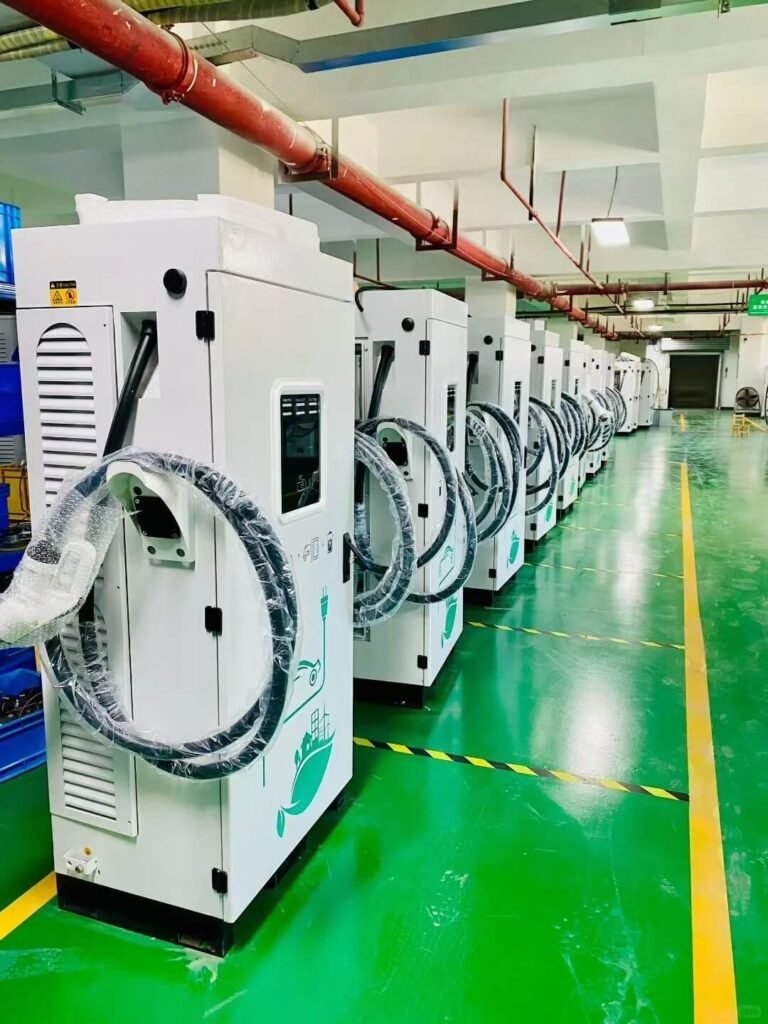
Match the charger to the dwell time. AC wallboxes at 7 to 22 kW suit villas, offices, malls, and hotels, where a vehicle parks for hours and charges overnight or through the workday — these are the volume products, sold in the thousands. DC fast chargers at 60 to 120 kW suit highways, retail fuel forecourts, and fleet depots, where turnover is measured in minutes; at 120 kW and above, liquid-cooled cables become effectively mandatory to keep charge sessions safe and comfortable. The storage battery pairs with both: a home or office charger benefits from a LiFePO4 battery buffering solar generation, while DC hubs increasingly pair with larger storage to shave peak demand charges. The table below maps the product set that Oridy Energy sources for this market.
Saudi Arabia EV Charger & Storage Product Matrix
| Product | Specification | Application | Target Buyer | Key Requirement |
|---|---|---|---|---|
| AC wallbox (Type 2) | 7–22 kW, IP65/IP67, RFID | Villa, mall, office parking | Developers, CPOs | 65°C rating, OCPP 2.0 |
| DC fast charger (CCS2) | 60–120 kW, liquid-cooled at 120 kW | Highway, retail, fleet | National network, PIF projects | CCS2 only, no CHAdeMO |
| Portable power station | 1 kWh / 2 kWh | Camping, construction, events | Retailers, SMEs | 30-unit MOQ |
| Home all-in-one battery | 5 / 10 / 16 kWh | Villa solar-plus-storage | Distributors, installers | IP65, hybrid compatible |
| Split storage system | 32 kWh | Commercial, villa estate | Project developers | Custom, 2–3 month lead |
Specifications for the Saudi Vision 2030 market, Q3 2026. Source: Oridy Energy factory portfolio.
🔌 Sourcing EV Chargers & Solar Batteries for Saudi Arabia? We Can Help.
SASO-ready Type 2/CCS2 chargers and LiFePO4 storage. 65°C and IP65 spec confirmed. OCPP 2.0 firmware. Arabic documentation included. DDP Dammam or Jeddah. OEM branding with your logo. MOQ from 30 units. Get a Quote →
3. How Do You Get SASO Certification for EV Chargers and Batteries?
Quick Answer: SASO certification is mandatory, not optional. It takes three to five weeks through SASO-accredited bodies SGS, Bureau Veritas, or Intertek — ask Oridy for a current fee quote. The process includes factory audit, IEC product testing, and documentation review, plus a separate budget for Arabic-language documentation. Products arriving at Dammam or Jeddah without a valid SASO Certificate of Conformity are rejected, not delayed — start certification before your production order.
What does the SASO process actually cost and how long does it take?
Plan a three-to-five-week timeline through SGS, Bureau Veritas, or Intertek, the SASO-accredited inspection bodies; the fees are modest compared with the cost of a rejected or held container. A “product family” is a group of models sharing the same core design — so a 7 kW, 11 kW, and 22 kW wallbox built on one platform can often be certified as a single family, while a wallbox and a DC fast charger are two separate families. Renewal is annual with reduced fees, but the first registration is the one that blocks or unblocks your entry. The practical rule is to start certification the moment you select a product, in parallel with production, so the certificate is ready when the container reaches Saudi customs — never after.
Why is Arabic documentation a hard requirement?
Saudi regulations require product documentation in Arabic — installation manual, user guide, and warranty terms included. An English-only manual does not comply, and a non-compliant manual is treated as a non-compliant product at clearance. Professional translation and layout is an affordable, well-defined line item, and it must be technically accurate, because a mistranslated safety instruction is a liability, not a typo. This is a frequent failure point for first-time importers who assume English documentation “will be fine.” It will not. Fold Arabic documentation into your SASO budget from day one, and treat it as part of the certification cost, not an afterthought.
Do you need a local partner to sell into Saudi Arabia?
For government and large corporate tenders, yes. Saudi government tenders typically require a local partner or a registered commercial entity — many international suppliers operate through a Saudi trading partner or a Saudi Limited Liability Company registered via SAGIA (now part of MISA, the Ministry of Investment). The local partner handles SASO liaison, customs clearance, and client-facing commercial relationships, and Saudi tenders commonly pay within 60 to 90 days with performance guarantees and irrevocable Letters of Credit for large purchases. A sourcing agent does not replace that local partner, but it removes the China-side risk: verifying the factory, confirming the SASO test basis, and ensuring the goods leave the factory compliant rather than hoping they are accepted at the port.
4. How Do You Import Equipment into Saudi Arabia Through Dammam and Jeddah?
Quick Answer: Dammam on the Arabian Gulf serves the Eastern Province and Riyadh; Jeddah on the Red Sea serves the Western Province. Sea freight from Shanghai runs 18 to 22 days — among the fastest China-to-Middle-East transit times. Import duty on EV chargers and solar batteries is 5% under the GCC Common External Tariff, plus 15% VAT. Budget 7 to 10 working days clearance with correct SASO paperwork, longer if discrepancies arise. DDP Dammam or Jeddah is the recommended term for first-time importers.
Which port should you use and what is the transit time?
Choose the port closest to your customer, not the one your forwarder prefers. Dammam, on the Arabian Gulf, feeds the Eastern Province — the Kingdom’s industrial heartland — and the capital Riyadh. Jeddah, on the Red Sea, feeds the Western Province and the Red Sea megaprojects. Sea freight from Shanghai to Dammam takes 18 to 22 days, which is among the fastest container transit times from China to the Middle East and makes Saudi Arabia one of the most logistically attractive markets in the region. Both ports are modern and well-equipped, but both apply the same rigorous SASO documentary check, so the deciding factor is almost always geography: ship to the port that minimises the final inland leg to your buyer.
What duties, VAT, and clearance timeline should you budget?
Import duty on EV chargers and solar batteries is 5% under the GCC Common External Tariff for renewable-energy equipment, and VAT is 15%. Those are the headline numbers, but the timeline is where importers lose money. With complete and correct SASO documentation, clearance runs 7 to 10 working days; with discrepancies, it stretches to 10 to 20 working days while the shipment sits incurring storage and demurrage. Saudi customs checks every shipment against its SASO Certificate of Conformity, so a missing or mismatched certificate is not a minor delay — it is the single most common cause of a container being held. Get the certificate right, get the commercial invoice and packing list matching the certificate exactly, and clearance stays in the fast lane.
Why is DDP double-clearance the right term for first-time importers?
DDP — Delivered Duty Paid — to Dammam or Jeddah means your supplier handles export clearance in China, ocean freight, import duty, VAT, and Saudi-side customs clearance, delivering to your warehouse or project site. Oridy Energy ships DDP with double-clearance to the door, which removes the two places first-time importers most often stumble: Chinese export clearance and Saudi import clearance. Note that this is sea freight, not air freight — lithium batteries and heavy chargers move by container, and there is no air shortcut for storage products. For first-time importers and smaller shipments, DDP is strongly recommended; at higher volumes, experienced buyers sometimes shift to CIF and manage Saudi clearance themselves to capture the logistics margin.
🚀 Ready to Start Your Saudi Arabia Order?
Tell us: product + quantity + destination port. We quote within 24 hours — SASO documentation, Arabic manuals, and DDP double-clearance to Dammam or Jeddah included. Contact Oridy Energy →
5. What Does the Saudi EV Charger and Storage Market Look Like by 2030?
Quick Answer: The 50,000 public chargers targeted by 2030 translate into sustained wholesale volume across AC wallboxes and DC fast chargers, while Ceer’s 170,000-vehicle annual capacity guarantees localised demand for the charger network supporting it. Solar-plus-storage attaches to every new building over 5,000 square metres and to quality-first villa buyers. The fastest-growing segments through 2030 are DC fast charging, home all-in-one storage, and the charger-plus-battery bundle — the three categories where a certified, climate-rated supplier wins.
How does the 50,000-charger target translate into wholesale volume?
Fifty thousand public chargers is a mix, not a single SKU. The majority will be AC wallboxes in malls, offices, hotels, and residential developments — high-volume, lower-unit-value products where a distributor wins on certification, price, and supply reliability. A meaningful minority will be DC fast chargers on highways and in retail fuel forecourts, where each unit is worth ten times an AC wallbox and carries far more engineering risk. Smart distributors position for both: AC volume to build cash flow and DC projects to build margin. Because the entire network is being built to one standard — Type 2/CCS2 with OCPP 2.0 — a single certified product line serves both segments and the wider GCC, multiplying the value of one SASO investment across four more Gulf markets.
Which product segments will grow fastest through 2030?
Three segments stand out. First, DC fast charging, because highway and retail electrification lags the urban network and will be built out aggressively in the back half of the decade. Second, home all-in-one storage at 5, 10, and 16 kWh, because villa solar-plus-storage is a default purchase for Saudi homeowners, not an early-adopter niche, and the integrated all-in-one design makes these units a turnkey villa solution. Third, the charger-plus-battery bundle, because the same customer building a villa or opening a commercial site needs both, and a supplier who quotes both in one package wins the whole relationship. For each of these, the entry barrier is the same: SASO certification, climate-rated specification, and Arabic documentation. Clear that barrier once, and you are positioned across all three.
6. Why Does Oridy Energy’s Sourcing Model Fit the Saudi Market?
Quick Answer: Oridy Energy is a sourcing agent, not a factory — which means it works for the buyer, selecting and auditing the right factory for each product rather than pushing a single in-house line. It sources SASO-ready EV chargers and LiFePO4 storage from audited factories, then ships DDP double-clearance to the door across Africa, Asia, Latin America, and the Middle East.
What exactly does a sourcing agent do differently from a factory?
A factory sells what it makes; a sourcing agent buys what you need. For the Saudi market, that distinction matters because the winning product set spans two entirely different manufacturing disciplines — EV charging electronics and battery storage — that rarely exist under one roof. Oridy Energy’s role is to match each requirement to the right audited factory, verify SASO certification test basis and climate ratings before money changes hands, and manage the export so the goods arrive compliant. For a buyer who needs chargers and batteries together, a sourcing agent is the difference between one coordinated supply chain and two mismatched vendor relationships.
Which products can Oridy source for the Saudi market?
On the EV charger side, Oridy sources Type 1, Type 2, CCS1, CCS2, GB/T, and NACS connectors — covering everything from a 7 kW villa wallbox to a high-power DC fast charger, with the Type 2/CCS2 and OCPP 2.0 configuration the Saudi network requires. On the storage side, Oridy sources portable power stations at 1 kWh and 2 kWh, home all-in-one systems at 5, 10, and 16 kWh, and split systems at 32 kWh. Together these cover the villa, commercial, and portable segments of the Vision 2030 market.
How do MOQ and lead time work for Saudi orders?
Standard MOQ is 30 units, with custom and OEM-branded production carrying a two-to-three-month lead time — the window during which SASO certification and Arabic documentation run in parallel, so the certificate is ready when the goods ship. OEM goes beyond a logo: Oridy customises branding, connector interfaces, specifications, packaging, and multilingual manuals to match your target market. Because Oridy is an agent working across factories rather than a single plant, you are not locked into one product family or one minimum quantity; the mix can be tailored to what your Saudi customers actually order. Shipping is DDP double-clearance to the door, by sea — not air freight, which is not viable for lithium batteries and heavy chargers. Contact is direct: info@oridy.net or WhatsApp +86 182 1781 1889.
Frequently Asked Questions
1. What minimum order quantity applies to Saudi EV chargers and solar batteries?
The standard MOQ is 30 units across the charger and storage ranges. Custom and OEM-branded production carries a two-to-three-month lead time, which conveniently overlaps with the three-to-five-week SASO certification window, so your certificate and Arabic documentation are ready before the container ships.
2. Which EV connector standard does Saudi Arabia use?
Type 2 for AC charging and CCS2 for DC fast charging — the European standard adopted across the Gulf. North American Type 1 and CCS1 equipment is not compatible and cannot be legally installed. OCPP 2.0 is required for network interoperability. Oridy’s factory portfolio covers Type 2 and CCS2 in the correct configuration.
3. How much does SASO certification cost and how long does it take?
Plan three to five weeks through SGS, Bureau Veritas, or Intertek, and budget separately for Arabic-language documentation. Start certification before you place your production order, so the SASO Certificate of Conformity is ready when the goods reach Dammam or Jeddah.
4. Can Oridy deliver DDP to my warehouse in Dammam or Jeddah?
Yes. Oridy Energy ships DDP double-clearance to the door in Dammam, Jeddah, or any Saudi destination. Your price includes Chinese export clearance, ocean freight (18 to 22 days), 5% import duty, 15% VAT, and Saudi-side clearance. This is sea freight, not air freight — lithium batteries and heavy chargers move by container only.
5. Do I need Arabic documentation for my products?
Yes — it is a hard requirement, not a preference. Installation manuals, user guides, and warranty terms must be provided in Arabic. An English-only manual does not comply and will be treated as a non-compliant product at clearance. Oridy includes Arabic documentation in the sourcing package.
6. Why should I use a sourcing agent instead of buying directly from a factory?
A factory sells what it makes; a sourcing agent buys what you need. Oridy matches chargers and batteries to the right audited factory, verifies SASO test basis and 65°C climate ratings before you pay, and coordinates one supply chain for a two-product bundle. You get factory-direct pricing with buyer-side verification. Contact us for a supplier-verification checklist.
Ready to Supply Saudi Arabia’s Vision 2030 Market?
SASO-ready chargers and batteries, climate-rated for the Gulf, with Arabic documentation and DDP double-clearance to Dammam or Jeddah.Get Your Saudi Arabia Quote →
📧 info@oridy.net | 📱 +86 182 1781 1889
Disclaimer: SASO requirements, import duties, and Vision 2030 programme details are subject to change. Verify current regulations with your customs broker and SASO. Pricing and specifications are indicative as of Q3 2026.