
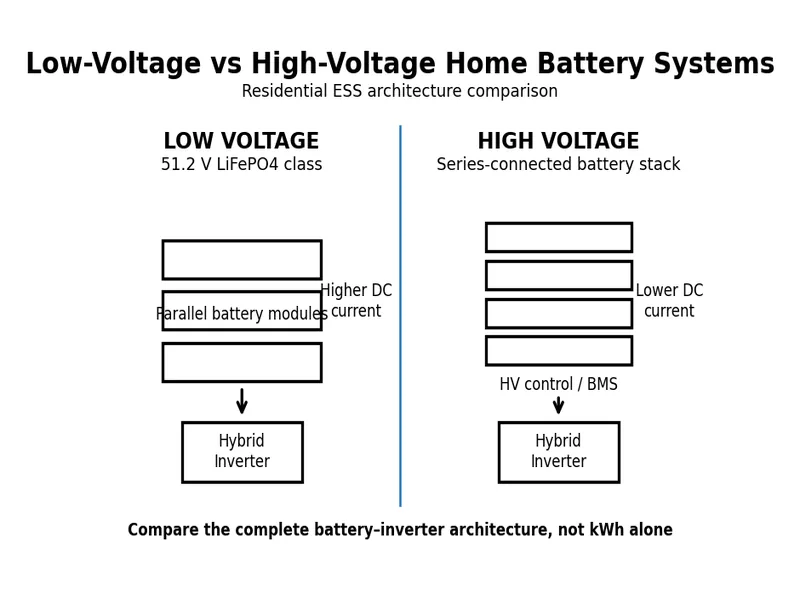
Low-Voltage vs High-Voltage Home Battery Systems: How to Choose the Right Architecture
A residential energy storage system can look simple from the outside: a lithium battery, a hybrid inverter, protection devices, and a few cables. But one decision changes almost everything behind that appearance—the battery-side operating voltage.
A 48 V or 51.2 V low-voltage battery system can be practical, familiar, and easy to service for many small and medium residential projects. A high-voltage battery system can reduce DC current dramatically, support higher inverter power with smaller conductors, and improve system-level efficiency in the right architecture. Neither is automatically “better.” The correct choice depends on inverter power, usable battery capacity, peak load, cable length, installation environment, local service capability, expansion plans, and—most importantly—whether the battery and inverter were designed and validated to work together.
Quick Answer:
Low-voltage batteries are usually a strong fit for cost-sensitive residential systems, common 48/51.2 V inverter platforms, and projects where simple serviceability matters. High-voltage batteries become more attractive as inverter power, charge/discharge power, and system capacity increase because higher DC voltage reduces current and cable losses. For procurement, do not select by battery kWh alone: confirm voltage window, BMS communication, current limits, inverter compatibility, protection requirements, and approved battery combinations before ordering.

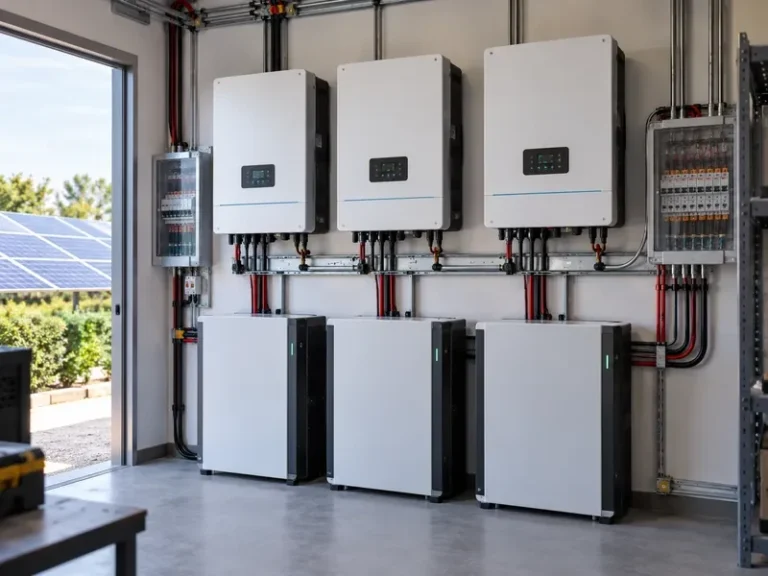
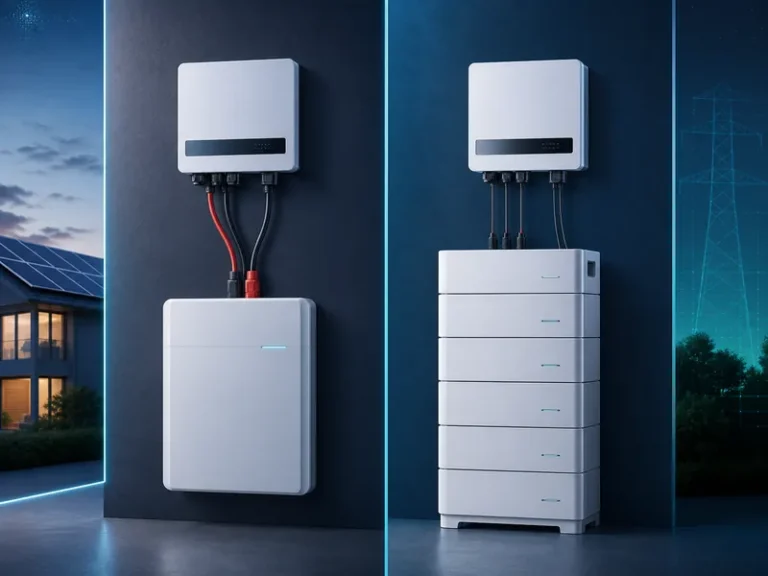
Image 1 — Featured image. Use as the WordPress featured image and place once below the Quick Answer if the theme also displays featured images inside the article.
Why Battery Voltage Matters More Than Many Buyers Expect
Battery capacity is usually marketed in kilowatt-hours, while inverters are marketed in kilowatts. That makes it easy to focus on two numbers—“10 kWh battery” and “10 kW inverter”—and assume they are a natural match.
They may not be.
The battery must deliver enough DC power to support the inverter. At a simplified level:
Power (W) = Voltage (V) × Current (A)
For the same power, lower voltage requires higher current.
Ignoring conversion losses for a moment:
| Required DC Power | Approx. Current at 51.2 V | Approx. Current at 200 V | Approx. Current at 400 V |
|---|---|---|---|
| 3 kW | 58.6 A | 15 A | 7.5 A |
| 5 kW | 97.7 A | 25 A | 12.5 A |
| 8 kW | 156.3 A | 40 A | 20 A |
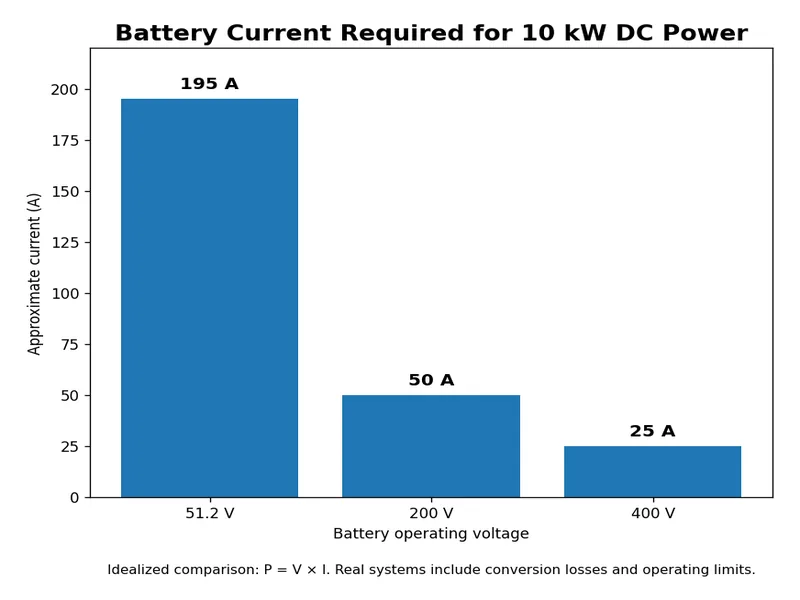
| 10 kW | 195.3 A | 50 A | 25 A |
| 12 kW | 234.4 A | 60 A | 30 A |
These are idealized calculations. Real systems must also account for inverter efficiency, BMS limits, cable losses, temperature, state of charge, and the manufacturer’s permitted operating range.
The practical point is straightforward: a low-voltage system can require several times more battery current than a high-voltage system to deliver the same power.
That difference affects:
- battery BMS current rating;
- busbar and terminal design;
- DC cable cross-section;
- fuse or breaker selection;
- connector temperature rise;
- voltage drop;
- continuous and surge power capability;
- installation cost;
- system efficiency;
- fault-energy management.
A procurement decision based only on “10 kWh vs 10 kWh” misses the electrical architecture that determines whether the system can actually deliver the required load.

What Is a Low-Voltage Home Battery System?
In residential ESS, “low voltage” commonly refers to battery platforms around the 48 V class, with 51.2 V nominal LiFePO4 packs being especially common.
A standard 51.2 V LiFePO4 battery is often built from 16 cells in series:
16 × 3.2 V nominal cell voltage = 51.2 V nominal pack voltage
A common 100 Ah pack therefore has a nominal energy of:
51.2 V × 100 Ah = 5.12 kWh
This architecture is widely used because the module format is familiar, batteries can often be paralleled for additional capacity, and many hybrid/off-grid inverters are designed around a 40–60 V-class battery input.
Where low-voltage systems are strong
Low-voltage systems can be attractive when:
- inverter power is moderate;
- the battery is installed close to the inverter;
- the project uses common 48/51.2 V hybrid inverter platforms;
- local installers already understand low-voltage battery wiring;
- serviceability and module replacement are priorities;
- the project needs flexible parallel capacity expansion;
- initial equipment cost is tightly controlled.
They are especially practical in markets where installers routinely work with 5 kWh or 10 kWh wall-mounted, rack-mounted, or floor-standing LiFePO4 batteries.
Where low-voltage systems become more demanding
The challenge appears as power rises.
For example, a 12 kW inverter operating near full output may require more than 230 A from a 51.2 V battery before allowing for conversion losses. A single battery with a 100 A BMS cannot supply that power continuously. Even a 200 A battery may be operating close to its limit depending on inverter efficiency, state of charge, and manufacturer settings.
That means a high-power low-voltage system may require:
- multiple batteries in parallel;
- higher-current BMS hardware;
- heavier DC cables;
- careful current sharing between parallel modules;
- properly sized busbars and protection devices;
- shorter battery-to-inverter cable runs.
Low voltage is therefore not the same as low complexity. It is simple only when power, current, cabling, and parallel architecture remain within a well-designed range.
What Is a High-Voltage Home Battery System?
A high-voltage residential battery normally uses multiple battery modules connected in series under a dedicated battery management architecture. Depending on the product, the operating voltage may be roughly 100 V to several hundred volts.
Instead of keeping voltage near 51.2 V and increasing current, a high-voltage system raises voltage so the same power can flow at a much lower current.
This becomes increasingly useful with:
- 8–15 kW residential hybrid inverters;
- three-phase home energy systems;
- larger villas or multi-load households;
- heat pumps and EV charging loads;
- 15–30+ kWh residential storage;
- systems requiring high charge/discharge power;
- longer battery-to-inverter connections within permitted design limits.
The system may include several battery modules, a base or rack, a high-voltage control box, BMS/master controller, service disconnect, and inverter communication connection.
Why high voltage can improve power delivery
Consider the same 10 kW battery-side power requirement:
- at 51.2 V: about 195 A;
- at 200 V: about 50 A;
- at 400 V: about 25 A.
Because resistive cable loss is proportional to I²R, lowering current can reduce conductor losses substantially when all other conditions are comparable.
However, this does not mean every high-voltage system is automatically more efficient in every operating condition. Real efficiency depends on the complete battery/inverter topology, DC conversion stages, switching design, cell configuration, SOC, temperature, and load level.
The procurement value of high voltage is not a marketing percentage. It is the ability to deliver higher power with lower current and an architecture designed around that advantage.
48 V vs High-Voltage Battery: Practical Comparison
| Decision Factor | Low-Voltage Battery System | High-Voltage Battery System |
|---|---|---|
| Common residential architecture | 48/51.2 V-class battery | Series-connected modules, often 100–500+ V system range |
| Battery current at high power | Higher | Lower |
| DC cable requirement | Usually thicker as power rises | Lower current can reduce required conductor size |
| Small-system simplicity | Strong | May be unnecessary for small loads |
| High-power scalability | Requires careful parallel/current design | Often well suited to higher-power systems |
| Module expansion | Frequently parallel | Frequently series within specified tower/rack limits |
| Inverter compatibility | Broad across many 48 V platforms, but still model-specific | More tightly dependent on approved voltage and BMS protocol |
| Installation familiarity | High in many markets | Requires technicians familiar with HV ESS procedures |
| Electrical hazard | Lower voltage, but still capable of very high fault current | Higher shock/arc risk; stricter isolation and service procedures |
| Typical procurement priority | BMS current, parallel limits, cable design | Voltage window, module count, BMS master/control box, approved inverter pairing |
| Best fit | Moderate-power and service-friendly residential systems | Higher-power, three-phase, larger-capacity residential systems |
This table should be used as a design starting point, not as a universal rule. Individual products can differ substantially.
The Most Important Selection Question: What Power Must the Battery Actually Deliver?
A useful residential ESS specification should separate energy from power.
Energy answers: “How long can the system run?”
Example:
A home has a 10.24 kWh battery with 90% usable energy.
Usable energy:
10.24 kWh × 90% = 9.216 kWh
If the average backed-up load is 1.5 kW:
9.216 kWh ÷ 1.5 kW ≈ 6.1 hours
This is a simplified runtime estimate. Actual runtime changes with inverter efficiency, battery reserve settings, load variation, temperature, battery ageing, and other losses.
Power answers: “What can the system run at the same time?”
A 10.24 kWh battery may store enough energy for several hours but still fail to support a large instantaneous load if the BMS discharge current is too low.
For a 51.2 V battery:
- 100 A ≈ 5.12 kW DC;
- 150 A ≈ 7.68 kW DC;
- 200 A ≈ 10.24 kW DC.
The usable AC power will be lower after inverter conversion losses and system limits.
This is why a distributor comparing batteries for a 10 kW or 12 kW inverter should ask for the continuous discharge current, not only the battery capacity.
For a high-voltage system, the same principle applies, but current is much lower because the battery voltage is higher.
When Low Voltage Is Usually the More Practical Choice
1. 3–6 kW residential inverter systems
For many apartments, small homes, backup systems, and cost-sensitive markets, a 48/51.2 V platform remains practical.
A 5 kW inverter and a properly matched 5–10 kWh LiFePO4 battery can be a straightforward package when:
- the BMS current supports the inverter requirement;
- the inverter recognizes the battery communication protocol;
- battery cables are short and correctly sized;
- surge loads are within both inverter and battery limits.
2. Markets with strong 48 V service familiarity
A system is only as useful as the local team’s ability to install and support it.
If installers already stock compatible breakers, lugs, cables, busbars, and 48 V batteries, a low-voltage architecture can reduce training and after-sales complexity.
3. Projects needing flexible module replacement
Parallel low-voltage modules can be operationally convenient for distributors carrying standardized 5.12 kWh or similar battery blocks.
But parallel expansion still needs limits. Before mixing or adding modules, check:
- manufacturer-approved maximum parallel quantity;
- firmware/BMS requirements;
- cable length symmetry;
- current sharing method;
- battery age and SOC matching rules;
- master/slave communication configuration.
When High Voltage Becomes More Attractive
1. 8–15 kW and three-phase residential systems
As inverter output rises, the battery-side current requirement of a 51.2 V architecture becomes substantial.
For a 12 kW system, high voltage can reduce current from hundreds of amps to a few tens of amps, depending on the battery voltage.
This can make system engineering cleaner, particularly for premium residential, villa, and three-phase installations.
2. Homes with high simultaneous loads
A modern home may combine:
- air conditioning;
- induction cooking;
- water heating;
- heat pump;
- pool pump;
- EV charging;
- well pump;
- workshop loads.
The issue is not only total daily kWh. The system may need to supply several heavy loads at the same time.
A high-voltage battery paired with a suitable hybrid inverter can be a better architecture where continuous and peak power requirements are high.
3. Larger residential storage capacity
At 20–30 kWh or above, a series-connected high-voltage battery stack can become more elegant than paralleling many low-voltage modules—provided the inverter voltage range and approved module count match.
4. Projects prioritizing system-level integration
High-voltage residential ESS is often sold as a tightly integrated battery-and-inverter solution. That can be beneficial for installers who prefer one validated architecture rather than assembling components from unrelated suppliers.
The trade-off is that compatibility becomes more model-specific.

Inverter Compatibility Is More Important Than the Voltage Label
Two batteries can both be called “high voltage” and still be incompatible with the same inverter.
Likewise, two 51.2 V batteries can share a nominal voltage but communicate differently with a hybrid inverter.
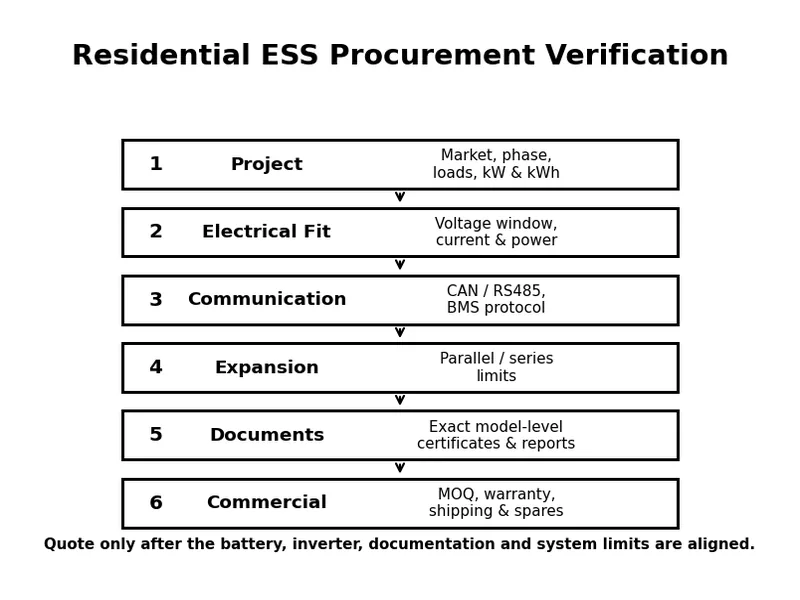
Before confirming a battery/inverter combination, verify at least six items.
1. Battery voltage window
Check:
- nominal voltage;
- minimum discharge voltage;
- maximum charge voltage;
- inverter battery operating range.
For high-voltage systems, also confirm the permitted number of battery modules in series.
2. BMS communication protocol
Common physical interfaces such as CAN or RS485 do not guarantee communication compatibility.
The inverter and battery must use compatible:
- message definitions;
- baud rate;
- CAN IDs or register maps;
- battery brand/profile selection;
- firmware versions.
A cable that fits the port is not proof of protocol compatibility.
3. Continuous charge and discharge current
Confirm both sides:
Battery
- maximum continuous charge current;
- maximum continuous discharge current;
- peak current and allowed duration.
Inverter
- maximum battery charge current;
- maximum battery discharge current;
- maximum battery charge/discharge power.
The usable system limit is controlled by the weakest permitted limit in the chain.
4. Approved battery list
If the inverter manufacturer publishes a compatible battery list, check the exact battery series and firmware—not only the brand name.
For procurement, written compatibility confirmation is much stronger than “our engineer says it should work.”
5. Parallel or series expansion rules
Ask how capacity is increased.
Low-voltage systems may expand through parallel batteries. High-voltage systems may require a specific number of modules in series and may permit multiple strings only with dedicated architecture.
Never assume expansion rules are interchangeable.
6. Fault and protection behavior
Confirm how the system behaves during:
- BMS alarm;
- overcurrent;
- overvoltage;
- undervoltage;
- overtemperature;
- communication loss;
- emergency shutdown.
This matters for both commissioning and after-sales support.
Installation: Cable Size, Distance, Protection, and Serviceability
Battery voltage affects installation hardware directly.
Low-voltage systems: current is the design pressure
At high current, installers must pay close attention to:
- cable cross-section;
- cable length;
- crimp quality;
- terminal torque;
- fuse/breaker DC rating;
- busbar current rating;
- connector temperature;
- parallel battery current sharing.
Even a small resistance becomes important at 150–250 A.
For example, if a circuit resistance were 0.01 Ω:
- at 50 A, resistive loss = 25 W;
- at 200 A, resistive loss = 400 W.
Using P = I²R, four times the current produces sixteen times the resistive loss at the same resistance.
That is why high-current low-voltage DC design cannot be treated casually.
High-voltage systems: isolation and safety are the design pressure
High voltage reduces current but increases electrical hazard.
Installers need appropriate procedures and equipment for:
- isolation;
- DC-rated disconnects;
- touch-safe connectors;
- insulation;
- pre-charge sequence where applicable;
- high-voltage PPE and tools where required;
- service lockout/tagout;
- correct module sequence;
- controlled commissioning.
A high-voltage residential battery should be treated as an engineered system, not as a stack of interchangeable battery boxes.
Safety and Certification: Ask for Documents by Exact Model
Distributors often ask one broad question:
“Does it have CE / IEC / UL?”
That is not specific enough for a sourcing decision.
Documentation should be tied to the exact product or product family being quoted. Depending on market and product type, the required documents may include safety test reports, transport documentation, EMC-related documents, battery standards, inverter standards, or local grid-connection approvals.
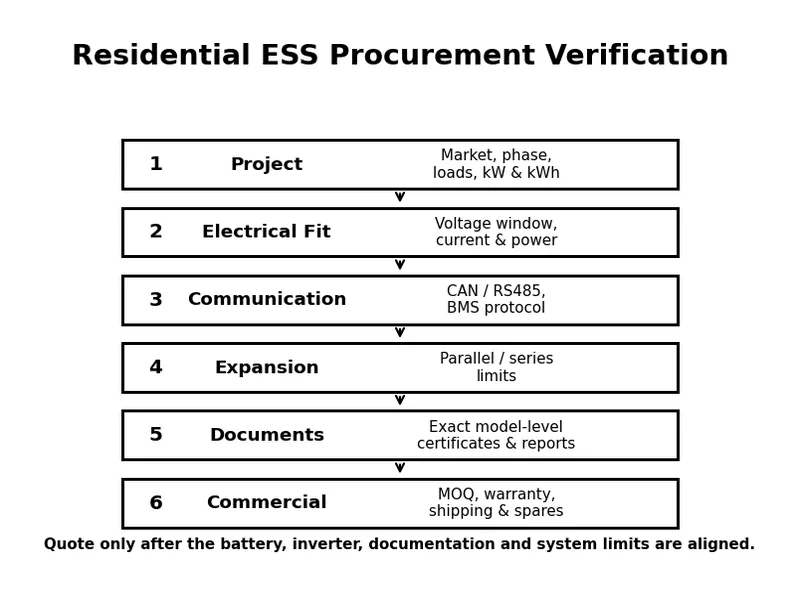
The correct procurement workflow is:
- confirm destination market;
- confirm exact battery and inverter model;
- identify the documents required for import, installation, and grid connection;
- request the exact certificates/test reports for those models;
- verify model names, applicant/manufacturer information, standard numbers, issue dates, and report/certificate status;
- resolve any mismatch before purchase.
Do not assume one supplier’s certificate covers every enclosure, capacity, voltage, inverter, or battery variation.
This is especially important when sourcing from China, where a supplier may offer several product families under similar exterior designs.
Expandability: Do Not Compare “Supports 30 kWh” Without Reading the Architecture
A battery brochure may state that the system expands to 20 kWh, 30 kWh, or more. Buyers should ask how that expansion works.
For low-voltage systems
Check:
- capacity per module;
- maximum parallel modules;
- maximum system current;
- need for external busbars;
- master battery logic;
- communication daisy-chain limits;
- whether inverter charge/discharge current is shared correctly.
For high-voltage systems
Check:
- minimum modules per stack;
- maximum modules per stack;
- resulting voltage range at minimum and maximum SOC;
- whether multiple stacks are supported;
- whether an HV combiner/controller is required;
- maximum inverter battery voltage;
- commissioning sequence after adding modules.
A 30 kWh low-voltage bank and a 30 kWh high-voltage tower can have completely different installation and service requirements even though the energy number is identical.
A Practical Selection Matrix for Residential Projects
| Project Situation | Architecture Usually Worth Evaluating First | Why |
|---|---|---|
| 3–5 kW inverter, 5–10 kWh battery, cost-sensitive home backup | Low voltage | Familiar 48/51.2 V ecosystem, simple capacity blocks |
| 5–8 kW inverter, 10–15 kWh battery | Compare both | Decision depends on discharge current, inverter platform, cabling and local service |
| 8–12 kW inverter, 15–25 kWh battery | High voltage increasingly attractive | Lower current and stronger fit for higher power |
| 10–15 kW three-phase home ESS | High voltage often preferred | More natural architecture for higher power and three-phase hybrid systems |
| Remote market with technicians experienced mainly in 48 V | Low voltage may reduce service friction | Familiar tools, spares and troubleshooting |
| Premium integrated solar + storage + EV/heat-pump home | High voltage often worth evaluating | High simultaneous load and tighter system integration |
| Retrofit where customer already owns a compatible 48 V inverter | Low voltage | Avoid unnecessary inverter replacement |
| Project requiring exact approved battery/inverter pairing | Follow approved compatibility | Compatibility takes priority over generic voltage preference |
The phrase “usually worth evaluating first” is deliberate. Final selection should always be based on the exact inverter, battery, load profile, and local requirements.
What Distributors Should Ask a Supplier Before Requesting a Quote
A useful supplier inquiry should go beyond capacity and unit price.
Send the supplier a request containing:
Battery information
- chemistry and cell configuration;
- nominal energy and usable energy;
- nominal/minimum/maximum voltage;
- continuous charge current;
- continuous discharge current;
- peak discharge current and duration;
- cycle-life test conditions;
- operating temperature;
- IP rating;
- communication ports/protocols;
- maximum expansion quantity;
- dimensions and weight;
- warranty terms;
- exact model-level certificates and test reports.
Inverter information
- single-phase or three-phase;
- rated AC output;
- maximum PV input;
- MPPT quantity and range;
- battery voltage range;
- maximum battery charge/discharge current or power;
- backup/EPS output;
- switching time where relevant;
- supported battery list;
- grid standards for the destination market;
- warranty terms.
System information
- confirmed battery/inverter communication;
- cable and connector set;
- required breaker/fuse;
- parallel or series configuration;
- commissioning procedure;
- monitoring platform;
- firmware requirements;
- packaging dimensions;
- spare parts;
- after-sales response path.
A lower unit price can become an expensive purchase if the installer later discovers that the battery cannot deliver the inverter power, the communication profile is unsupported, or the required local documentation is missing.

How ORIDY ENERGY Approaches Battery and Inverter Matching
ORIDY ENERGY works on the China supply side for renewable-energy products. Our role is not to push every project toward low voltage or high voltage. The first step is to understand the project and then narrow the supply options.
For a residential ESS request, useful information includes:
- destination country;
- single-phase or three-phase grid;
- inverter power;
- current or preferred inverter brand/model;
- required battery capacity;
- main loads;
- backup requirement;
- expected quantity;
- installation environment;
- required certifications or local approvals;
- target trade term such as EXW, CIF, or DDP where available.
From there, battery and inverter options can be screened for electrical fit, BMS communication, expansion architecture, documentation, and commercial suitability.
Mid-article sourcing CTA
If you are currently comparing 48/51.2 V low-voltage batteries with high-voltage residential ESS, send us your target inverter power, battery capacity, destination market, and expected quantity.
We can help narrow the China-side options before you spend time comparing quotations that are not electrically equivalent.
Contact ORIDY ENERGY: Send your project requirements
Example: 10 kW Inverter + 10 kWh Battery
Consider a customer asking for:
- 10 kW hybrid inverter;
- approximately 10 kWh LiFePO4 storage;
- residential backup;
- high peak loads.
Option A: One 51.2 V, 200 Ah battery
Nominal energy:
51.2 V × 200 Ah = 10.24 kWh
If the battery BMS allows 100 A continuous discharge:
51.2 V × 100 A = 5.12 kW DC
That battery cannot support a 10 kW inverter at full load.
If it allows 200 A continuous discharge:
51.2 V × 200 A = 10.24 kW DC
Even then, the design needs margin for conversion losses, voltage variation, cabling, terminal ratings, temperature, and manufacturer limits.
Option B: Two compatible 5.12 kWh batteries in parallel
If each module can provide 100 A and the manufacturer permits two modules to share current correctly, total available current may be increased.
But the buyer still needs to verify:
- maximum permitted parallel quantity;
- shared current behavior;
- inverter battery current setting;
- busbar/cable design;
- communication architecture.
Option C: High-voltage 10 kWh battery stack
Suppose the battery operates around 200 V.
A 10 kW DC power level requires approximately:
10,000 W ÷ 200 V = 50 A
At around 400 V:
10,000 W ÷ 400 V = 25 A
This makes the electrical advantage of high voltage clear for higher-power systems.
But Option C is only preferable if the inverter supports the battery voltage, BMS protocol, module configuration, and safety architecture.
The correct procurement question is therefore not:
“Which battery is better?”
It is:
“Which complete battery-inverter architecture can safely deliver the required power, runtime, serviceability, and compliance for this project?”
Common Procurement Mistakes
Mistake 1: Matching kWh directly to inverter kW
A 10 kWh battery is not automatically a 10 kW battery.
Always check continuous discharge power/current.
Mistake 2: Assuming all 51.2 V batteries work with all 48 V inverters
Voltage compatibility does not guarantee BMS communication compatibility.
Mistake 3: Buying high voltage only because it sounds more advanced
A small 3 kW or 5 kW system may gain little from a more complex HV architecture if low voltage already meets the project requirements.
Mistake 4: Ignoring cable and protection cost
Battery pricing should be evaluated together with:
- cable;
- busbar;
- breaker/fuse;
- connector;
- installation labor;
- commissioning;
- service requirements.
Mistake 5: Treating certification as a brand-level statement
Request documents for the exact quoted model and destination requirement.
Mistake 6: Comparing quotations without normalizing the specification
Two “10 kWh systems” may differ in:
- usable DoD;
- BMS current;
- cell grade/specification;
- voltage architecture;
- inverter compatibility;
- enclosure/IP rating;
- warranty;
- included cables;
- communication accessories;
- certificates;
- shipping package;
- after-sales support.
Price comparison only becomes meaningful after these items are aligned.
Low Voltage or High Voltage: The Final Decision Framework
Use the following order when making the decision:
- Define load power.
What is the continuous load and what are the largest simultaneous or surge loads? - Define required runtime.
Convert the backup objective into usable kWh. - Choose the inverter architecture.
Single-phase or three-phase, rated output, grid requirements, PV input, and backup output. - Check battery-side power.
Calculate whether the battery can actually deliver the inverter’s required power. - Compare LV and HV system current.
Review cable size, losses, protection, installation distance, and service method. - Verify BMS communication.
Confirm exact battery/inverter compatibility and firmware. - Check expansion rules.
Make sure future capacity can be added within the product architecture. - Verify model-level documentation.
Match certificates, test reports, transport documents, and local approvals to the exact models. - Compare landed system cost—not only battery price.
Include accessories, shipping, duties/taxes where applicable, installation implications, spare parts, and after-sales risk. - Order against a confirmed configuration.
The purchase order should identify the exact inverter, battery, module quantity, communication accessories, and relevant documentation.
Conclusion
Low-voltage and high-voltage batteries solve the same basic problem—storing DC energy for later use—but they solve the power-delivery problem differently.
A 48/51.2 V system is often practical for moderate-power residential installations, mature installer ecosystems, and projects that value simple module-level service. A high-voltage system becomes increasingly attractive as inverter output, simultaneous load, and storage capacity rise because it can deliver the same power at much lower current.
For distributors, EPCs, and installers, the most expensive mistake is not choosing the “wrong voltage” in isolation. It is buying a battery and inverter combination without checking the electrical limits, BMS communication, expansion architecture, protection requirements, and model-specific documentation.
If you are evaluating a residential ESS package from China, send ORIDY ENERGY the destination market, inverter power, battery capacity, preferred brand/model if any, expected quantity, and target trade term. We can help compare technically equivalent supply options and identify compatibility questions before you place the order.
Contact ORIDY ENERGY for a residential ESS sourcing review →
One Comment
Comments are closed.