
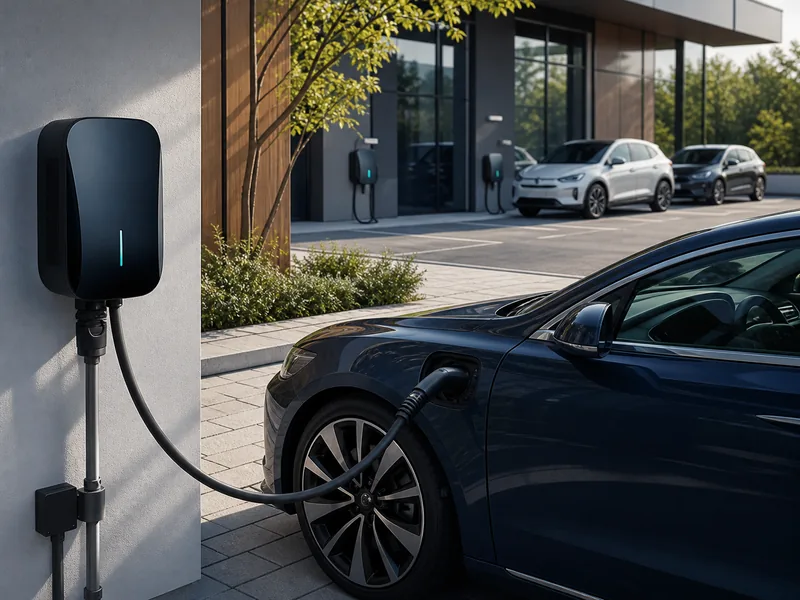
7kW vs 11kW vs 22kW EV Charger: Which One Should You Choose?
A practical guide for installers, distributors and project buyers.
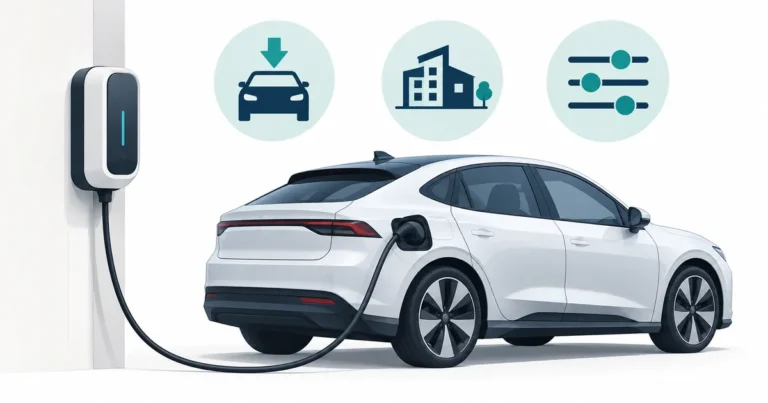
For most single-phase residential installations, a 7kW EV charger is usually sufficient, especially when the vehicle can remain connected overnight. An 11kW charger becomes more useful where three-phase power is available and the vehicle supports 11kW AC charging. A 22kW charger is better suited to compatible vehicles, commercial parking, fleets, shorter dwell times, or projects that genuinely need higher charging capacity.
The key point is that a higher-rated charger does not automatically mean faster charging. Installing a 22kW charger will not make an EV limited to 11kW AC charge at 22kW. Actual charging power is limited by the lowest-capacity part of the system, including the site supply, circuit, charger configuration, cable and the vehicle’s onboard AC charger.
For installers, distributors and EPC contractors, the right choice should therefore be based on more than charger power alone. Phase availability, vehicle AC capability, parking duration, electrical capacity, load management, connector configuration, software requirements and the destination market all affect the final specification. This guide compares 7kW, 11kW and 22kW AC chargers and explains what should be checked before installation or procurement.
7kW vs 11kW vs 22kW EV Charger: The Short Answer
A 7kW-class AC charger is usually associated with a 230V single-phase, 32A circuit. An 11kW charger is commonly associated with a 400V three-phase, 16A-per-phase supply, while a 22kW charger commonly requires 400V three-phase at 32A per phase. These are nominal examples; actual voltage, permitted current, wiring and installation rules vary by market and site.
| Factor | 7kW / 7.4kW | 11kW | 22kW |
|---|---|---|---|
| Typical supply | 230V single phase | 400V three phase | 400V three phase |
| Typical current | 32A | 16A/phase | 32A/phase |
| Example time to add 40kWh | ~5.7 h | ~3.6 h | ~1.8 h |
| Best fit | Home / overnight | Three-phase home / workplace | Commercial / fleet / shorter dwell time |
| Vehicle capability needed to use full output | ~7kW AC capability | 11kW AC capability | 22kW AC capability |
| Main site issue | Single-phase capacity | Three-phase availability | Higher site capacity |
| Buyer takeaway | Practical for many single-phase sites | Balanced three-phase option | Choose only when capacity can be used |
Simplified calculation based on usable charging power; real charging time varies with vehicle limits, losses and power management.
The European Alternative Fuels Observatory classifies AC charging up to 22kW as normal-power charging under the European framework. That regulatory classification should not be confused with the charging time a particular vehicle will achieve.
Which EV Charger Should You Choose?
The right choice depends on three things: the site supply, the vehicle’s AC charging capability, and how long the vehicle normally remains parked.
Choose 7kW if:
- the site is single phase;
- charging is mainly overnight;
- the vehicle accepts around 7kW AC;
- lower electrical infrastructure requirements are preferred;
- daily driving energy can be replenished within the available parking time.
Choose 11kW if:
- three-phase power is available;
- the vehicle supports 11kW AC charging;
- faster residential or workplace charging is useful;
- 22kW would provide capacity that the current vehicle cannot use;
- the project needs a balanced option between charging speed and site demand.
Choose 22kW if:
- the site has sufficient three-phase capacity;
- the target vehicles can use higher AC charging power;
- parking duration is shorter;
- the charger serves commercial users, fleets or shared parking;
- future vehicle requirements justify the additional electrical capacity.
If a vehicle is limited to 11kW AC, installing a 22kW charger will not reduce charging time unless another vehicle or a future use case can make use of the additional capacity.
7kW vs 11kW EV Charger: Is 11kW Worth It?
The main difference between 7kW and 11kW is not simply the additional 4kW of charger rating. In common European-style installations, moving from around 7kW to 11kW usually also means moving from single-phase charging to three-phase charging.
If the property already has suitable three-phase power and the EV supports 11kW AC charging, an 11kW charger can significantly reduce charging time. However, if the vehicle accepts only around 7kW AC, installing an 11kW charger will provide little or no immediate charging-speed benefit.
| Question | 7kW | 11kW |
|---|---|---|
| Typical phase | Single phase | Three phase |
| Typical current | 32A | 16A per phase |
| Suitable for overnight home charging | Yes, in many cases | Yes |
| Faster for a vehicle limited to ~7kW AC | No difference | No |
| Better when the EV supports 11kW AC | Adequate | Yes |
| Main site requirement | Sufficient single-phase capacity | Suitable three-phase supply |
For many residential buyers, 7kW remains sufficient when the vehicle stays parked overnight. An 11kW charger becomes more attractive when both the site and the vehicle can support three-phase charging and shorter charging times provide real value.
11kW vs 22kW EV Charger: When Does 22kW Make Sense?
Both 11kW and 22kW AC chargers are commonly associated with three-phase supply, but the current requirement is different. An 11kW charger typically operates around 16A per phase, while a 22kW charger may require around 32A per phase.
The main question is whether the additional 22kW capacity can actually be used.
A 22kW charger makes more sense when:
- the vehicle supports 22kW AC charging;
- several vehicle types will use the charger;
- the parking duration is relatively short;
- the site has sufficient connection capacity;
- the charger is used in commercial, fleet or destination-charging applications;
- future vehicle requirements justify the higher rating.
If most vehicles are limited to 11kW AC, an 11kW charger may deliver the same real-world charging speed while requiring less site capacity.
For commercial projects, the decision should also consider simultaneous charging. Installing several 22kW units does not necessarily mean each charger needs to operate at full power at the same time; dynamic load management may reduce the required peak connection capacity.
Why Rated Charger Power Is Not the Same as Charging Speed
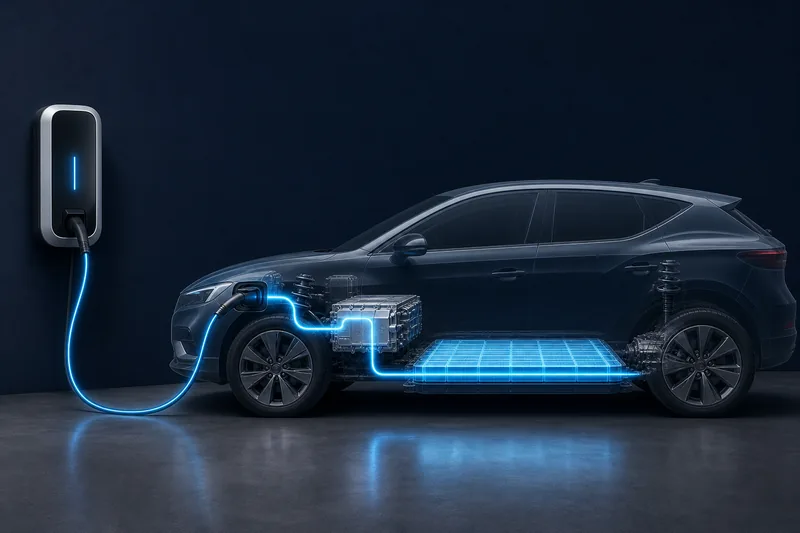
The actual AC charging rate is approximately the lowest limit imposed by the site, charger, cable, vehicle and active control settings. A higher-rated wallbox creates capacity; it cannot force a vehicle to accept more AC power than its onboard charger permits.
The vehicle’s onboard charger is a hard limit
An AC wallbox supplies controlled AC power to the vehicle. The onboard charger inside the EV converts that AC energy into DC for the traction battery. Tesla’s onboard-charger guidance, for example, shows that vehicle variants can have different maximum AC power and current limits even when connected to the same wall connector.
If an EV accepts 7.4kW single-phase AC, connecting it to an 11kW three-phase unit does not automatically produce 11kW. Likewise, an EV limited to 11kW AC will not normally use the full output of a 22kW AC charger. Installers should check the exact vehicle model and market variant rather than relying on a general vehicle family name.
The site may reduce the available power
The upstream connection, main protective device, distribution board, cable route and other building loads determine how much current can be allocated safely. A charger configured below its nameplate limit is not defective; it may be intentionally restricted to protect the site or comply with the approved connection.
The cable and control settings also matter
For socketed chargers, the cable’s current and phase capability must support the intended configuration. Installer settings, scheduled charging, solar-surplus control and load-management commands may also reduce current. The displayed charging rate can therefore change during a session even when the hardware rating stays the same.
How Single-Phase and Three-Phase Supply Change the Choice
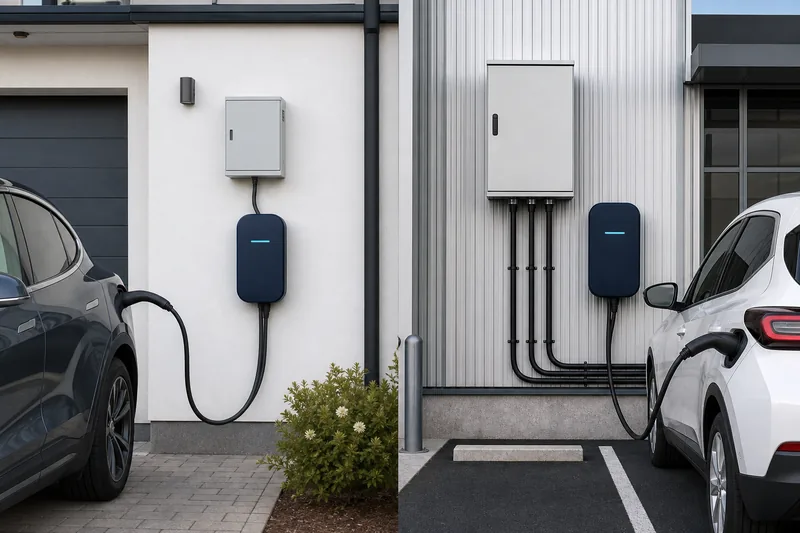
The difference between 7kW, 11kW and 22kW is closely connected to phase architecture. A single-phase charger delivers power through one phase, while a three-phase charger distributes current across three phases. The site and vehicle must both support the intended arrangement.
For a simplified unity-power-factor comparison:
- Single-phase power is approximately voltage × current.
- Three-phase power is approximately √3 × line-to-line voltage × line current.
The underlying single- and three-phase power relationships are set out in Schneider Electric’s Electrical Installation Guide. Applying the simplified formulas:
- 230V × 32A ≈ 7.36kW.
- √3 × 400V × 16A ≈ 11.09kW.
- √3 × 400V × 32A ≈ 22.17kW.
These calculations explain the familiar nominal labels, but they are not installation instructions. Actual supply voltage, permitted continuous current, conductor sizing, protection, earthing and inspection requirements must be determined for the destination market and site by a qualified professional.
What happens when the vehicle uses fewer phases?
A three-phase charger does not guarantee that every connected EV will use all three phases. If the vehicle accepts AC on one phase only, its result may be closer to a single-phase current limit. That is why distributors should request a vehicle-compatibility use case, not simply ask whether a customer wants an “11kW charger.”
How Much Charging Time Can Each Power Level Save?
A useful first estimate divides the energy to be added by the actual charging power, not the charger’s nameplate power:
Estimated charging time = energy added ÷ actual charging power
If a vehicle needs 40kWh added and can accept the full stated AC power, the simplified comparison is:
| Energy to add | 7kW | 11kW | 22kW |
|---|---|---|---|
| 20kWh | ~2.9 h | ~1.8 h | ~0.9 h |
| 40kWh | ~5.7 h | ~3.6 h | ~1.8 h |
| 60kWh | ~8.6 h | ~5.5 h | ~2.7 h |
| 80kWh | ~11.4 h | ~7.3 h | ~3.6 h |
Real sessions take longer because of conversion losses, auxiliary consumption, temperature, battery management and power variation. The battery may also be charged from a partly full state rather than from a consistent starting point. Use the calculation for early design comparison, then validate it against the vehicle documentation and operating scenario.
Which EV Charger Power Fits Each Application?
The best rating is the lowest practical level that meets dwell-time, energy and future-use requirements without creating unnecessary electrical work. The answer differs between a private driveway, an apartment car park and a fleet depot.
Market context also affects the product mix. Projects evaluating EV charging infrastructure in Africa and the Middle East, for example, may encounter different site capacities, vehicle fleets and operating models from established European AC charging networks. Specify the real deployment rather than copying another market’s standard range.
When a 7kW charger is usually sufficient
A 7kW-class charger often fits single-phase residential sites where the vehicle remains parked overnight. It can also suit small workplaces where each vehicle has a long dwell time and modest daily energy demand.
Choose it because the use case fits—not merely because the hardware price is lower. Confirm that the main connection can support the additional current and whether load management is required when cooking, heating, air conditioning or other major loads operate.
When 11kW is the balanced three-phase option
An 11kW charger can be a practical middle ground for three-phase homes, workplaces, hotels and mixed-use parking. At 16A per phase, it may impose less incremental current than a 22kW unit while serving vehicles that support 11kW three-phase AC at their full rate.
For a distributor, 11kW may also reduce mismatch risk in markets where many target vehicles accept 11kW AC but relatively few use 22kW. That market-fit conclusion must come from the actual vehicle mix, not a universal assumption.
When 22kW capacity creates real value
A 22kW charger is most defensible when vehicles can use the power, dwell times are shorter, daily energy turnover is high, or the site wants capacity for future fleets. It may suit commercial destination charging, shared parking or operational vehicles that return several times per day.
The site must be evaluated as a system. Several 22kW charge points operating simultaneously can create a much larger connection requirement than their individual ratings suggest. In many projects, managed charging is more economical than designing for every connector to deliver full power at the same time.
Why Load Management Can Matter More Than Nameplate Power
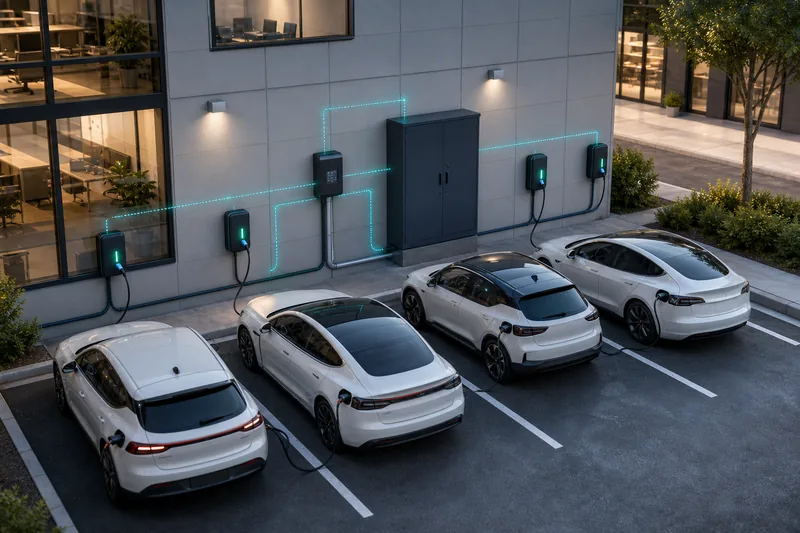
Load management adjusts charging current according to the capacity available at the building or across a group of charge points. It can help a project install higher-rated hardware while controlling the coincident demand seen by the site.
A single-home system may reduce EV charging when household demand rises. A commercial system may share a defined power budget across multiple vehicles. Wallbox’s overview of EV charging energy-management functions illustrates the distinction between managing one charger and sharing power across multiple chargers.
For EPC design and procurement, confirm:
- whether control is static, dynamic or both;
- the required meter or current-transformer hardware;
- the maximum number of coordinated charge points;
- whether operation depends on a cloud connection or can continue locally;
- how minimum current and phase switching are handled;
- what happens if communications fail.
Do not assume that two chargers described as “smart” provide the same load-management architecture. Ask for the system diagram, supported meter list and commissioning procedure for the exact model and firmware.
What Installers Should Verify Before Specifying a Charger
Installer selection should begin with the site and vehicle, then move to the charger. The following checks prevent a high nameplate rating from becoming an underused or difficult-to-commission installation.
- Supply architecture: confirm available voltage, phase count, main connection capacity and any utility constraints.
- Vehicle AC capability: verify maximum AC power, accepted phases and connector for the exact vehicle variant.
- Circuit design: determine conductor, protective device, isolation, residual-current protection, earthing and inspection requirements under local rules and the product instructions.
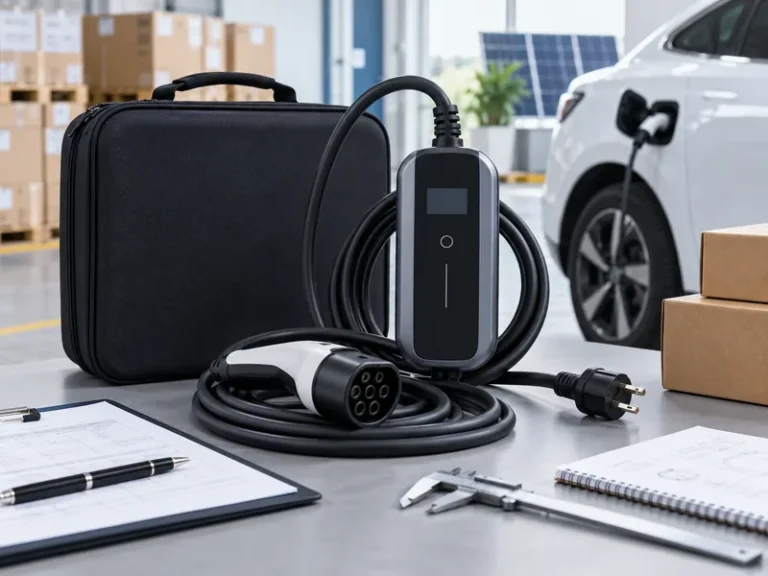
- Charging interface: select tethered or socketed design, connector type and cable current rating for the market and use case.
- Load management: confirm meter compatibility, control topology, fail-safe behaviour and multi-charger limits.
- Access and billing: define whether plug-and-charge, RFID, app control, user authentication or backend integration is required.
- Environment: confirm the selected model’s installation location, enclosure rating, temperature limits, mounting clearances and cable management.
- Commissioning: verify installer access, current-limit settings, network setup, firmware process and diagnostic tools.
The international baseline for conductive EV supply equipment includes IEC 61851-1, which covers general characteristics, operating conditions, the EV–equipment connection and electrical-safety requirements. Applicable standards, approvals and installation obligations still depend on the exact product, market and project.
What Distributors and EPC Buyers Should Confirm Before Ordering

A strong RFQ describes the commercial deployment, not only “22kW Type 2.” Product configuration, backend functions, documentation, packaging and support responsibilities can materially change the offer.
| RFQ field | What to specify | Why it matters |
|---|---|---|
| Electrical rating | 7kW, 11kW or 22kW; voltage; phase; current | Defines the electrical platform and installation use |
| Charging interface | Connector, socket or tethered cable, cable length | Must match vehicles, market practice and user operation |
| Access functions | Plug-and-charge, RFID, app or other authorization | Affects residential, workplace and public-use workflows |
| Communications | Ethernet, Wi-Fi, cellular and required backend protocol | Determines monitoring, fleet operation and integration |
| Energy management | Single-charger or multi-charger control, meter model, solar integration | Prevents unsupported assumptions about “smart charging” |
| Market documentation | Destination country and required model-specific documents | Documentation and compliance scope vary by model and market |
| Commercial scope | Quantity, branding, packaging, Incoterm and destination | Allows a comparable quotation and logistics plan |
For private-label projects, review the distinction between a cosmetic logo change and a full OEM EV charger programme. Confirm which hardware, firmware, app, cloud platform, packaging and documentation elements are actually customizable before approving samples.
ORIDY ENERGY supports OEM and ODM coordination as well as CIF and DDP supply options. The applicable configuration, documentation, price, quantity and logistics responsibilities depend on the selected model, destination and quotation. Buyers comparing landed-delivery structures can also review how DDP and FOB responsibilities differ before finalizing an Incoterm.
Need help comparing EV charger configurations for your market?
Send ORIDY ENERGY your destination country, required charging power, site voltage and phase, connector type, software requirements, load-management needs and expected quantity.
We can help compare suitable sourcing, OEM/ODM and logistics options before you confirm samples or bulk orders.
Website: https://oridy.net/
Contact: https://oridy.net/contact-us/
WhatsApp: https://wa.me/8618217811889
Common Selection Mistakes
- Buying 22kW for an 11kW vehicle without a future-use reason: the extra charger capacity may remain unused.
- Ignoring phase availability: a three-phase rating cannot be assumed at a single-phase site.
- Estimating time from nameplate power: calculations should use the realistic minimum of all system limits.
- Specifying several chargers independently: the combined site load and diversity strategy must be evaluated.
- Treating “smart” as a complete specification: metering, backend, protocol and fail-safe behaviour need explicit confirmation.
- Generalizing compliance: certification requirements and available documentation depend on the selected model and target market.
- Ordering before software verification: app, RFID, backend and load-management functions should be demonstrated on the intended configuration.
How to Make the Final 7kW, 11kW or 22kW Decision
Start with the vehicle fleet and dwell time, then confirm the site’s phase and available capacity. If overnight parking provides enough time, 7kW may be entirely adequate. Where three-phase supply and 11kW-capable vehicles are common, 11kW can offer a balanced specification. Choose 22kW when the vehicles, turnover requirement and electrical infrastructure can use it—or when a justified future deployment plan makes the additional capacity valuable.
For multi-unit or distribution projects, test the complete configuration before bulk ordering. Confirm current limits, connector and cable, access control, communications, load-management hardware, firmware, documentation and destination-market requirements on the exact model.
Frequently Asked Questions
Is an 11kW EV charger better than a 7kW charger?
Only when both the site and the vehicle can use the additional capacity. If the EV is limited to around 7kW AC, installing an 11kW charger will not significantly increase charging speed.
Does an 11kW EV charger need three-phase power?
In common 400V systems, 11kW charging is typically delivered using three-phase supply at around 16A per phase. Actual requirements depend on the destination market, site and product configuration.
Can I install a 22kW EV charger at home?
It may be possible where suitable three-phase power and sufficient electrical capacity are available. However, the vehicle must also support higher AC charging power for the full 22kW rating to provide a charging-speed benefit.
Will a 22kW charger charge an 11kW EV faster?
No. If the vehicle’s onboard AC charger is limited to 11kW, a 22kW wallbox will normally still charge the vehicle at around the vehicle’s maximum accepted AC power.
Is 7kW enough for home EV charging?
For many overnight residential applications, yes. The correct choice depends on daily energy use, parking duration, site capacity and the vehicle’s AC charging capability.
Should distributors stock 7kW, 11kW or 22kW chargers?
The product mix should reflect the target market’s grid architecture, vehicle fleet, residential and commercial demand, connector standard, software requirements and applicable product documentation.
Need a 7kW, 11kW or 22kW EV Charger for Your Market?
For distribution, installation or project sourcing, send ORIDY ENERGY the following information:
- destination country;
- required charging power: 7kW, 11kW or 22kW;
- site voltage and phase;
- Type 1, Type 2, socketed or tethered configuration;
- cable length;
- RFID, app or OCPP requirements;
- load-management requirements;
- estimated quantity;
- OEM or private-label requirements;
- preferred shipping term.
ORIDY ENERGY can help compare suitable China-side sourcing, OEM/ODM coordination and CIF/DDP logistics options based on the selected model and destination market.
Website: https://oridy.net/
Contact: https://oridy.net/contact-us/
WhatsApp: https://wa.me/8618217811889
6 Comments
Comments are closed.